
Official statement
Other statements from this video 6 ▾
- □ Is creating truly 'useful' content really the secret to ranking on Google?
- □ Is Japanese SEO really catching up with American standards?
- □ Is Japan really getting priority treatment for Google Search features?
- □ Does active community engagement really make you a better SEO professional?
- □ Does Google really read every single piece of user feedback submitted on their documentation?
- □ Why is Google probably ignoring your feedback on SEO documentation?
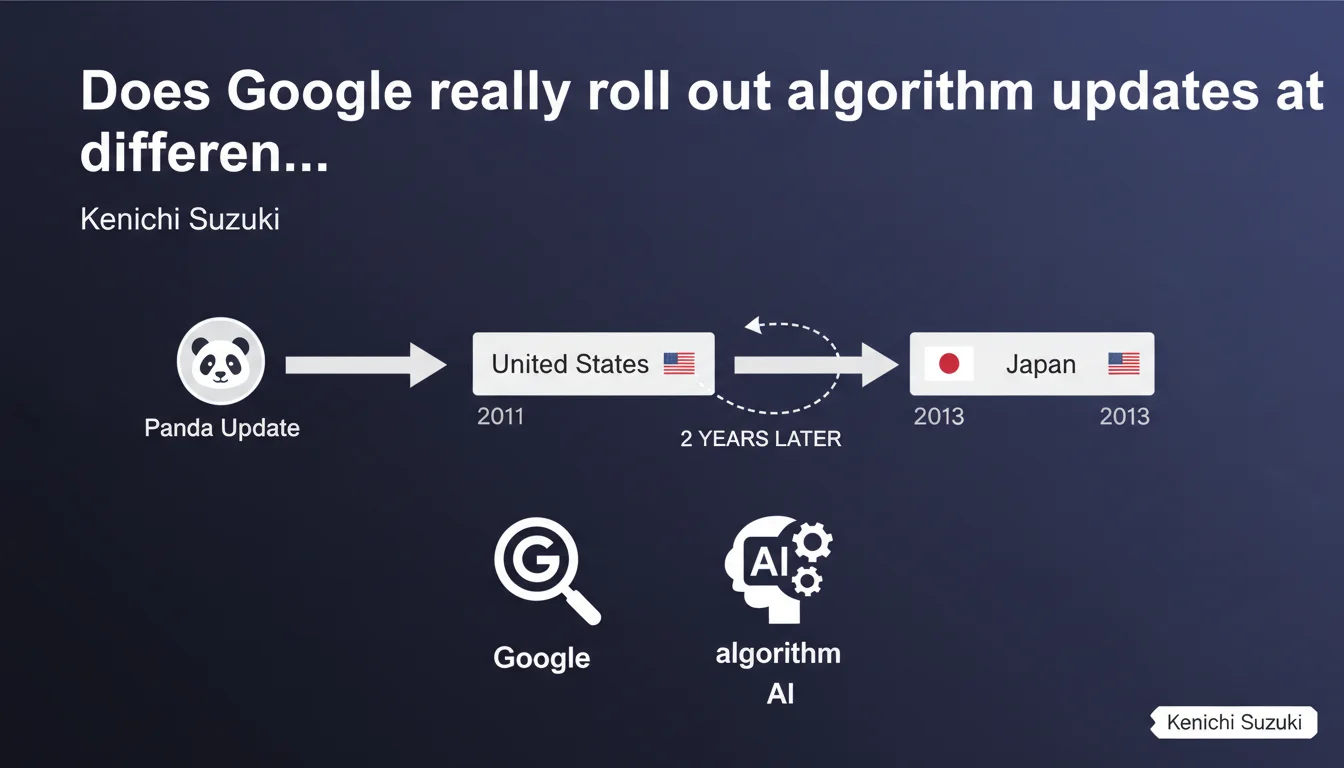
Some of Google's major updates like Panda were never deployed simultaneously across all regions. Japan's case is striking: Panda launched nearly two years after the United States. This historical reality reveals geographic staggering that can create competitive distortions across markets.
What you need to understand
Why does Google stagger algorithm deployment across different regions?
Several technical and strategic reasons explain these staggered rollouts. Linguistic complexity plays a major role: an algorithm like Panda, designed to identify low-quality content, requires massive training on corpora in each language.
Japanese, with its three writing systems (hiragana, katakana, kanji) and grammar radically different from English, requires specific training. Google must also adapt its quality signals to local editorial standards — what is considered thin content in the United States isn't necessarily so in Japan.
Which updates have experienced these geographic staggered rollouts?
Panda remains the most documented example with those two years of delay for Japan. But other algorithms have followed similar trajectories, particularly in Asian languages and markets less prioritized by Google.
These staggered rollouts primarily concern linguistically sensitive algorithms (content quality, natural language processing). Purely technical infrastructure updates (speed, mobile-first) are generally deployed more uniformly.
Does this practice still exist today?
The question remains open. Google rarely communicates about the geographic specifics of its current rollouts. Recent Core Updates seem to hit most markets simultaneously, but the intensity of impact can vary.
Practitioners still observe algorithmic behavior differences across countries, even if pure deployment delays appear to have shortened with improvements in Google's multilingual machine learning capabilities.
- Content understanding algorithms require specific linguistic training
- Staggered deployment can create competitive opportunity windows on certain markets
- Google's transparency on these staggered rollouts remains limited
- English-speaking and major European markets are typically prioritized
SEO Expert opinion
Does this statement change our understanding of how Google works?
Not really. International SEO professionals have long known about these geographic variations. What's interesting is that Google admits it openly — the company generally prefers to maintain a fiction of algorithmic universality.
The Panda case with two years of staggering remains exceptional. We're talking about an era when Google still managed relatively isolated regional indexes. The situation has evolved, but the underlying principle persists: not all markets are equal when facing algorithmic innovations.
What are the implications for multilingual sites?
Let's be honest: this seriously complicates things. A site present on multiple markets can find itself penalized on certain language versions months before others. Or vice versa — benefiting from a favorable update on a test market.
The problem is that we lack concrete data on current staggered rollouts. [To be verified]: Google publishes no geographic deployment calendar, making precise strategic planning impossible. This opacity forces monitoring each language version independently.
Is this practice problematic for competition?
Clearly, yes. Imagine two direct competitors, one based in the United States, the other in Japan, both targeting the Japanese market. For two years, the American company was able to refine its anti-Panda strategy before its local competitor was even affected.
Conversely, the Japanese competitor benefited from a window where tactics that had become obsolete in the United States still worked. These asymmetries create unanticipated distortions and potentially unfair outcomes for some players.
Practical impact and recommendations
What should you concretely do for a site present on multiple markets?
Monitor each language version separately. Don't rely on overall performance — an algorithm can hit your Japanese version three months before the French one. Use region-specific tracking tools.
Set up geographic alerts on your rankings. A sudden drop on one market may signal the local rollout of an update already active elsewhere. You then gain valuable time to react.
How do you anticipate algorithmic changes on your secondary markets?
Watch what happens on English-speaking markets first. Historically, they serve as testing grounds. A Panda penalty in the United States gives you potentially months to correct before impact in Japan.
Join local SEO communities for each targeted market. Field practitioners often detect algorithmic changes before official announcements. This collective intelligence becomes a real strategic advantage.
What mistakes should you absolutely avoid?
Do not blindly duplicate a winning strategy from one market to another. What works today on your American version may be obsolete tomorrow on your German version — or worse, already penalized by an algorithm not yet active in the United States.
Avoid centralizing all your optimizations. A one-size-fits-all approach ignores these time delays and regional algorithmic specifics. Each market deserves its own diagnosis.
- Segment your analytics reporting by country/language, not just globally
- Establish algorithmic monitoring on English-speaking markets even if they're not your primary target
- Document the impact dates of each Core Update by language version of your site
- Maintain strategic flexibility allowing market-by-market adjustments
- Plan dedicated resources by major geographic zone rather than a single centralized SEO team
- Test optimizations on your secondary markets before broad rollout
❓ Frequently Asked Questions
Tous les algorithmes de Google sont-ils déployés avec décalage géographique ?
Comment savoir si une mise à jour Google a touché mon marché spécifique ?
Le décalage de deux ans pour Panda au Japon peut-il se reproduire aujourd'hui ?
Un site multilingue doit-il adapter sa stratégie SEO pays par pays ?
Google communique-t-il sur le calendrier géographique de ses mises à jour ?
🎥 From the same video 6
Other SEO insights extracted from this same Google Search Central video · published on 26/04/2022
🎥 Watch the full video on YouTube →
💬 Comments (0)
Be the first to comment.