
Official statement
Other statements from this video 7 ▾
- □ Should you still use rel=next and rel=prev for pagination?
- □ Do you really need to validate your HTML with W3C to get crawled by Google?
- □ Does Google really render all of your JavaScript pages?
- □ Does semantic HTML really enhance Google’s trust in your content?
- □ Does Google really pay attention to your feedback on its SEO documentation?
- □ Why do your PageSpeed Insights scores fluctuate with each test?
- □ Is it true that Lighthouse scores are calculated transparently?
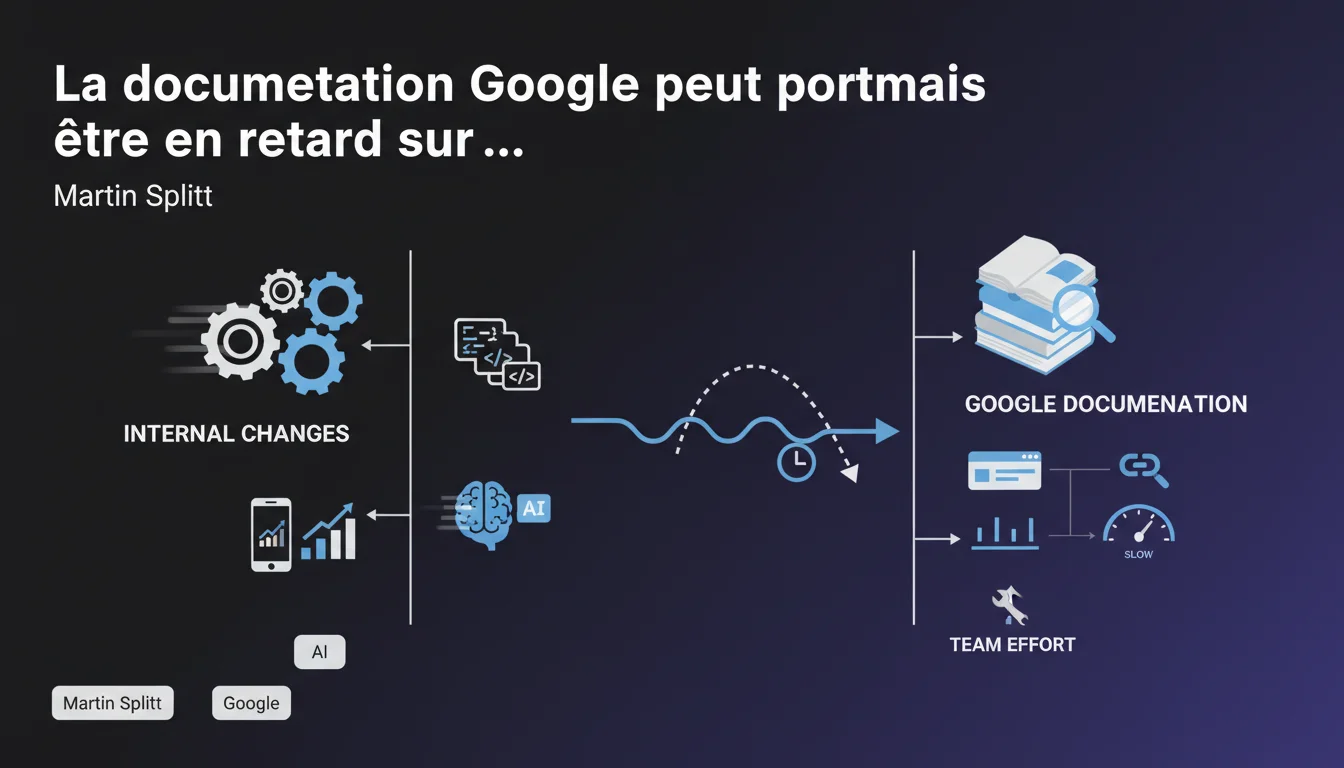
Martin Splitt acknowledges that Google's documentation is not always in sync with the technical developments of the engine. There are discrepancies between what is documented and what is actually deployed. For SEO professionals, this means cross-referencing official sources with real-world observations.
What you need to understand
Why does Google publicly admit to this discrepancy?
This statement breaks away from the image of a perfectly oiled machine. Google acknowledges that its technical infrastructure evolves faster than its ability to document these changes.
The documentation team is working on hundreds of pages, guides, and technical references. Meanwhile, engineering teams continually deploy changes. The delay between a change going live and its documentation can therefore be measured in weeks — or even months.
What kind of discrepancies are we actually observing?
There is no shortage of examples. Deprecated meta tags remain documented for quarters. Recommendations on structured data evolve without immediate updates to the official guides.
More problematic: some crawler behaviors change without any announcement. SEO teams discover these changes through their server logs or monitoring tools, well before any official communication.
Is this situation acceptable for an SEO practitioner?
No, and this is where the problem lies. SEO professionals rely on documentation as a truth reference. If this is outdated, decisions made may be based on obsolete information.
This forces practitioners to adopt a stance of perpetual doubt. Every official recommendation must be compared against real-world observations, A/B tests, and community feedback.
- Google documentation is not an absolute source of truth in real time
- Discrepancies exist between technical evolutions and their communication
- Practitioners must cross-reference official documentation and empirical observations
- Silent changes in crawler behavior are frequent
- Field verification remains the only reliable means to validate information
SEO Expert opinion
Is this statement really a revelation?
Let's be honest: no. Any experienced practitioner has known this for years. We regularly observe behaviors that contradict the documentation.
What changes is the public admission. Google finally acknowledges a reality that the SEO community has long documented on forums, in case studies, and through tests. This — late — transparency is welcome, but it resolves nothing.
In which areas does this discrepancy pose the most problems?
Structured data is a minefield. Official validators sometimes display errors for formats that the algorithm accepts. Conversely, some validated formats do not generate any rich snippets.
JavaScript rendering is another glaring example. The official documentation on Googlebot and JS execution remains vague, generic, and behind the crawler's actual capabilities. [To be verified]: are the current recommendations on JS crawl budgets still aligned with rendering practices for 2025?
The Core Web Vitals too. The documented thresholds do not change, but the real impact on ranking fluctuates. Is this an undocumented algorithm change or an evolution in weighting? Impossible to say for sure.
What stance should we adopt in light of this situation?
Empirical verification becomes non-negotiable. Every Google recommendation must be tested in real conditions before massive deployment.
This involves maintaining test environments, monitoring server logs, and analyzing correlations between technical changes and traffic variations. It is time-consuming, but it is the only way to avoid being caught out by outdated documentation.
Practical impact and recommendations
How can you validate that a Google recommendation is still relevant?
First instinct: check the last updated date of the documentation page. If it dates back more than 18 months, consider it potentially obsolete.
Second step: cross-reference with recent statements from Google's spokespersons — John Mueller, Gary Illyes, Martin Splitt. Their public interventions often better reflect the real state of the algorithm than the static documentation.
Third validation: test in a controlled environment. Deploy the change on a subset of pages, measure the impact over 4 to 6 weeks, analyze the crawl logs.
What mistakes should be avoided when knowing that documentation might be lagging?
Never deploy a major technical change across the entire site without a testing phase. The risk of relying on outdated recommendations is too high.
Avoid dogmatically adhering to official guidelines if your real-world data shows otherwise. The real algorithm takes precedence over theoretical documentation.
Do not overlook feedback from the SEO community. Specialized forums, Slack groups, and shared case studies are often ahead of the official documentation. Use them as complementary sources.
What monitoring methodology should be put in place?
Follow Google's spokespersons on Twitter/X and YouTube. Their responses to community questions are often more up-to-date than support pages.
Monitor your server logs and crawl stats in Search Console. Changes in Googlebot's behavior appear here before any official announcement.
Maintain an internal documentation of your tests and observations. Build your own empirically validated knowledge base, independent of Google's doc.
- Systematically check the last updated date of any Google documentation page
- Cross-reference with recent statements from official spokespersons (Mueller, Illyes, Splitt)
- Test any technical change on a sample before global deployment
- Monitor server logs and crawl stats for undisclosed changes
- Follow SEO community feedback on specialized forums and groups
- Build an internal knowledge base validated by your own tests
- Never consider Google documentation as absolute truth
❓ Frequently Asked Questions
À quelle fréquence la documentation Google est-elle mise à jour ?
Peut-on se fier aux validateurs officiels de Google pour les données structurées ?
Les déclarations des porte-parole Google sont-elles plus fiables que la documentation ?
Comment détecter un changement non documenté de l'algorithme ?
Faut-il continuer à suivre les guidelines officielles malgré ce décalage ?
🎥 From the same video 7
Other SEO insights extracted from this same Google Search Central video · published on 13/01/2022
🎥 Watch the full video on YouTube →
💬 Comments (0)
Be the first to comment.