
Official statement
Other statements from this video 7 ▾
- □ Should you still use rel=next and rel=prev for pagination?
- □ Do you really need to validate your HTML with W3C to get crawled by Google?
- □ Does Google really render all of your JavaScript pages?
- □ Does semantic HTML really enhance Google’s trust in your content?
- □ Can we really trust Google's official documentation?
- □ Why do your PageSpeed Insights scores fluctuate with each test?
- □ Is it true that Lighthouse scores are calculated transparently?
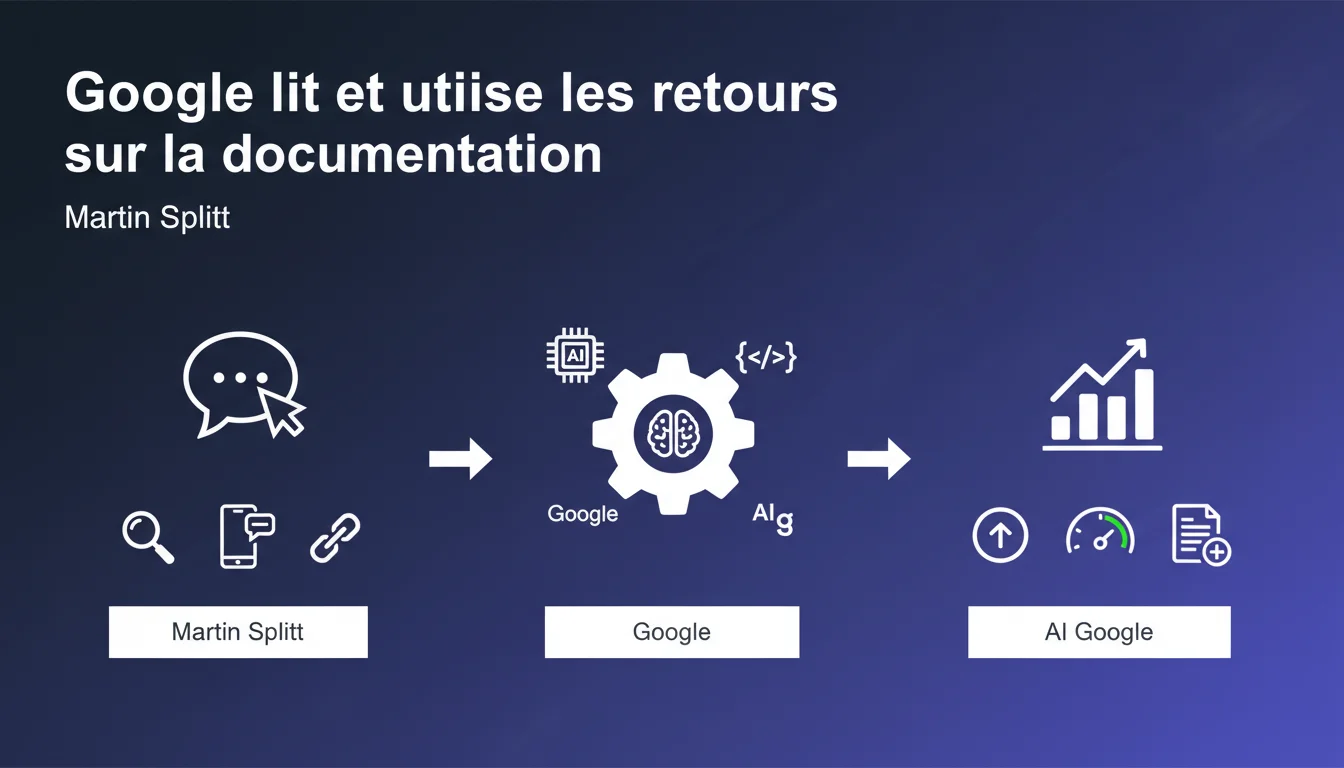
The Google team systematically reads comments left on its documentation pages, even if no visible response is provided. This feedback directly contributes to the ongoing improvements of the official documentation. It confirms that your reports of contradictions or inaccuracies do not go unnoticed.
What you need to understand
Why doesn’t Google ever respond directly to comments?
The lack of public response does not mean your feedback is ignored. Google prefers to avoid bilateral exchanges on its documentation for several reasons: to prevent public debates that could create confusion, maintain editorial consistency, and above all, focus resources on improving content rather than moderation.
Specifically, each comment is archived and categorized. Recurrent reports on the same section trigger an internal review. It's a one-way flow by design — not a discussion forum.
How do these feedbacks actually influence the documentation?
Comments serve as detectors of ambiguities. When multiple professionals point out that a section is confusing, the team identifies a wording issue or a lack of concrete examples.
This data is added to internal metrics (bounce rates on specific pages, reading time, unsuccessful searches in the documentation). All of this feeds into a backlog of revisions. But — let’s be honest — the time between your comment and a visible change can stretch over months.
What is the real significance of this statement?
Martin Splitt confirms a practice that was suspected but never publicly formalized. It’s a tacit invitation to report inconsistencies rather than to multiply redundant questions on third-party forums.
- Comments are read and archived by Google’s documentation team
- No guarantee of individual response, even for specific technical questions
- Recurrent reports carry more weight than isolated comments
- The improvement process is iterative and can take several months
- Focus on factual feedback (errors, contradictions) rather than requests for opinions
SEO Expert opinion
Does this statement change anything on the ground?
Not really. Most seasoned practitioners already knew that Google monitors this feedback — if only through basic behavioral analysis. What changes is the official confirmation, which legitimizes the reporting process.
The problem remains the same: no SLA, no visibility on processing. You can report a blatant contradiction between two sections of the Search Console Help and wait six months without knowing if your comment has been taken into account. It’s a one-way channel without acknowledgement.
Are there concrete improvements observed following community feedback?
Yes, but it’s hard to establish direct causality. Some sections of the documentation have been reworked after waves of criticism — particularly regarding E-E-A-T guidelines or explanations around crawl budget. However, Google also improves its documentation internally, without external prompting.
The risk: overestimating the impact of your comments. [To be verified]: Google provides no metrics on the volume of feedback processed, nor on the resulting modification rate. It’s impossible to quantify the effectiveness of the system.
In what cases does your feedback fall on deaf ears?
If you use the feedback system to ask tactical questions about your specific site or to request clarifications that would require a personalized response. This is not technical support; it’s an editorial improvement channel.
Another case: purely opinion-based comments like “this feature is terrible.” Google looks for reports of documentation bugs, not satisfaction surveys. Focus on factual contradictions, obsolete examples, glaring omissions.
Practical impact and recommendations
Should you always report detected inconsistencies?
Yes, but with discernment. Target factual contradictions or ambiguous wording that may mislead other practitioners. Avoid redundant comments on points already raised — check existing discussions beforehand.
Adopt a factual and constructive tone. Instead of saying “this section is incomprehensible,” prefer to say “this sentence contradicts the example given three paragraphs above, creating confusion regarding the handling of URL parameters.”
How can you maximize the impact of your feedback?
Structure your comments: precisely identify the relevant section, explain the nature of the problem (contradiction, obsolete example, lack of precision), and if possible, propose a rephrasing or addition.
Reports that point to behaviors observed in production carry more weight. For example: “The documentation states X, but our tests on 50 sites consistently show Y — could you clarify?”
- Check that no similar comment has already been posted on the same page
- Precisely identify the problematic section with exact citations
- Adopt a factual and constructive tone, without controversy
- Document with concrete examples or screenshots if relevant
- Propose an improvement rather than just criticize
- Do not expect an individual response — consider this channel as a bug report
- Monitor documentation changes in the following months to see if your feedback has been integrated
What strategy should you adopt to stay informed of developments?
Set up monitoring on critical sections of Google’s documentation. Some monitoring tools can track page modifications, but this requires dedicated infrastructure.
Follow official channels (Google Search Central Blog, Martin Splitt's X account, and others) to identify major revisions. And participate in SEO communities where these changes are often dissected quickly.
❓ Frequently Asked Questions
Mes commentaires sur la documentation Google sont-ils vraiment lus par quelqu'un ?
Pourquoi Google ne répond-il jamais directement à mes commentaires ?
Combien de temps faut-il pour qu'un retour soit pris en compte ?
Quel type de retour a le plus d'impact ?
Puis-je utiliser ce canal pour poser des questions techniques sur mon site ?
🎥 From the same video 7
Other SEO insights extracted from this same Google Search Central video · published on 13/01/2022
🎥 Watch the full video on YouTube →
💬 Comments (0)
Be the first to comment.