
Official statement
Other statements from this video 6 ▾
- □ Comment Google découvre-t-il réellement vos pages avant de les classer ?
- □ Le sitemap ne sert-il vraiment qu'à la découverte de vos URLs ?
- □ Peut-on vraiment indexer une page sans la crawler ?
- □ Pourquoi une page indexée n'apparaît-elle pas forcément dans les résultats Google ?
- □ Pourquoi une page indexée peut-elle rester invisible dans les résultats de recherche ?
- □ Pourquoi votre contenu indexé ne se classe-t-il toujours pas ?
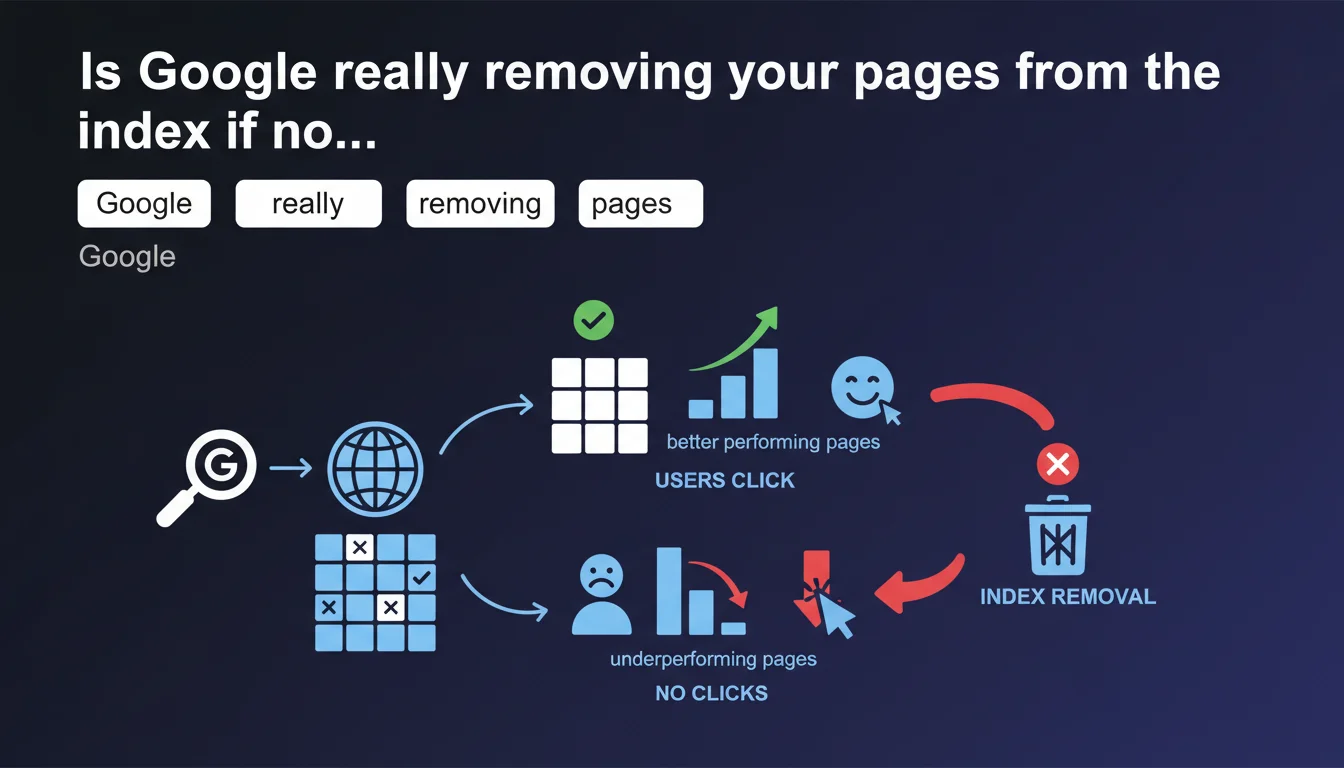
Google confirms that it deindexes pages that generate no user engagement in search results. If an indexed page fails to attract clicks compared to the competition, it will be removed from the index. It's a system of continuous performance: indexing is no longer a guaranteed status but a privilege that must be earned.
What you need to understand
This official statement confirms what many suspected: indexation is not a permanent right. Google gives your pages a trial period, but if they don't perform in real search results, they disappear.
The search engine operates a permanent Darwinian sorting. Other pages answer the search intent better — yours get pushed out.
How does Google determine if a page is "low-performing"?
The wording remains intentionally vague. Google talks about users who "aren't using them in the results," which suggests a CTR (click-through rate) criterion and probably post-click behavior.
Concretely? If nobody clicks on your page when it appears in the SERPs, or if users bounce immediately, Google draws its conclusions. The page serves no purpose — it exits the index.
Is this deindexation permanent?
Nothing suggests it's irreversible. If you drastically improve the content, Google can reindex the page on its next crawl. But you're starting from scratch in terms of credibility.
The problem: you don't always know a page has been deindexed until you manually check. Monitoring tools become essential.
- Indexation is conditional: a page can be removed if it underperforms against the competition
- The primary criterion seems to be user engagement: CTR and post-click behavior in real results
- Google performs permanent sorting: other pages take the place of yours if they're better
- Reindexation remains possible after substantial content improvement
- No precise threshold is communicated: Google remains evasive about exact metrics
SEO Expert opinion
Does this statement match what we observe in the field?
Absolutely. For several years now, we've seen massive disappearances of previously indexed pages, especially after algorithm updates. This isn't a bug — it's an acknowledged policy.
Sites with lots of weakly differentiated content are hardest hit. Empty category pages, product sheets with generic descriptions, recycled blog articles — anything that brings nothing distinctive eventually gets cut.
What gray areas remain in this explanation?
Google doesn't specify the observation timeframe. How long does a page have to prove its worth? A week? Three months? [To be verified]
Another gray area: what exactly is a user who "isn't using" the page? Zero CTR? Below 0.5%? High bounce rate? Short visit duration? Google probably blends multiple signals, but which ones exactly — and in what proportions — remains opaque.
In what cases does this rule apply less or differently?
Pages with strong domain authority seem to benefit from broader tolerance. An established site can keep moderately performing pages longer than a new site.
Highly technical or specialized content — documentation, research studies, knowledge bases — sometimes escape the filter if Google identifies them as reference resources, even with low traffic. But this is an exception, not the norm.
Practical impact and recommendations
How do you identify pages at risk of deindexation?
First step: audit your indexed pages that receive zero impressions in the Search Console. If a page is indexed but never appears in results, it's a candidate for ejection.
Next, look at pages with impressions but CTR close to zero. They appear but nobody clicks — exactly the scenario Google described. These are your priority targets.
What can you do to avoid deindexation of your content?
Let's be honest: if a page serves nobody, deindexing it isn't necessarily a disaster. It's better to concentrate your crawl budget on what works.
But if the content has strategic value, you need to either drastically improve its quality or reconsider its positioning. A page deindexed because it targets the wrong keyword can come back to life with a different angle.
- Identify indexed pages with zero impressions over 3 months in the Search Console
- Spot pages with impressions but CTR below 0.5% — they're on borrowed time
- For each at-risk page, decide: improve, merge, or delete
- If you improve, change radically: new title, new structure, enriched content, revised angle
- Optimize titles and meta descriptions to increase CTR if the page appears but doesn't attract clicks
- Verify that your pages answer a real search intent, not an imagined one
- Set up automatic monitoring of indexed pages to detect disappearances
- Avoid massively publishing weakly differentiated content — quality over quantity
❓ Frequently Asked Questions
Une page désindexée pour sous-performance peut-elle être réindexée ?
Combien de temps Google laisse-t-il à une page pour faire ses preuves ?
Un faible CTR suffit-il à déclencher la désindexation ?
Les pages de niche avec peu de volume sont-elles condamnées ?
Comment savoir si une de mes pages a été désindexée pour cette raison ?
🎥 From the same video 6
Other SEO insights extracted from this same Google Search Central video · published on 19/03/2025
🎥 Watch the full video on YouTube →
💬 Comments (0)
Be the first to comment.