
Official statement
Other statements from this video 6 ▾
- □ Comment Google découvre-t-il réellement vos pages avant de les classer ?
- □ Le sitemap ne sert-il vraiment qu'à la découverte de vos URLs ?
- □ Peut-on vraiment indexer une page sans la crawler ?
- □ Pourquoi une page indexée n'apparaît-elle pas forcément dans les résultats Google ?
- □ Pourquoi une page indexée peut-elle rester invisible dans les résultats de recherche ?
- □ Google retire-t-il vraiment vos pages de l'index si personne ne clique dessus ?
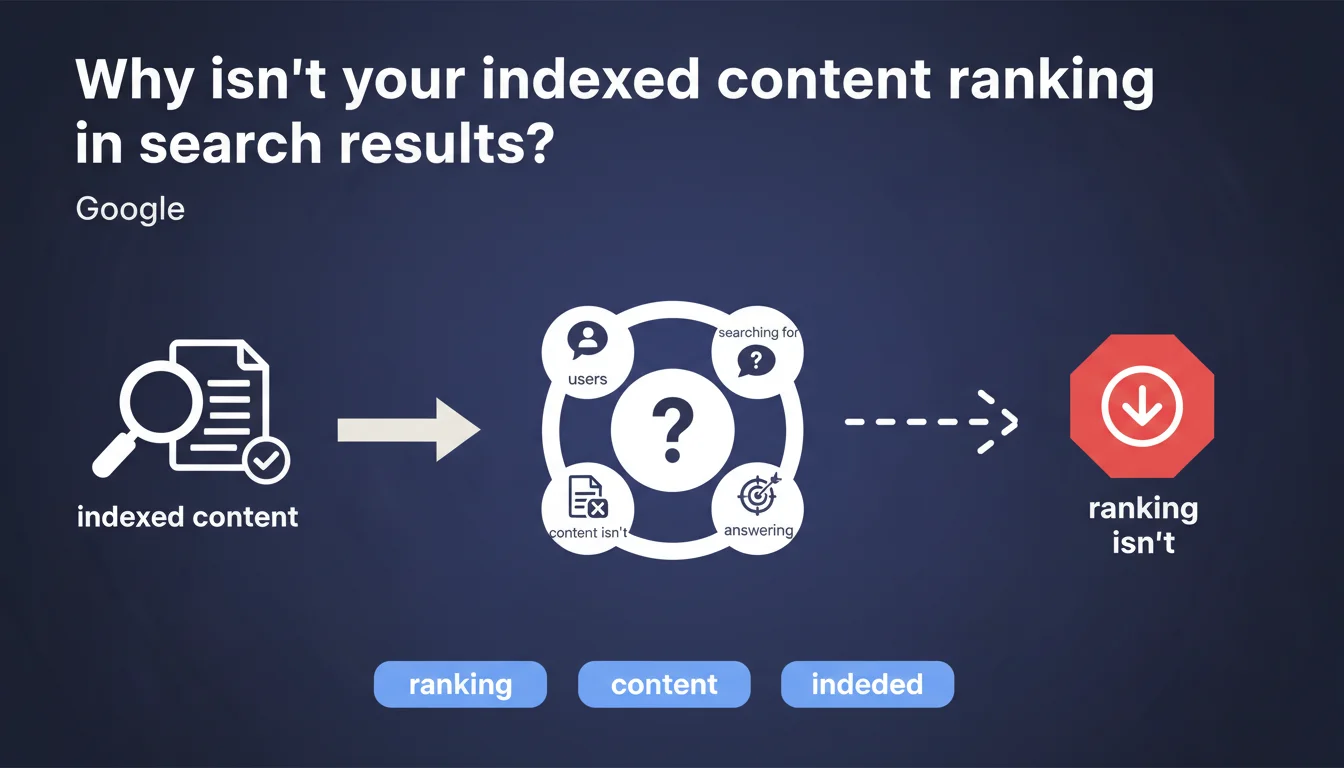
Google confirms that indexation doesn't guarantee ranking. If your indexed pages aren't appearing in results, that's a direct signal your content isn't sufficiently meeting user search intent. The problem is qualitative, not technical.
What you need to understand
What's the real difference between indexation and ranking?
Indexation means Google has discovered, crawled, and stored your page in its index. Ranking, on the other hand, determines whether that page deserves to appear for a given search query — and at what position.
Many SEO professionals confuse these two stages. A page can be perfectly indexed (verifiable via site: or Search Console) yet remain invisible in the SERPs for its target keywords. Google makes this clear: it's not a bug, it's a content performance problem.
What does it really mean when content "doesn't sufficiently answer the query"?
Google evaluates whether your content satisfies the actual search intent behind a query. An article can be well-written, technically optimized, and still never rank if Google determines it doesn't deliver enough value compared to pages already ranking for that term.
This statement shifts the burden: it's no longer "Google doesn't understand me," but rather "my content isn't relevant enough." That distinction changes everything about your strategic approach.
How does Google actually measure content performance?
Google doesn't reveal the exact criteria, but we know it analyzes behavioral signals (clicks, time on page, bounce rate), freshness, depth of coverage, and search intent alignment (informational, transactional, navigational).
The engine also compares your page against competitors already ranking. If they cover the topic more thoroughly, provide more data, or satisfy users better, your page stays invisible even if indexed.
- Indexation ≠ ranking: having a page in the index guarantees zero visibility.
- The problem is usually qualitative, not technical.
- Google evaluates relevance against competing pages and actual search intent.
- Behavioral signals play a role in performance evaluation.
SEO Expert opinion
Does this statement actually match what we observe in the real world?
Absolutely. We regularly see sites with thousands of indexed pages but virtually no organic traffic. Google is confirming what we observe on the ground: the index has become massive, and the engine is filtering aggressively to show only what truly deserves visibility.
The problem is Google remains vague about what "content performance" actually means. No thresholds, no quantifiable indicators, no exploitable metrics. How do you objectively measure whether your content "responds sufficiently"? [Needs verification] on what specific criteria this evaluation is based.
What biases does this statement introduce?
Google puts all the weight on content quality, which is partly true — but incomplete. We know that domain authority, link profile, and even brand recognition massively influence rankings.
Mediocre content on an authoritative site can rank ahead of excellent content on a new domain. Google never mentions these variables in statements like this, creating a distorted picture. Let's be honest: content alone doesn't always cut it.
When does this rule actually break down?
Certain highly specialized or ultra-niche long-tail content can be indexed without ever appearing in standard SERPs, yet still generate traffic through very specific queries. That's not a quality issue, it's a search volume issue.
Similarly, orphaned pages or those poorly integrated into your site architecture can be indexed via sitemap but never rank due to lack of internal importance signals. Again, this isn't purely a content question.
Practical impact and recommendations
What concrete steps should you take to improve content performance?
Start by auditing your indexed but invisible pages. Search Console lets you identify indexed URLs generating zero impressions. These pages should be your priority: either improve them significantly or remove them from the index.
Next, analyze the competitor pages actually ranking for your target keywords. What do they cover that you don't? How deep is their treatment? What formats do they use (video, tables, case studies)? Competitive analysis is brutal but essential.
What mistakes should you avoid at all costs?
Stop creating content "for Google" without a clear user search intent. Generic, flat pages with no unique angle are exactly what stays invisible even when indexed.
Also avoid internal duplication or near-duplicate content across multiple pages. Google will only rank one version, and often it's not the one you hoped for. Consolidate instead of multiplying.
How can you verify your content actually meets Google's expectations?
Focus on the actual queries generating impressions in Search Console. If your pages appear at positions 20-50, you're indexed but underperforming. Optimize for those specific queries, not generic keywords.
Also test actual user behavior with tools like Hotjar or Microsoft Clarity. If visitors bounce immediately or don't scroll, Google will eventually tank your ranking.
- Identify indexed pages generating zero impressions in Search Console
- Compare your content against the top 3 ranking competitors for each target keyword
- Analyze actual search intent (informational, transactional, navigational)
- Consolidate internal content that's too similar or duplicated
- Add depth: hard data, concrete examples, explanatory visuals
- Optimize for queries already generating impressions (positions 20-50)
- Monitor behavioral signals (bounce rate, time on page, scroll depth)
❓ Frequently Asked Questions
Une page indexée mais invisible dans les SERP est-elle pénalisée par Google ?
Combien de temps faut-il pour qu'un contenu amélioré se classe mieux ?
Vaut-il mieux désindexer les pages qui ne performent pas ?
Le fait d'avoir beaucoup de pages indexées mais invisibles nuit-il au site ?
Comment Google mesure-t-il la performance du contenu exactement ?
🎥 From the same video 6
Other SEO insights extracted from this same Google Search Central video · published on 19/03/2025
🎥 Watch the full video on YouTube →
💬 Comments (0)
Be the first to comment.