
Official statement
Other statements from this video 6 ▾
- □ Comment Google découvre-t-il réellement vos pages avant de les classer ?
- □ Le sitemap ne sert-il vraiment qu'à la découverte de vos URLs ?
- □ Peut-on vraiment indexer une page sans la crawler ?
- □ Pourquoi une page indexée n'apparaît-elle pas forcément dans les résultats Google ?
- □ Pourquoi votre contenu indexé ne se classe-t-il toujours pas ?
- □ Google retire-t-il vraiment vos pages de l'index si personne ne clique dessus ?
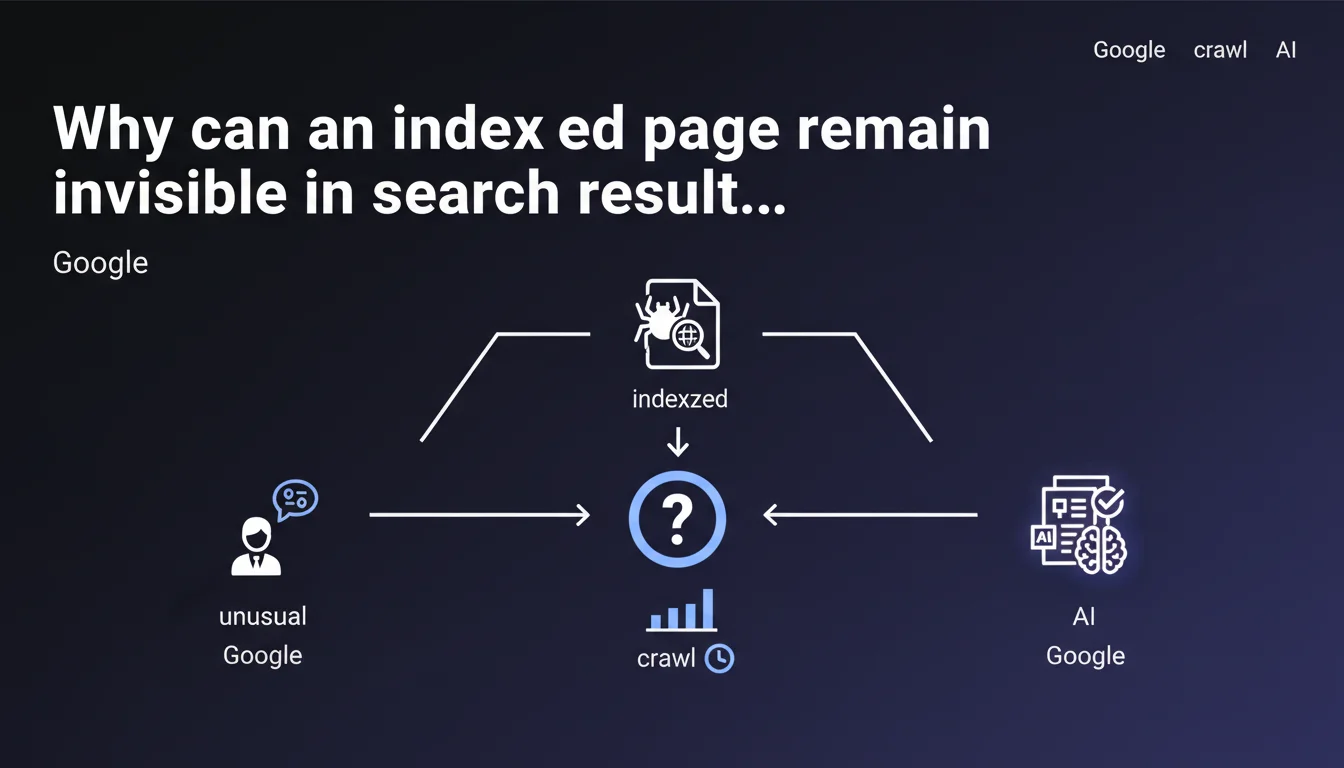
Google confirms that indexation does not guarantee visibility. Three reasons explain why an indexed page remains invisible: the search query is too unusual, it is rarely searched for, or other pages are deemed more relevant. Indexation is only one step — the real battle is fought over the quality and relevance perceived by the algorithm.
What you need to understand
Does indexation really guarantee visibility?
No, and this is a classic trap. Indexation simply means Google has crawled and stored a page in its index. Nothing more. This tells us nothing about its future ranking or its ability to appear in the SERPs.
Many SEOs still confuse these two stages. A page can be indexed for months and never generate a single impression. Google confirms it here: being in the index means passing through the door — not securing a spot on the podium.
What constitutes an "unusual" query according to Google?
Google deliberately remains vague. An unusual query can be a very specific keyword combination, rarely searched, or an atypical phrasing that deviates from standard linguistic patterns. The search engine cannot display relevant results for every imaginable variation.
In practice — and this is where it gets tricky — Google provides no numerical threshold. How many monthly searches constitute a "normal" query? Radio silence. [To verify] in the field, but we observe that queries under 10-20 monthly searches often struggle to trigger stable results.
Why does Google judge other pages as "more useful"?
This is the heart of ranking. Google constantly compares candidate pages and favors those that best match the perceived search intent. Criteria include: domain authority, content freshness, depth of treatment, UX signals, backlinks, etc.
If your indexed page does not appear, it is because it is systematically losing to the competition on these criteria. Indexation gives you the right to play — ranking rewards the best players.
- Indexation ≠ ranking: a stored page is not a visible page
- Rare or atypical queries do not always trigger exploitable results
- Google constantly filters based on perceived relevance and comparative utility
- No public threshold to define what constitutes an "unusual" query
SEO Expert opinion
Is this statement consistent with field observations?
Yes, largely. We regularly see pages indexed for months with zero organic impressions. Google applies relevance filters before even considering displaying a URL. The index is vast, the SERPs are selective.
What is missing here is transparency on thresholds. "Unusual query" is a convenient catch-all for Google, but unusable for an SEO trying to optimize. How many queries per month? Which linguistic combination triggers this filter? No data. [To verify] in your own GSC.
What nuances should be applied to this rule?
First nuance: a page invisible today can become visible tomorrow if the query frequency increases or if competition collapses. It is not binary. Ranking fluctuates based on context.
Second nuance: certain sites benefit from an algorithmic "trust bonus." An article published on an authoritative site may appear for rare queries where an unknown site remains invisible. Indexation is egalitarian, ranking is not.
In what cases is this statement insufficient to diagnose a problem?
If you find that an indexed page never appears even on brand queries or ultra-specific expressions that no one else targets, there is likely an underlying technical issue: misconfigured canonical, internal duplicate content, discreet manual penalty, or targeting conflict between multiple site pages.
Google does not mention here the quality filters (Helpful Content, spam, etc.) that can also explain persistent invisibility despite indexation. This is only one possible diagnosis, not the only one.
Practical impact and recommendations
What should you concretely do to improve the visibility of an indexed page?
First, verify the actual search volume for your targeted queries. If you are optimizing for near-nonexistent combinations, indexation will not help you. Use GSC, Semrush, Ahrefs — cross-reference sources to identify real intent.
Next, analyze competition on these queries. Who is ranking? What content depth? What format type (article, product page, video)? If you are consistently dominated, you need to boost quality, topical authority, or user experience.
What mistakes should you avoid to not waste crawl budget on useless pages?
Do not try to massively index ultra-specific pages if they address no real demand. Indexation has a cost — and an index polluted by zombie pages dilutes your site's overall signal.
Also avoid creating infinite content variations to cover every imaginable combination. Google prefers one strong page that captures multiple close semantic variations over a dozen weak invisible pages.
How can you verify that your strategic pages do not fall into this trap?
Use Search Console: Performance tab, filter by page, cross-reference impressions vs. clicks vs. average position. An indexed page with 0 impressions over 3 months is a red flag — either the target is off-market, or you are losing to the competition.
Also test manually: type specific queries into Google in private browsing. If your own pages never appear, even when refining terms, it means Google deems them non-relevant or redundant compared to other site URLs.
- Verify actual search volume for targeted queries via GSC and SEO tools
- Analyze ranking competition: depth, format, authority
- Identify indexed pages with no impressions over 3+ months
- Avoid creating infinite variations for near-nonexistent queries
- Manually test visibility on specific queries in private browsing
- Improve quality, E-E-A-T, and UX of strategic pages
❓ Frequently Asked Questions
Une page peut-elle être indexée et totalement invisible dans les résultats ?
Comment savoir si mes pages indexées génèrent des impressions ?
Qu'est-ce qu'une requête inhabituelle selon Google ?
Faut-il désindexer les pages qui n'apparaissent jamais dans les résultats ?
Combien de temps faut-il pour qu'une page indexée devienne visible ?
🎥 From the same video 6
Other SEO insights extracted from this same Google Search Central video · published on 19/03/2025
🎥 Watch the full video on YouTube →
💬 Comments (0)
Be the first to comment.