
Official statement
Other statements from this video 6 ▾
- □ Comment Google découvre-t-il réellement vos pages avant de les classer ?
- □ Le sitemap ne sert-il vraiment qu'à la découverte de vos URLs ?
- □ Peut-on vraiment indexer une page sans la crawler ?
- □ Pourquoi une page indexée peut-elle rester invisible dans les résultats de recherche ?
- □ Pourquoi votre contenu indexé ne se classe-t-il toujours pas ?
- □ Google retire-t-il vraiment vos pages de l'index si personne ne clique dessus ?
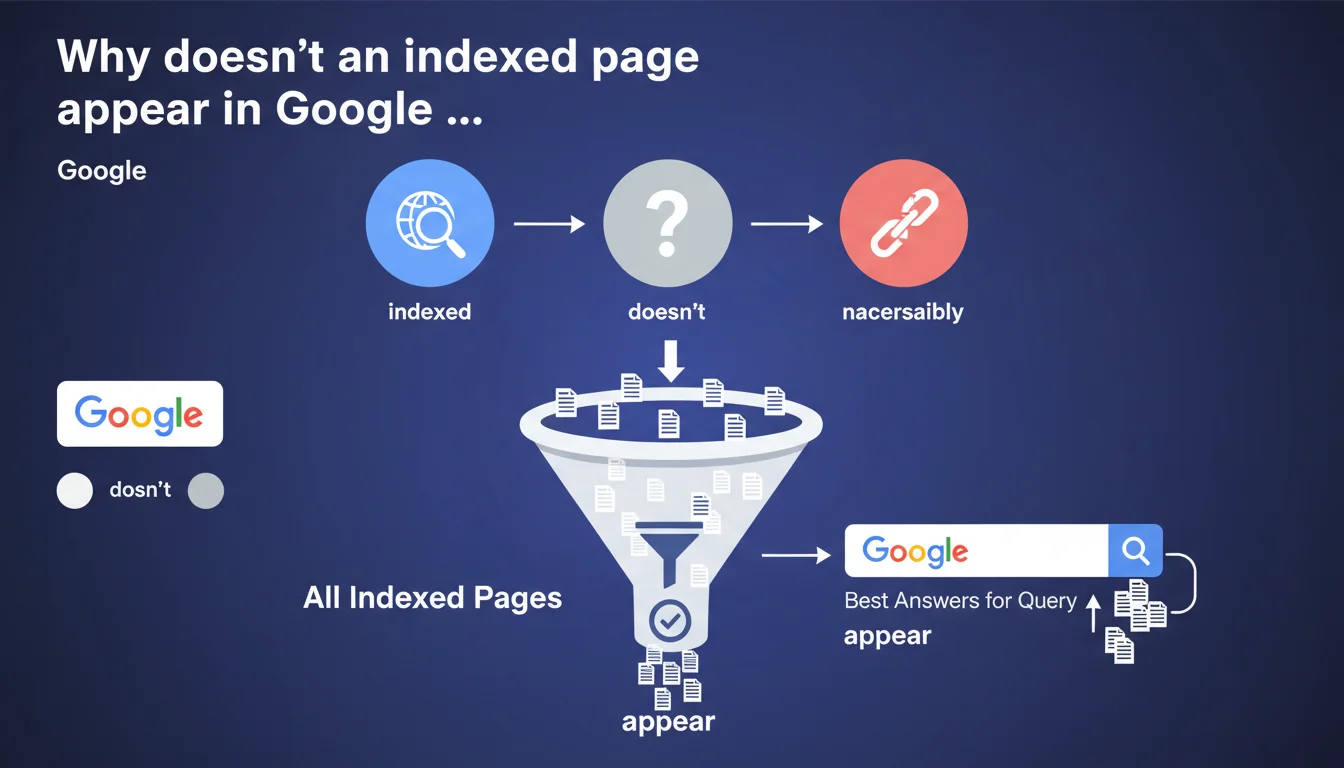
Google clearly distinguishes between indexing and ranking: having a page in its index provides no guarantee whatsoever that it will be served to users. The search engine only selects URLs deemed 'best answers' for each query, leaving millions of indexed pages invisible. This statement confirms what every SEO experiences daily — but raises the question: what criteria determine this selection?
What you need to understand
What's the difference between indexing and appearing in SERPs?
Googlebot crawling your page, analyzing it, and storing it in its database is called indexing. It's a necessary but insufficient technical step. Your URL exists in the index, period.
Appearing in search results involves a completely different process: ranking. When a user types a query, Google scans its index and applies ranking algorithms to extract pages deemed most relevant. Your page could be indexed for months without ever passing this filter.
Why does Google insist on making this distinction?
Because too many webmasters and even SEO professionals confuse the two. Seeing your page in Search Console with an "Indexed" status doesn't mean it generates traffic or even appears at position 100. It's just a technical confirmation: Google knows this URL.
This clarification also aims to temper expectations. Mass indexing doesn't mechanically create visibility — and Google has no obligation to serve your content if others do the job better for a given intent.
How many indexed pages are never displayed?
Google publishes no official figures, but field observations show that sites with 50,000 indexed pages may have only 5,000 pages actually generating organic traffic. The rest sleep in the index without ever being judged a "best answer".
This reality directly challenges industrial content strategies: producing 10,000 pages makes no sense if 9,500 will never be served. Quality takes precedence — even though Google remains vague about what concretely defines a "best answer".
- Indexing ≠ ranking: these are two distinct processes with different criteria
- Google severely filters indexed pages before proposing them to users
- Millions of pages remain invisible despite an "indexed" status in Search Console
- Producing massive amounts of content without working on relevance guarantees no visibility
- The exact selection criteria remain opaque — Google speaks of "best answers" without elaborating
SEO Expert opinion
Is this statement consistent with field observations?
Absolutely. All experienced SEO professionals have already observed this phenomenon: correctly indexed pages that never rank, even on their exact title. Google applies quality filters upstream of ranking — filters that eliminate a significant portion of the index before competition for positions even begins.
What's critically missing from this statement is transparency about these selection criteria. Google speaks of "best answers" without ever defining what makes a page eligible or not. [To verify]: no documented quality threshold, no explicit mechanism — just a black box between the index and the SERPs.
What nuances should be added to this claim?
The phrasing "does not guarantee" is typically cautious. It doesn't say "rarely," or "in X% of cases." It suggests this is exceptional when it's probably the norm for a majority of indexed pages on the web.
Another point: this statement completely sidesteps the concepts of freshness and crawl budget. A page can be indexed but with obsolete data, never recrawled, so never re-evaluated for new queries. Google doesn't specify whether a "dormant" page in the index is periodically tested or simply ignored until it receives external signals.
In which cases will an indexed page remain invisible?
Several classic scenarios: duplicate or near-duplicate content where Google chooses a canonical URL different from yours, ultra-thin pages with no added value, orphan pages without internal linking or backlinks, content off-topic relative to your site's theme.
But also — and this is less documented — pages caught by local algorithmic filters. Google can decide that a domain lacks sufficient authority to rank on certain topics, even if its pages are technically indexed. [To verify]: no Google representative has ever officially confirmed this "thematic ceiling" mechanism, but observed patterns strongly resemble it.
Practical impact and recommendations
What should you concretely do to move from "indexed" status to "visible"?
First, audit your indexed pages to identify those generating zero traffic despite "indexed" status. Cross-reference Search Console data (indexed pages) with Google Analytics (pages generating organic traffic). The gap reveals your dormant content.
Then, for each invisible page, ask yourself: is there a real search intent for which this page would be the best answer? If no, delete or consolidate. If yes, optimize massively: content, internal linking, backlinks, authority signals.
What mistakes should you avoid to not waste indexation?
Stop producing industrial content without editorial strategy. Publishing 100 mediocre pages hoping 10 will rank is a crawl budget waste and dilutes your domain authority. Google may index these 100 pages, but won't serve any if they don't beat the competition.
Another classic mistake: ignoring internal linking. An orphan page can be indexed via XML sitemap but will remain invisible for lack of internal relevance signals. Google needs context to understand why a page deserves to be served — linking structure participates in this evaluation.
How do you verify your pages have a chance of appearing in results?
Test your pages with ultra-specific queries including snippets of the exact title. If even then Google refuses to display them, it's a strong signal: the page is indexed but filtered. Either it's duplicated, judged insufficient quality, or cannibalized by another URL on your site.
Also analyze the impression rate in Search Console. A page indexed for 6 months with zero impressions isn't "pending" — it's actively ignored by algorithms. Decide then: drastic improvement or deletion.
- Identify indexed pages generating no traffic for at least 3 months
- Evaluate for each page whether a real search intent exists
- Consolidate or delete content with no clear added value
- Strengthen internal linking toward strategically important poorly ranked pages
- Test your pages with specific queries to detect filters
- Always prioritize quality over quantity in your content strategy
- Monitor Search Console impression rate as an eligibility indicator
❓ Frequently Asked Questions
Combien de temps faut-il à une page indexée pour commencer à apparaître dans les résultats ?
Une page indexée mais invisible peut-elle soudainement commencer à ranker ?
Faut-il désindexer les pages qui ne rankent jamais ?
Google indexe-t-il toutes les pages d'un site même si elles ne rankeront jamais ?
Comment savoir si une page indexée est filtrée ou simplement pas encore classée ?
🎥 From the same video 6
Other SEO insights extracted from this same Google Search Central video · published on 19/03/2025
🎥 Watch the full video on YouTube →
💬 Comments (0)
Be the first to comment.