
Official statement
Other statements from this video 13 ▾
- 3:25 Why don't valid rich results guarantee visibility in Job Search?
- 5:14 Does the employmentType field in JobPosting structured data really impact query matching?
- 7:19 Is it true that you can't aggregate reviews from other websites in your structured data?
- 10:28 Is it really necessary to have strictly identical content between mobile and desktop for Mobile-First Indexing?
- 10:28 Does hiding mobile content with CSS really sabotage your Mobile-First indexing?
- 19:07 Is it true that hidden content in accordions and tabs is indexed by Google?
- 19:07 Why is Google so silent about massive indexing problems?
- 24:24 Why does the number of URLs in Search Console's Web Vitals vary each month?
- 25:24 Why are your Page Experience metrics fluctuating when you haven't changed anything?
- 31:07 Are geo-targeted redirects using cookies considered cloaking by Google?
- 31:07 Should you really ditch geolocation redirects in favor of hreflang?
- 31:07 Do IP redirections really block the indexing of your multilingual content?
- 48:33 Could A/B testing actually risk cloaking in Google's eyes?
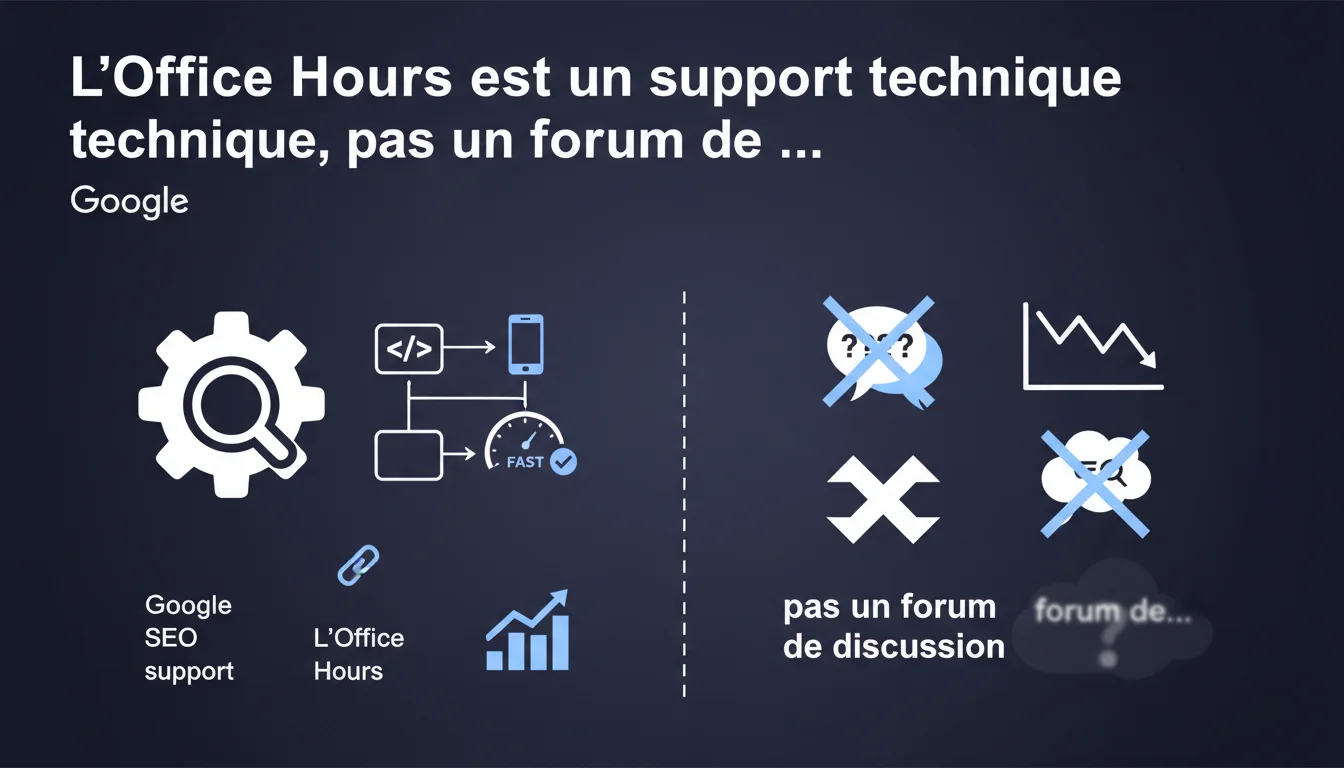
Google is redefining the scope of its Office Hours: the team will no longer discuss SEO strategies or theoretical cases but will focus solely on actionable technical issues related to Google’s guidelines and products. In other words, if your question sounds like “What is the best linking strategy?”, forget it — but if it’s “Why does Search Console show a CLS error on this specific page?”, you have a chance.
What you need to understand
Why does Google limit the scope of its Office Hours?
Google receives a massive volume of SEO questions during its Office Hours sessions. The problem is that a significant portion of these questions pertains to strategic debate rather than pure technical support. Practitioners ask, "Should we prioritize this type of content?" or "What length should my articles be?" — such questions that Google cannot answer without opening Pandora's box. By strictly framing the format, Google limits digressions and channels the team’s resources toward concrete, actionable, and documentable issues. In practical terms? If your question requires precise diagnostics, screenshots, URLs, or logs, you’re on the right track. An actionable issue is one that can lead to a technical check, a configuration fix, or a guideline clarification. Google wants to be able to respond with facts, official tools (Search Console, PageSpeed Insights, Rich Results Test), and documented references. In contrast, a question like “My traffic is dropping, what should I do?” is too vague. It requires context analysis, market conditions, competition — dimensions that Google cannot handle in a short and public format. Yes and no. In practice, the most useful answers during Office Hours have always been those related to specific bugs, documented inconsistencies, or guideline clarifications. Strategic questions often received vague responses, such as “it depends on the context” — in other words, nothing new. This reframing simply formalizes a reality: Google will never conduct personalized SEO audits in public. If you seek strategic advice, you’ll have to rely on your expertise, your tests, or the support of a third party.What is considered an “actionable issue” according to Google?
Does this limitation really change anything for SEO practitioners?
SEO Expert opinion
Is this statement consistent with observed practices?
Absolutely. Anyone who has attended an Office Hours knows that the most solid answers pertained to documentable technical issues: indexing errors, JavaScript rendering bugs, schema.org markup inconsistencies, etc. Strategic questions invariably received diluted responses or referrals to documentation. This clarification mainly prevents some practitioners from wasting time formulating complex questions that will never yield usable answers. Google is being transparent about its limits — which, paradoxically, is more honest than suggesting that personalized strategic advice is possible. The line between “actionable technical” and “SEO strategy” remains blurry. For instance: “My e-commerce site suffers from keyword cannibalization between product listings and categories, how should I structure it?” — it’s technical (architecture, internal linking, canonicals) but also strategic (which content to prioritize, what granularity to use). Google can respond on the mechanical aspects (how to use canonicals, how to indicate indexing preferences), but not on editorial arbitration (should these pages be merged or segmented). [To be verified]: how far will Google go in interpreting “actionable technical”? Practice will show whether this boundary is strict or leaves room for interpretation. If Google refuses to answer or systematically redirects to the documentation, that’s a clear signal: your question falls under personalized SEO advice, not product support. You then have three options: test it yourself, consult trusted experts, or hire an agency for an in-depth diagnosis. Let’s be honest — this limitation pushes practitioners to become more independent in their diagnostics and to better articulate their problems. It’s a healthy discipline: isolating the technical symptom before asking for help.What nuances should be added?
What should you do if your question is deemed out of scope?
Practical impact and recommendations
How can you frame a question that is likely to get addressed?
Prepare a precise file: affected URL(s), screenshots from Search Console, log excerpts if relevant, factual description of the observed behavior. The more documented and reproducible your question is, the more likely it is to be accepted. Avoid vague formulations like “My SEO isn’t working.” Prefer: “For three weeks, Googlebot has returned a 5xx status on this URL while the server responds 200 live — here are the logs, here’s the timeline.” It’s actionable, factual, and addressable. Never ask Google to validate your editorial strategy or architecture. “Is this site structure optimal?” will receive no usable response. In contrast, “Does this structure generate indexing errors in this specific case?” may get a technical clarification. Do not mix multiple issues in a single question. If you have a JavaScript rendering issue AND a canonical problem, ask two distinct questions. Google addresses isolable problems, not holistic diagnostics. Office Hours remain useful for product bugs, documentation inconsistencies, and guideline clarifications. If your issue falls within these categories, keep reaching out — but don’t waste time if your need is strategic. For in-depth diagnostics, complex technical audits, or editorial arbitrations, you will need personalized support. That’s where on-the-ground expertise comes into play — and it’s also where many practitioners realize they lack internal resources to conduct these analyses themselves.What mistakes should you avoid when making support requests?
Is it still worth participating in Office Hours or should you look elsewhere?
❓ Frequently Asked Questions
Quels types de questions Google acceptera-t-il encore lors des Office Hours ?
Puis-je encore demander à Google de vérifier pourquoi mon trafic baisse ?
Cette limitation signifie-t-elle que Google ne donnera plus aucun conseil SEO ?
Comment savoir si ma question est trop stratégique pour être acceptée ?
Que faire si Google refuse de répondre à ma question ?
🎥 From the same video 13
Other SEO insights extracted from this same Google Search Central video · published on 21/12/2021
🎥 Watch the full video on YouTube →
💬 Comments (0)
Be the first to comment.