
Official statement
Other statements from this video 9 ▾
- □ Why is Google replacing your title tags with H1 headings?
- □ Should you abandon client-side JavaScript rendering to succeed in SEO?
- □ Should you abandon dynamic rendering for SEO?
- □ Does the URL inspection tool really reveal what Google actually sees during JavaScript rendering?
- □ Does JavaScript-rendered content really impact your Google indexation, and should you worry about it?
- □ Is server-side rendering really faster than client-side rendering for SEO?
- □ Does Google really master JavaScript, or are there still pitfalls to avoid?
- □ Can Lighthouse really diagnose your critical rendering problems for Google?
- □ Should you really crawl your website every three months to avoid technical problems?
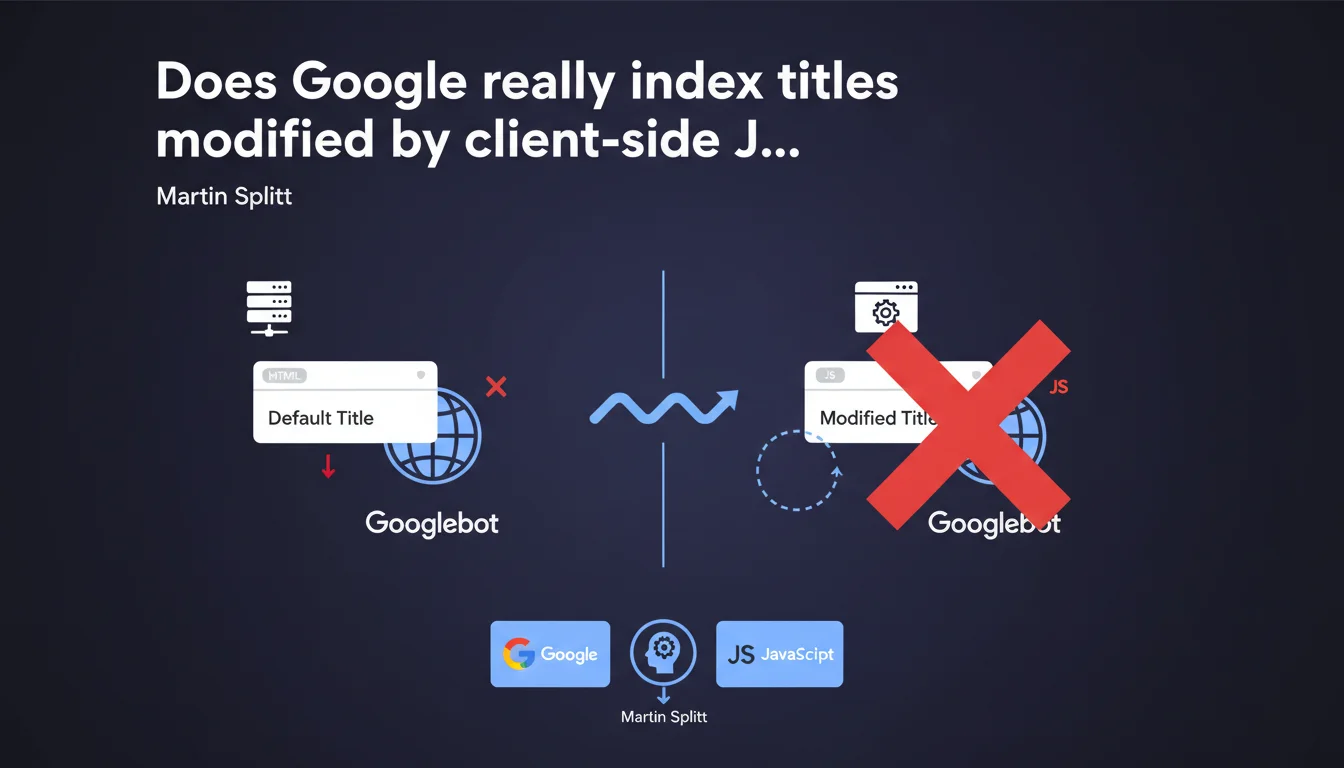
Google may index the default title present in the initial HTML rather than the title modified by JavaScript after the page loads. This client-side rendering limitation directly impacts how your <title> tags are interpreted by the search engine. Sites using JavaScript frameworks to manage their titles need to review their technical architecture.
What you need to understand
Why would Google index a default title instead of the final one?
Google's indexation process unfolds in two distinct phases: initial crawling of raw HTML, then JavaScript rendering. Between these two steps, a delay can occur — sometimes a few hours, sometimes several days depending on the crawl budget allocated to your site.
When your server sends initial HTML with a generic title (like "Loading..." or "My Site"), Google captures that version. If JavaScript then modifies this title, nothing guarantees that Google will wait for the rendering phase to index it.
Does this limitation apply to all JavaScript-based sites?
No. The statement specifically targets client-side rendering (CSR) where the server sends minimal HTML shell. Sites using SSR (Server-Side Rendering) or SSG (Static Site Generation) are not affected since the correct title arrives in the initial HTML.
Frameworks like Next.js, Nuxt, or Gatsby in SSR/SSG mode escape this problem. Conversely, a classic React SPA in pure CSR remains vulnerable.
What are concrete cases where this problem manifests?
The typical scenario: a React/Vue/Angular application that first loads HTML with <title>Loading...</title>, then JavaScript replaces this title with the real one after fetching data via API.
- Headless e-commerce: product pages whose titles are built dynamically
- SaaS dashboards: where each page modifies the title via JavaScript based on user context
- Multilingual sites: that detect language in JS and modify the title accordingly
- Single Page Applications: where internal navigation doesn't reload the page but modifies the title via
document.title
SEO Expert opinion
Is this statement consistent with real-world observations?
Yes, and it aligns with recurring field reports since 2019. Audits of CSR-based sites frequently reveal indexed titles different from those displayed in the browser. Google Search Console sometimes shows "Loading" titles or placeholders in indexation data.
But let's be honest: the wording "may index" remains deliberately vague. Google doesn't specify either the frequency of this behavior or the criteria that trigger indexation of pre-JS versus post-JS titles. [To verify]: no official metrics quantify this phenomenon.
In which cases does this rule not apply systematically?
Paradoxically, some pure CSR sites see their JavaScript titles correctly indexed. Two likely hypotheses: either the crawl budget is generous and Google systematically waits for complete rendering, or the delay between crawl and rendering is short enough to capture the modified title.
High-authority or frequently crawled sites appear less affected. But banking on this is a gamble — a technical architecture should never depend on a "maybe".
Should you completely abandon JavaScript for managing titles?
No. The hybrid approach remains viable: SSR for critical indexable content, JavaScript for post-load interactivity. Wanting to eliminate all JavaScript amounts to ignoring 15 years of web evolution — it's neither realistic nor desirable.
The problem isn't JavaScript itself, but the architecture that delegates critical SEO elements to the client. A title can perfectly be manipulated in JS after the first render, as long as the initial HTML already contains the correct value.
Practical impact and recommendations
What should you do concretely to secure title indexation?
The most robust solution: switch to Server-Side Rendering for all indexable pages. The server generates complete HTML with the definitive title before sending it to the client. Next.js, Nuxt, SvelteKit, or Remix facilitate this transition.
If full SSR isn't feasible in the short term, prioritize pre-rendering (static generation) for pages with stable content. Tools like Prerender.io or Rendertron can serve as a transitional solution, though this approach multiplies failure points.
How do you verify that your titles are correctly indexed?
Several complementary methods are essential. First, URL inspection in Google Search Console: compare the title in "Indexed page" versus the one in the source code. Any discrepancy signals a problem.
Next, use the Google mobile-friendly test which shows the final render. If the displayed title differs from the source HTML, check how long it takes before JavaScript modifies it — any delay longer than 2-3 seconds increases the risk.
- Audit the
view-source:of your critical URLs: the title must be present and correct in the raw HTML - Set up regular monitoring of indexed titles via the Search Console API
- Test behavior with JavaScript disabled: what you see is what Google crawls in the first phase
- For SPAs, ensure each route has its own pre-rendered HTML or uses dynamic SSR
- Check Core Web Vitals: an LCP that's too long delays JS execution and increases pre-render indexation risk
What mistakes should you absolutely avoid?
Never leave a placeholder title like "Loading", "Untitled", or just the site name in the initial HTML. Even if your JavaScript replaces it in 500ms, Google can capture that version.
Also avoid workarounds like injecting the title via document.write() or third-party libraries that modify the DOM after several seconds. The later the change occurs in the page lifecycle, the greater the risk.
❓ Frequently Asked Questions
Le pre-rendering résout-il définitivement le problème des titres JavaScript ?
Les métadonnées autres que le titre sont-elles également concernées ?
Un site en CSR peut-il quand même bien se positionner malgré ce problème ?
Combien de temps Google attend-il avant de rendre le JavaScript d'une page ?
Peut-on forcer Google à attendre le rendu JavaScript avant d'indexer ?
🎥 From the same video 9
Other SEO insights extracted from this same Google Search Central video · published on 05/10/2022
🎥 Watch the full video on YouTube →
💬 Comments (0)
Be the first to comment.