
Official statement
Other statements from this video 5 ▾
- □ Does the Search Console Verification API Really Transform Property Management at Scale?
- □ How can you effectively debug Core Web Vitals using your browser's DevTools?
- □ Should you really start with Search Console before investing in complex SEO tools?
- □ How can you get your content discovered across Google's new search surfaces beyond traditional search results?
- □ Will Google's generative AI in Search Labs completely reshape your SEO strategy?
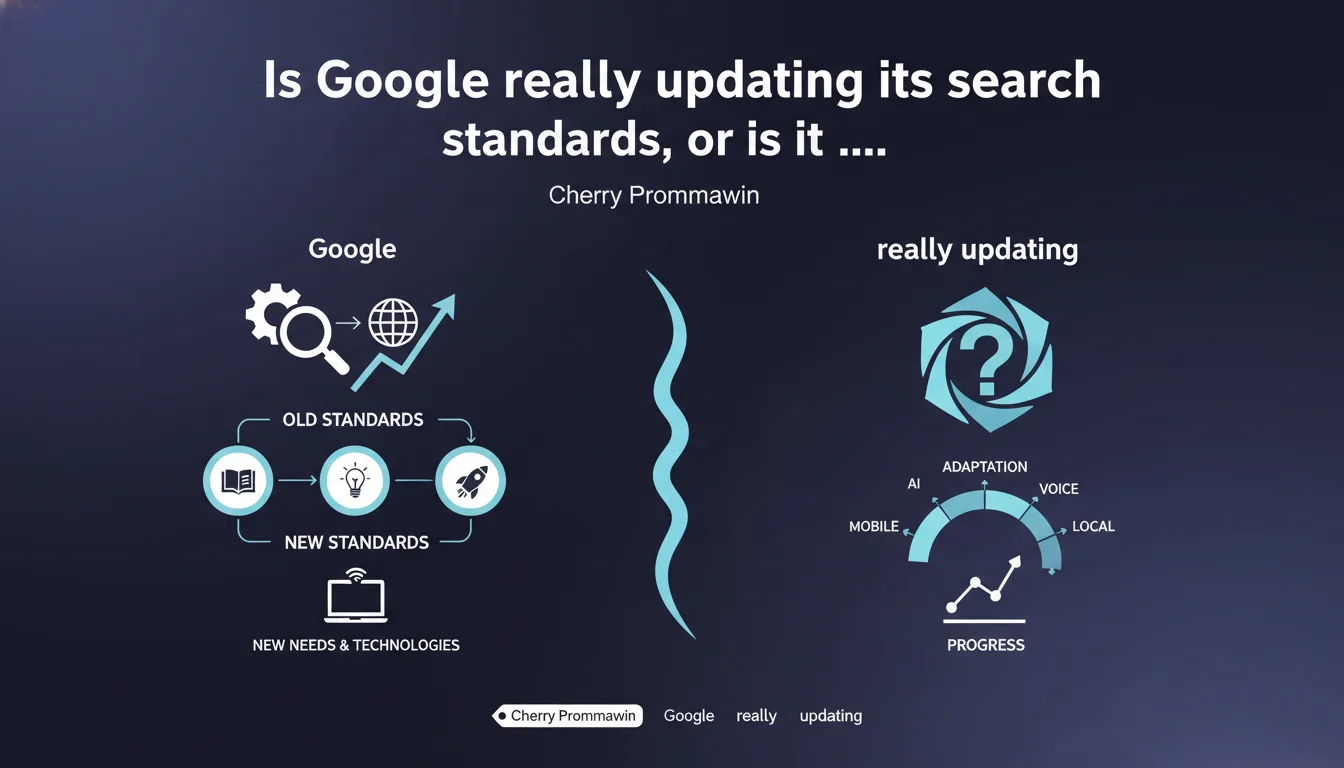
Google announces it's working to modernize the standards and protocols used in search. The stated objective: adapt to new technologies and emerging needs. Whether this will have any real concrete impact for SEO practitioners remains to be seen, as the statement is remarkably vague.
What you need to understand
Which standards and protocols could Google potentially evolve?
Google mentions an evolution of search standards and protocols, without specifying which ones. We can speculate on several possibilities: the robots.txt protocol, meta robots tags, X-Robots-Tag directives, or even structured data formats like Schema.org. It could also involve mobile-first indexing, adoption of new URL formats, or evolution of Search Console APIs.
The problem — and this is where it gets stuck — is that the statement provides no details whatsoever. It's impossible to know if we're talking about minor improvements or structural changes that will impact the way we optimize our sites.
Why is Google announcing this now?
This announcement comes at a time when generative AI and new content formats are revolutionizing search. Google SGE, AI-enriched rich snippets, conversational answers… all of this potentially requires new protocols so that websites can communicate effectively with the search engine.
It's also possible that Google is trying to modernize aging standards. The robots.txt file, for example, dates back to the 1990s. Some meta tag formats are outdated. An update has been long overdue in the technical community.
What does this actually change for a website?
For now, nothing. And that's the real issue. Without precise guidance, it's impossible to anticipate or adapt your strategy. We can assume Google will publish detailed guidelines once these evolutions are implemented, but until then, it's complete fog.
- Google is working to modernize search standards, without specifying which ones or when.
- Likely candidates include robots.txt, Schema.org, or new AI-related protocols.
- No concrete action is possible until Google clarifies its intentions.
- This announcement could be a weak signal of major changes to come.
SEO Expert opinion
Is this statement consistent with observed practices in the field?
Let's be honest: this announcement is extremely vague. Google is used to communicating evasively, but here we're hitting record levels. No factual information, no timeline, no concrete examples. [To be verified] because for now, nothing allows us to validate this claim with field data.
That said, we are indeed observing weak signals over the past few months. Structured data evolves regularly, new types appear in Schema.org, and some webmasters report subtle changes in how Google interprets certain directives. But is this linked to this announcement? Impossible to say.
What nuances should we add to this announcement?
First nuance: Google tends to talk about "evolution" for minor adjustments that don't change anything in the day-to-day work of SEO professionals. We remember the supposed evolution of crawl budget that turned out to be a simple clarification of already existing practices.
Second nuance: even if Google is genuinely modernizing its standards, this doesn't necessarily mean the old ones will become obsolete overnight. The company generally maintains long-term backward compatibility to avoid breaking millions of sites. So no immediate panic — but stay vigilant.
In what cases could this evolution really impact our sites?
If Google introduces new mandatory protocols for indexing or eligibility for certain SERP features, then yes, it will become critical. Imagine, for example, that a new meta tag format becomes required to appear in AI-enriched search results. Or that a new configuration file replaces robots.txt.
In that case, sites that don't adapt quickly will lose visibility. But again, all of this remains hypothetical. [To be verified] as soon as Google releases details.
Practical impact and recommendations
What do you need to do concretely right now?
First step: actively monitor Google's official channels. Subscribe to Search Central alerts, follow official spokespeople on Twitter, and keep an eye on technical documentation updates. As soon as Google clarifies its intentions, you'll need to act fast.
Second step: audit your site's current state on existing standards. Verify that your robots.txt is clean, your structured data is valid, and your X-Robots-Tag directives are correctly implemented. If Google modernizes these protocols, starting from a solid foundation will make the transition easier.
What mistakes should you avoid while waiting for more clarity?
Don't panic and don't change anything hastily. As long as Google hasn't published precise specifications, any changes based on assumptions could do more harm than good. Wait for the facts.
Also avoid neglecting current standards under the assumption they'll evolve. The protocols in place remain valid until further notice. Continue to respect them meticulously.
How can you verify that your site will be ready for these changes?
As soon as Google publishes details, use official tools: Google Search Console, the structured data test, the rich results test, and the coverage report. These tools will quickly flag any incompatibilities with new standards.
In the meantime, maintain active technical monitoring. Participate in specialized forums, read other SEOs' experiences, and regularly test your site with available tools.
- Monitor Google's official announcements (Search Central, Twitter, documentation)
- Audit your robots.txt, structured data, and X-Robots-Tag directives
- Don't make hasty changes without precise specifications
- Use official tools (Search Console, structured data test) to verify compliance
- Maintain active technical monitoring and exchange with the SEO community
❓ Frequently Asked Questions
Quels standards Google pourrait-il faire évoluer concrètement ?
Dois-je modifier mon site immédiatement suite à cette annonce ?
Comment savoir quand Google publiera plus de détails sur ces évolutions ?
Les anciens standards deviendront-ils obsolètes du jour au lendemain ?
Cette annonce est-elle liée à l'intégration de l'IA dans la recherche ?
🎥 From the same video 5
Other SEO insights extracted from this same Google Search Central video · published on 29/12/2023
🎥 Watch the full video on YouTube →
💬 Comments (0)
Be the first to comment.