
Official statement
Other statements from this video 5 ▾
- □ L'API de vérification Search Console change-t-elle vraiment la gestion de propriété à grande échelle ?
- □ Comment déboguer efficacement les Core Web Vitals avec les DevTools du navigateur ?
- □ Faut-il vraiment commencer par Search Console avant d'investir dans des outils SEO complexes ?
- □ Comment positionner votre contenu sur les nouvelles surfaces de recherche de Google ?
- □ Google fait-il vraiment évoluer ses standards de recherche ou est-ce du vent ?
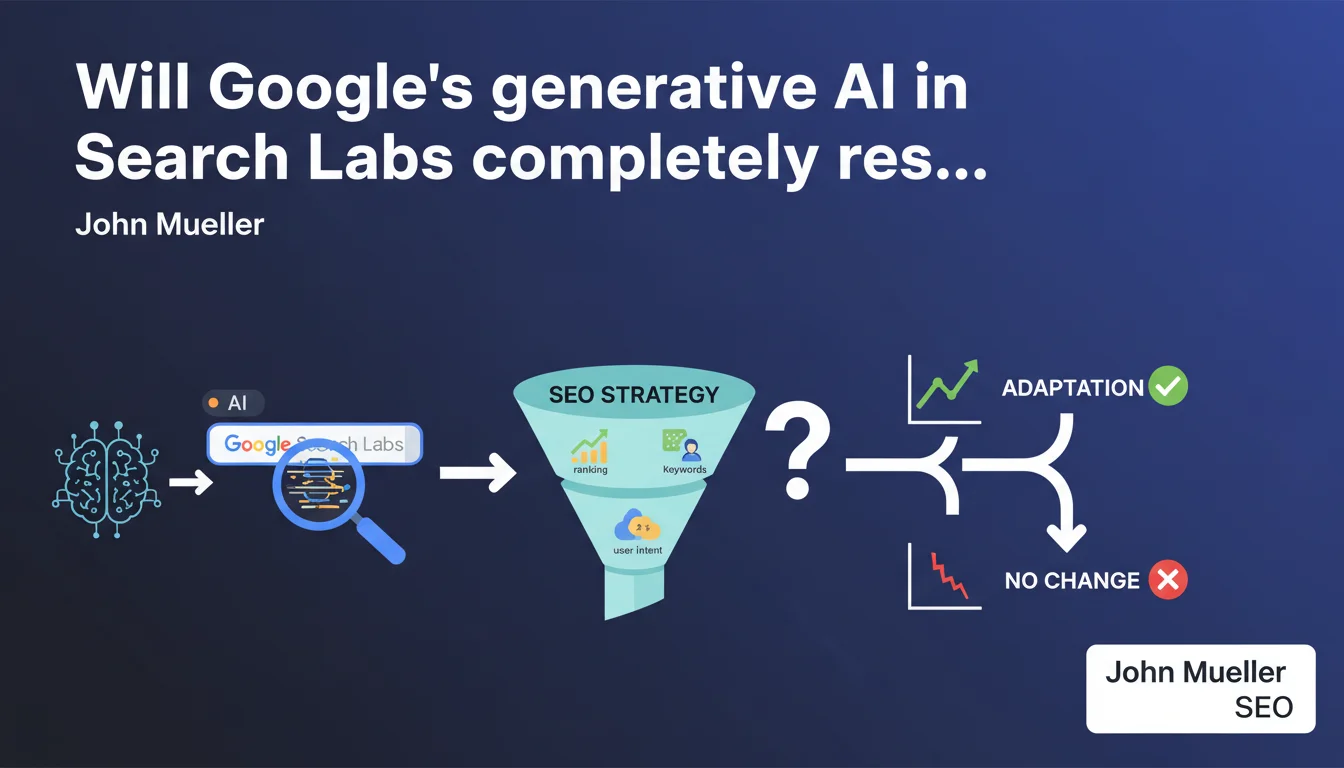
Google is launching Search Labs with generative AI to enrich search results with more context and information. This evolution changes how content is presented to users, with AI-generated direct answers complementing traditional links. SEO professionals need to anticipate changes in click behavior and traditional organic visibility.
What you need to understand
What exactly is Search Labs, and how does it differ from traditional search?
Search Labs represents Google's experimental environment for integrating generative artificial intelligence directly into search results. Unlike traditional organic results, this feature generates synthetic answers by compiling information from various sources.
Users now receive enriched context before even clicking on a link. This shift upends the typical user journey: fewer exploratory clicks, more direct information consumption on the SERP itself.
Why is Google betting on generative AI right now?
Competitive pressure from ChatGPT and other AI assistants forced Google to accelerate. But there's also a logic of improving user experience: providing complete, contextualized answers reduces search time.
For Google, it's also a way to keep users on its platform longer. Fewer bounces to third-party sites means more ad opportunities and control over the information ecosystem.
What are the direct implications for organic visibility?
The traditional position zero is evolving into something more complex. AI-generated answers don't always clearly cite their sources, or display them as secondary. Organic traffic could drop on certain informational queries.
Sites will need to rethink their content strategy: stop aiming solely for clicks, but also aim to be included in the sources the AI uses to generate its answers. This is a major paradigm shift.
- New answer formats: AI-generated summaries at the top of SERPs before traditional results
- Potential CTR decline on simple informational queries
- Unclear attribution: sources not always clearly credited
- Emerging opportunities: becoming a reference source for AI
- Increased volatility: generative algorithms less predictable than traditional ranking
SEO Expert opinion
Does this evolution align with what we're seeing in the field?
Let's be honest: Google has been testing generative AI for several months already, but deployment remains gradual and geographically limited. Field observations show variable results depending on verticals. On certain informational queries, AI responses do capture attention — on others, they remain superficial.
The problem is the lack of transparency around source selection criteria. [To be verified]: Google claims greater contextualization, but the exact mechanisms for extraction and attribution remain opaque. It's hard to optimize for a system whose precise rules you don't know.
What nuances should we consider about this announcement?
Search Labs is an experimental environment, not a feature rolled out universally. Not all users have access to it, and Google constantly adjusts based on feedback. So it's not yet the norm — but it probably will be.
Another nuance: generative AI works well on simple factual questions, less so on complex or nuanced topics. YMYL verticals (health, finance) are still treated with caution. Google won't replace the entire SERP with AI overnight.
In what cases doesn't this feature really apply?
Transactional queries largely remain untouched for now. If a user is looking to buy a specific product, Google continues to prioritize shopping results and traditional product pages. AI plays little role here — monetization takes precedence.
Similarly, local or navigational queries aren't disrupted. Searching for "Italian restaurant Paris 15th" or "Gmail login" doesn't trigger AI synthesis — that would be counterproductive. The impact concentrates on informational queries, where Google can truly deliver enriched context.
Practical impact and recommendations
What should you do concretely to stay visible with generative AI?
First priority: produce structured, authoritative content that AI can easily extract and synthesize. This means clear answers, precise definitions, verifiable data. Vague or overly promotional content is less likely to be picked up.
Next, optimizing for E-E-A-T (Experience, Expertise, Authoritativeness, Trustworthiness) becomes even more critical. Google's AI favors sources it deems trustworthy. Expert signatures, credible external references, regular updates — everything counts.
What mistakes should you avoid in this new context?
Don't fall into the trap of over-optimizing for featured snippets at the expense of depth. AI can pull from multiple sections of an article, not just the intro paragraph. Rich, comprehensive content has more value than an isolated ultra-synthetic answer.
Also, don't neglect long-tail queries. Generative AI works best on precise, complex questions where it can demonstrate added value. These specific queries represent an opportunity for differentiated visibility.
How can you verify your content is compatible with generative AI?
Test your content by asking yourself: "Can an AI extract a clear, factual answer from this?" If your article requires a full read to understand the main point, you need to restructure it. Direct intro, explicit subheadings, short, dense paragraphs.
Use schema.org markup to facilitate data extraction. FAQ schema, HowTo schema, Article schema with clearly identified sections — all of this helps AI understand and use your content.
- Structure content with direct, verifiable answers
- Strengthen E-E-A-T signals (identified authors, cited sources, demonstrated expertise)
- Implement relevant schema.org tags (FAQ, Article, HowTo)
- Create in-depth content for long-tail queries
- Monitor performance on informational queries post-AI deployment
- Diversify traffic sources beyond pure organic search
- Regularly test your content in Search Labs if accessible
❓ Frequently Asked Questions
Search Labs est-il déployé pour tous les utilisateurs Google ?
L'IA générative va-t-elle remplacer complètement les résultats organiques classiques ?
Comment Google sélectionne-t-il les sources utilisées par l'IA pour générer ses réponses ?
Le trafic organique va-t-il nécessairement diminuer avec l'IA générative ?
Faut-il optimiser différemment pour l'IA générative que pour le SEO traditionnel ?
🎥 From the same video 5
Other SEO insights extracted from this same Google Search Central video · published on 29/12/2023
🎥 Watch the full video on YouTube →
💬 Comments (0)
Be the first to comment.