
Official statement
Other statements from this video 4 ▾
- □ Faut-il vraiment anticiper les pics de recherche saisonniers avec un calendrier éditorial SEO ?
- □ Faut-il analyser les topics plutôt que les mots-clés individuels dans Google Search Console ?
- □ Comment exploiter les requêtes associées pour identifier des opportunités de contenu inexploitées ?
- □ Comment exploiter l'analyse comparative par région pour optimiser votre contenu local ?
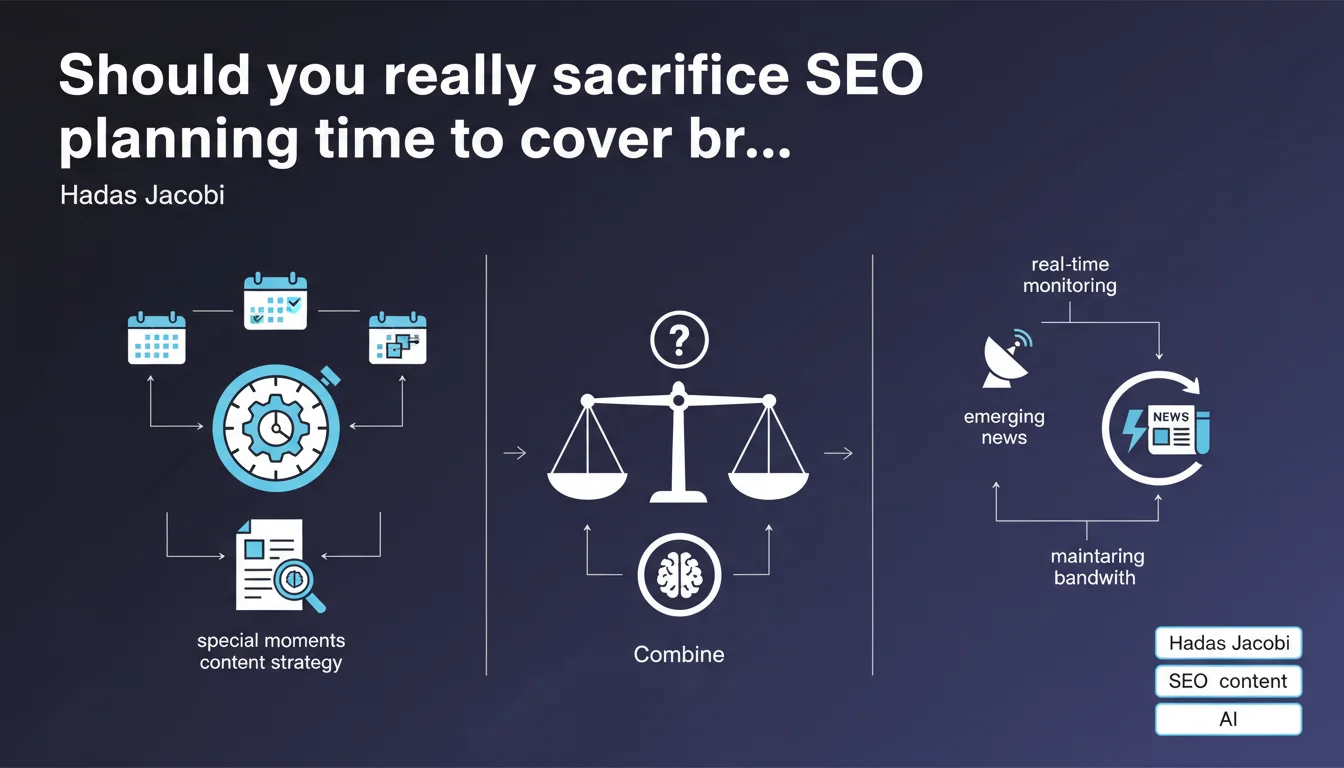
Google recommends a hybrid content strategy: plan major seasonal moments in advance while reserving capacity to react to emerging news. The challenge: avoid getting locked into a rigid calendar that prevents you from seizing hot traffic opportunities. The recommendation implies that balancing anticipation with agility maximizes visibility.
What you need to understand
Why does Google insist on this balance between planning and responsiveness?
The statement reflects an algorithmic reality: Google favors content that matches the search intent of the moment. A site that only covers predictable evergreen topics misses traffic spikes linked to unforeseen events — a political story, stock shortage, industrial scandal.
Conversely, a site that only produces reactive content lacks thematic depth and coherent internal linking. Planned content — whitepapers, guides, in-depth analyses — forms the semantic backbone that strengthens topical authority. Let's be honest: Google doesn't explicitly say how to weight the two approaches, and that's where it gets tricky.
What exactly do we mean by "special moments" and "emerging news"?
Special moments are predictable events: Black Friday, back-to-school, Olympics, industry trade shows, announced product launches. You can produce content two months ahead, optimize for associated queries, and be in a strong position when demand spikes.
Emerging news are unforeseen events or rapidly trending topics. An algorithm update, a social media buzz, an industry controversy. Here, publication speed and immediate relevance trump editorial perfection.
What concrete impact on editorial resource allocation?
The implicit instruction: don't saturate 100% of your bandwidth with planned content. If your entire team is locked into an editorial calendar three months in advance, you can't pivot when an opportunity arises.
Concretely, this means reserving 20% to 40% of your production capacity for opportunistic content. This can involve active monitoring, accelerated publishing workflows, and writers capable of handling a topic in a few hours.
- Advance planning: ensures stable semantic coverage and strengthens thematic authority
- Editorial responsiveness: captures traffic spikes tied to trends and unforeseen events
- Flexible allocation: reserve part of your resources for opportunistic content
- Active monitoring: track Google Trends, social networks, and industry alerts
- Agile workflows: ability to publish quality content in less than 24 hours
SEO Expert opinion
Is this recommendation really applicable across all sectors?
No, and this is a point Google glosses over. In certain sectors — finance, healthcare, insurance — news-related topics are rare or require legal validation that prevents any rapid response. A health insurance site cannot publish an article about healthcare reform without internal validation, legal review, and several days of delay.
Conversely, in media, tech, and fast-fashion e-commerce sectors, the recommendation is common sense. The tradeoff depends on sector volatility and editorial process maturity. If your validation chain involves five stakeholders, agility remains theoretical.
Does Google really value freshness enough to justify this approach?
Yes, but with nuance. Freshness is a ranking signal for QDF queries (Query Deserves Freshness) — news, trends, recent events. On these queries, content published the same day often outranks older content, even if better optimized.
But for evergreen queries — "how to calculate bounce rate," "difference between SEO and SEM" — freshness matters little. [To verify]: Google doesn't publish a list of QDF queries. You must infer this status by observing SERP volatility and the presence of recent content in the top 3.
Concretely? A site relying only on planning risks losing traffic on QDF queries. A site producing only reactive content lacks stability and depth. The balance isn't 50/50 for everyone — it depends on your target query mix.
Practical impact and recommendations
How do you concretely structure a hybrid editorial strategy?
First step: segment your editorial calendar into two columns. Column 1: planned content with fixed publication date and validated topics two to three months ahead. Column 2: reserved slots for opportunistic content with generic themes ("product news," "sector trends") but no fixed topic.
Second step: define accelerated publishing workflows. Reactive content can't go through the same validation process as a 3,000-word guide. Identify one or two writers capable of producing 500-800 words in two hours, establish a short validation path (writer → project manager → publish), and create ready-to-use templates.
Third step: automate your monitoring. Google Trends, Google Alerts, social listening tools, industry RSS feeds. The goal: detect an emerging trend before it's saturated with competing content. If you publish three days later than everyone else, you miss the spike.
What errors should you avoid in this approach?
Error #1: sacrificing quality for speed. Rushed content to chase news won't rank better than non-existent content. Google always prioritizes relevance and depth, even on QDF queries. It's better to publish a day late with real added value than rush out an empty shell.
Error #2: neglecting internal linking on reactive content. An article about breaking news must link to your evergreen content to avoid becoming an orphaned page once the buzz dies. Think about integrating relevant internal links from publication.
Error #3: not measuring differentiated impact. If you don't separately track planned vs. reactive content performance, you'll never be able to adjust the ratio. Use UTM tags, dedicated categories in Analytics, or manual tracking spreadsheets.
- Segment editorial calendar: planned content vs. reactive slots
- Reserve 20 to 40% of editorial capacity for unplanned opportunities
- Implement accelerated publishing workflows with short validation
- Automate monitoring: Google Trends, alerts, social listening, RSS feeds
- Prepare templates for reactive content to save time
- Never sacrifice quality for speed — mediocre content won't rank
- Systematically integrate internal linking from day one of reactive content publication
- Separately measure performance of planned vs. reactive content
- Adjust ratio based on results observed over three to six months
❓ Frequently Asked Questions
Quel pourcentage de capacité éditoriale faut-il réserver pour les contenus réactifs ?
Comment identifier si une requête mérite un contenu réactif ou planifié ?
Un contenu réactif publié vite mais moins optimisé peut-il quand même se classer ?
Faut-il dater les contenus réactifs pour signaler leur fraîcheur à Google ?
Cette stratégie hybride fonctionne-t-elle aussi pour les sites e-commerce ?
🎥 From the same video 4
Other SEO insights extracted from this same Google Search Central video · published on 23/10/2024
🎥 Watch the full video on YouTube →
💬 Comments (0)
Be the first to comment.