
Official statement
Other statements from this video 4 ▾
- □ Faut-il vraiment anticiper les pics de recherche saisonniers avec un calendrier éditorial SEO ?
- □ Faut-il analyser les topics plutôt que les mots-clés individuels dans Google Search Console ?
- □ Comment exploiter les requêtes associées pour identifier des opportunités de contenu inexploitées ?
- □ Faut-il vraiment sacrifier du temps de planification SEO pour couvrir l'actualité en temps réel ?
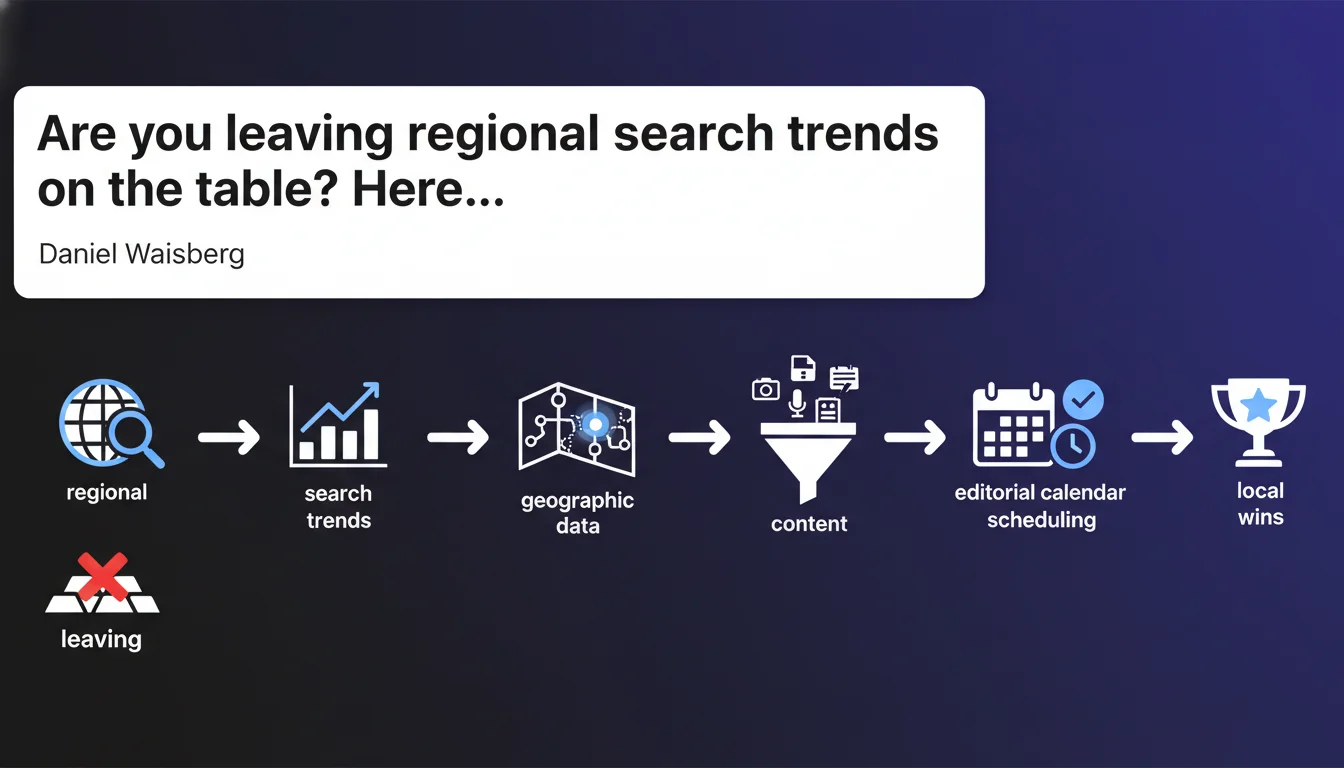
Google emphasizes that analyzing search trends by region and sub-region allows you to pinpoint where interest concentrates for any given topic. This approach helps you tailor your editorial strategy to local needs and schedule content publication based on regional interest peaks.
What you need to understand
Why does Google emphasize regional trend analysis?
Google highlights that interest in the same topic varies dramatically depending on geographic location. A Paris-based restaurant shouldn't publish its Epiphany cake content at the same time as a Lyon establishment — search peaks don't necessarily coincide.
Regional comparative analysis lets you move beyond a uniform national perspective. By breaking down data by region and sub-region, you spot missed opportunities and avoid publishing content at the wrong time for certain audiences.
What data enables this comparative analysis?
Google doesn't explicitly specify which tools to use, but it's clear they're referring to Google Trends and Search Console data filtered by country/region. These tools reveal interest variations across different geographic areas.
The idea is to compare trend curves between different regions to identify timing differences or varying intensity levels. A peak in the Northeast might precede one in the Southwest by two weeks.
How does this fit into editorial strategy?
This approach transforms your editorial calendar from a static document into a dynamic tool adapted to local realities. Instead of publishing a single article for all of France, you can plan multiple versions or staggered publication dates.
This aligns with geo-targeted content and local search optimization logic. Google implicitly suggests that sites ignoring these regional variations miss out on qualified traffic opportunities.
- Interest in topics varies geographically — analyzing region by region prevents one-size-fits-all thinking
- Search peaks aren't synchronized between regions — adjust publication timing accordingly
- Google Trends and Search Console are the logical tools for this comparative analysis
- Your editorial calendar must become dynamic and account for local specifics
- This approach supports content geo-targeting strategy at the editorial level
SEO Expert opinion
Is this statement really groundbreaking for SEO practitioners?
Let's be honest: regional trend analysis is nothing revolutionary. SEO professionals working on multi-regional sites or physical retail networks have been doing this for years. Google is simply formalizing an already-established practice.
The problem is that this statement remains extremely vague on concrete implementation details. Which specific tools? How granular should your geographic breakdown be? What methodology transforms this data into editorial decisions? None of this is clarified. [Needs verification]
What limitations should you keep in mind with this approach?
First limitation: Google Trends works with sampled data, not exhaustive data. For low search volumes or highly niche topics, regional variations might be statistical noise rather than exploitable signals.
Second limitation: this approach assumes you have the technical and editorial capacity to produce region-differentiated content. For a solo-authored blog or a small business with limited resources, this is unrealistic. The analysis is pointless if you can't act on it.
Third point — and this is where things often break down: how do you prevent duplicate content when creating regional variations of the same content? Google provides zero guidance on this critical issue. Hreflang tags? Genuinely distinct content? Canonicalization? Silence.
When does this recommendation actually make sense?
This approach is relevant for sites with strong local components: e-commerce with region-specific delivery, retail networks, location-based services, regional media, tourism. There, regional analysis can unlock real traffic gains.
Conversely, for a B2B SaaS platform selling project management software, the value of regional content variations is far more questionable. Search behavior is probably far more geographically homogeneous.
Practical impact and recommendations
How do you concretely implement this regional analysis?
First step: identify your strategic topics and verify whether they show significant geographic variations. Use Google Trends' "Interest by region" section and compare temporal curves across different zones.
If you detect timing shifts or intensity differences, that's a signal that a regionalized approach could pay off. Export the data, build comparison tables, identify recurring patterns.
Next, cross-reference this data with your Search Console. Filter queries by country/region if your volume allows, and check whether your pages perform differently across geographic zones. This confirms or disproves hypotheses drawn from Trends.
What mistakes should you avoid in this process?
Mistake #1: Creating duplicate content with just the region name changed. Google will catch this and you'll gain nothing — you risk diluting your authority instead.
Mistake #2: Launching a regionalized strategy without resources to maintain it long-term. A region-adapted editorial calendar requires discipline and consistency. If you abandon it after two months, your initial investment is wasted.
Mistake #3: Neglecting technical architecture. Poorly structured regional pages (inconsistent URLs, weak internal linking, missing tags) won't rank, regardless of your analysis quality.
How do you verify your approach is working?
Establish region-specific KPIs: geographic segments for organic traffic, conversion rate by zone, average rankings on your target regional queries. Track evolution month by month.
Use tools like Google Analytics 4 with geographic segments or rank tracking solutions that allow city/region-level monitoring. Compare performance before/after implementing your regionalized strategy.
- Identify topics with significant geographic variations via Google Trends
- Compare temporal curves between regions to spot timing differences
- Cross-reference with Search Console data filtered by region
- Create genuinely distinct content for each zone, not duplicates
- Structure regional pages technically (URLs, internal links, tags)
- Define geographic KPIs to measure impact
- Track evolution over time using localized rank tracking tools
- Adjust editorial calendar based on identified regional peaks
❓ Frequently Asked Questions
Quels outils utiliser pour analyser les tendances de recherche par région ?
Comment éviter le duplicate content avec une stratégie régionalisée ?
Cette approche fonctionne-t-elle pour tous les types de sites ?
À quelle granularité géographique descendre dans l'analyse ?
Combien de temps faut-il pour voir les résultats d'une stratégie régionalisée ?
🎥 From the same video 4
Other SEO insights extracted from this same Google Search Central video · published on 23/10/2024
🎥 Watch the full video on YouTube →
💬 Comments (0)
Be the first to comment.