
Official statement
Other statements from this video 4 ▾
- □ Faut-il vraiment anticiper les pics de recherche saisonniers avec un calendrier éditorial SEO ?
- □ Comment exploiter les requêtes associées pour identifier des opportunités de contenu inexploitées ?
- □ Faut-il vraiment sacrifier du temps de planification SEO pour couvrir l'actualité en temps réel ?
- □ Comment exploiter l'analyse comparative par région pour optimiser votre contenu local ?
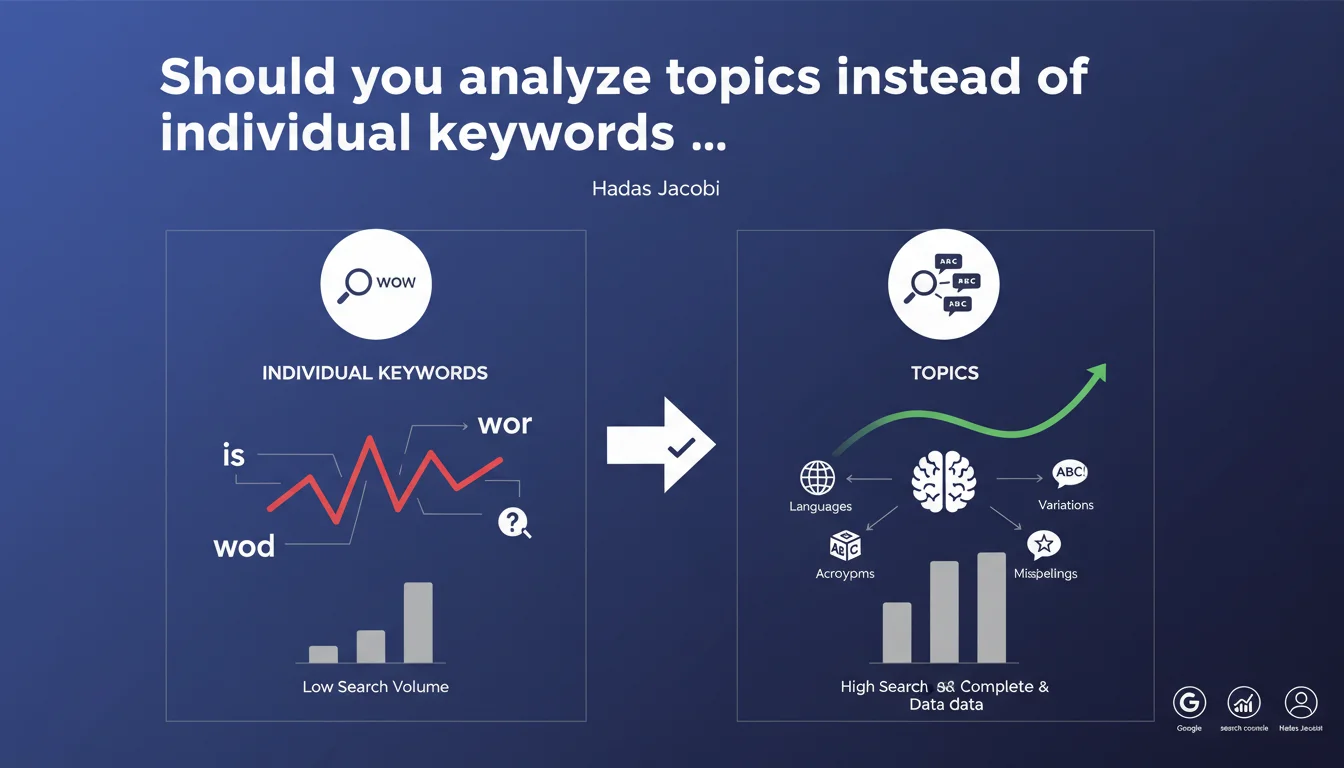
Google recommends analyzing performance by topics rather than isolated search terms. A topic automatically aggregates spelling variations, acronyms, and translations, providing a more complete view of actual search volume. This approach avoids biases related to data fragmentation across dozens of variants of the same concept.
What you need to understand
What is a topic according to Google?
A topic is an automatic grouping of several search terms that revolve around the same concept. Google consolidates spelling mistakes, linguistic variations, acronyms, and translations across all languages.
Concretely? If you analyze "car insurance", the topic includes "car insurence", "automobile insurance", "auto assurance", "insurance automobiles" and all possible variations. The aggregated volume gives a better idea of the real interest in this subject.
Why this recommendation now?
SEO professionals often spend too much time analyzing thousands of individual keywords in Search Console. Result: they see dozens of variants of the same concept, each with low volume, when aggregation would reveal a significant volume.
Google has been pushing this logic since the introduction of topic-based reports in Search Console. The objective: to guide analyses toward search intent rather than character strings.
What are the concrete advantages for an SEO practitioner?
- Consolidated view: No more scattered data across 50 variants of the same term
- More robust data: An aggregated volume reduces the impact of random fluctuations on low-traffic keywords
- Trend detection: Topic trends are more reliable than individual keywords subject to volatility
- Native multilingual: For international sites, topics automatically aggregate all languages
- Less noise: Typos and minor variations no longer pollute your analysis
SEO Expert opinion
Is this approach really new?
Not really. Third-party SEO tools (SEMrush, Ahrefs, etc.) have already been clustering keywords for years. What's changing is that Google is formalizing this practice and integrating it natively into Search Console.
The problem? The exact definition of a "topic" remains unclear. Google doesn't document the aggregation criteria precisely. We can guess that the system relies on semantic proximity and actual search data, but it's impossible to verify the underlying logic. [To verify]
What limitations should you keep in mind?
Analyzing by topics has obvious advantages, but it doesn't replace granular analysis. If you optimize a page for "best web hosting" and only rank for "website hosting service", the global topic can mask this intent mismatch.
Another point: topics work well for broad commercial or informational queries. For ultra-specific queries (brands, proper nouns, technical queries), aggregation can mix distinct intents. An SEO expert must therefore alternate between macro view (topics) and micro view (individual keywords).
Does this recommendation hide something?
Let's be honest: Google also benefits if advertisers and publishers think in terms of topics. It simplifies Google Ads campaign management and aligns semantics between SEO and SEM. The underlying message: "Don't focus on exact keywords, adapt to our semantic understanding".
This is consistent with the engine's evolution since RankBrain and BERT: Google interprets intent, not just words. But this consistency doesn't make the recommendation any less self-interested.
Practical impact and recommendations
How to leverage topics in Search Console?
Go to Search Console, "Performance" section. Enable the "Topics" filter instead of "Queries". You'll see thematic groups appear with their aggregated volume, impressions, clicks, and CTR.
Use this view to identify high-performing topics where you generate impressions but capture no traffic. This often indicates average positioning (pages 2-3) where optimization effort can shift the needle.
What mistakes should you avoid with this approach?
- Don't abandon analysis by individual keywords — both views are complementary
- Don't confuse topic with content cluster: a Google topic is automatic aggregation, not editorial architecture
- Don't rely solely on aggregated volumes for prioritization: a broad topic can mask high-converting sub-themes
- Don't forget that multilingual topics mix all languages — segment by country if your site is international
What should you do concretely?
Start by identifying your 3 to 5 priority topics by impression volume. For each one, verify that you have dedicated content that comprehensively covers the search intent.
If a topic generates high impressions but low CTR, it's often related to a positioning problem (you're visible but too low) or unappealing title/meta-description. Prioritize on-page optimization of these pages.
Cross-reference topic data with your third-party tools to validate consistency. If a topic appears as priority in Search Console but your tools don't show volume on associated keywords, dig deeper: either Google is detecting an emerging trend, or the aggregation is too broad.
❓ Frequently Asked Questions
Les topics remplacent-ils les mots-clés dans Search Console ?
Comment Google définit-il un topic exactement ?
Les topics incluent-ils automatiquement toutes les langues ?
Un topic peut-il regrouper des intentions de recherche différentes ?
Cette recommandation s'applique-t-elle aussi au SEA ?
🎥 From the same video 4
Other SEO insights extracted from this same Google Search Central video · published on 23/10/2024
🎥 Watch the full video on YouTube →
💬 Comments (0)
Be the first to comment.