
Official statement
Other statements from this video 4 ▾
- □ Faut-il analyser les topics plutôt que les mots-clés individuels dans Google Search Console ?
- □ Comment exploiter les requêtes associées pour identifier des opportunités de contenu inexploitées ?
- □ Faut-il vraiment sacrifier du temps de planification SEO pour couvrir l'actualité en temps réel ?
- □ Comment exploiter l'analyse comparative par région pour optimiser votre contenu local ?
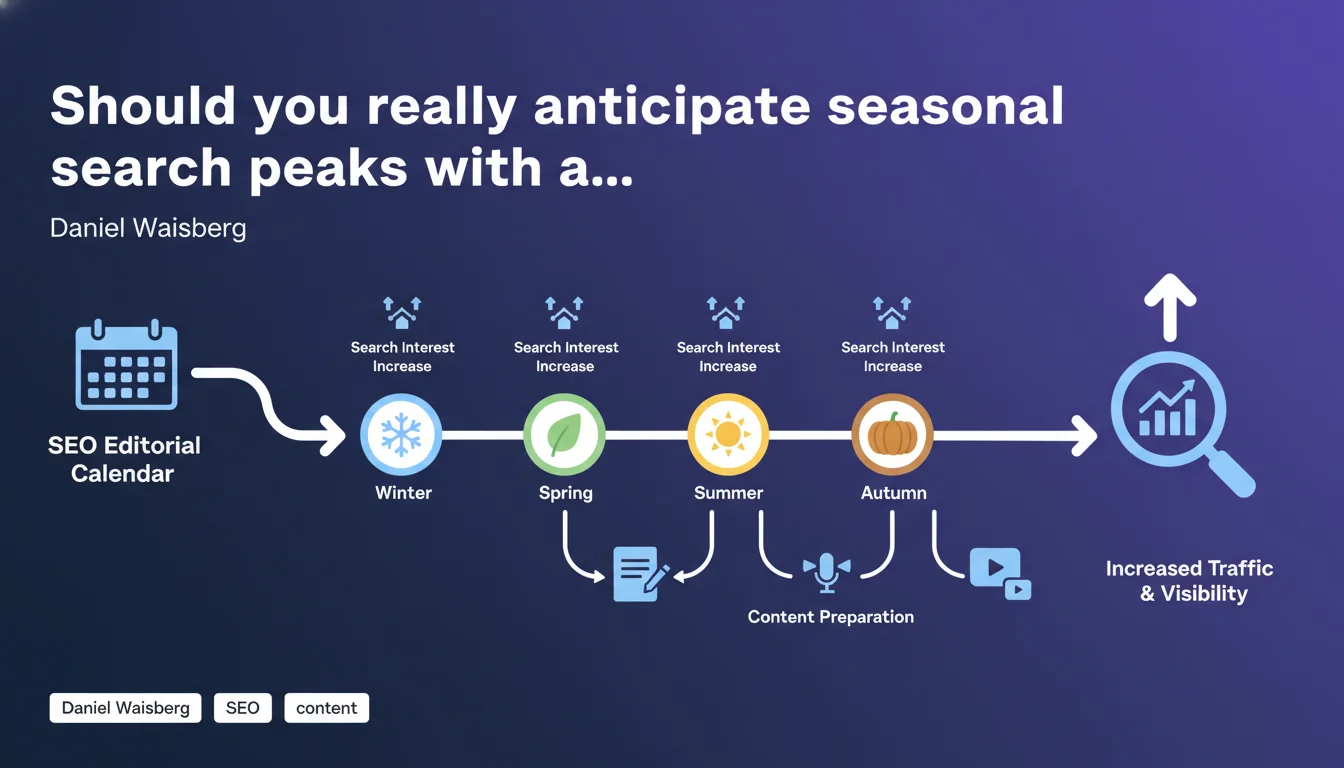
Google recommends creating an editorial calendar that anticipates recurring special moments (seasons, annual events) to publish content before search interest increases. The idea: capture traffic at the beginning of the interest curve, not when it's declining. In practice? Prepare your seasonal content several weeks—or even months—in advance.
What you need to understand
Why does Google insist on anticipating seasonal peaks?
The recommendation is based on a simple principle: Google needs time to index, evaluate, and rank new content. Publishing an article on "how to prepare your garden for spring" in March is already too late—most searches will have already happened in February.
The algorithm favors content that has had time to receive engagement signals (clicks, time on page, shares) before the demand peak. A piece of content published 4-6 weeks before the peak statistically has a better chance of ranking than a competitor published at the last minute.
What types of content are affected by this logic?
Anything related to predictable and recurring trends: seasonal changes, back-to-school, sales events, holidays (Christmas, Halloween, Mother's Day), annual sporting events, tax periods (tax filings). In short, anything that generates cyclical search volume.
On the other hand, this approach doesn't apply to evergreen content or unpredictable news topics. If your strategy relies on timeless content or editorial reactivity (newsjacking), the anticipated calendar doesn't carry the same weight.
What are the concrete benefits of a planned editorial calendar?
First point: you avoid rushing. Publishing in a hurry often leads to poorly crafted content, poorly optimized, with few internal or external backlinks. A calendar gives you time to produce solid pieces.
Second point: you can synchronize your SEO and marketing efforts. If you know that in January you're going to focus on "new year fitness resolutions," you can prepare backlinks, partnerships, and social content upstream.
- Indexing anticipation: Google needs time to crawl, index, and evaluate your content.
- Signal accumulation: content published early benefits from several weeks of engagement before the peak.
- Better writing quality: less rushing = better structured, better optimized content.
- Marketing coordination: possible alignment with paid campaigns, partnerships, PR.
- Competitive advantage: most websites publish at the last minute—anticipating puts you ahead.
SEO Expert opinion
Is this recommendation consistent with real-world observations?
Yes, but with one major caveat. On competitive queries, publishing 4-6 weeks before the peak isn't enough if your domain authority is weak. An established site can afford to publish later and still rank—a new site will need to anticipate even earlier, sometimes 3-4 months ahead.
I've observed cases where clients published seasonal content in October for January (year-end holidays) and it worked. Others published in November and got crushed by faster or more authoritative competitors. Anticipation is necessary, but not sufficient—authority, quality, and backlinks remain decisive.
What mistakes should you avoid with an SEO editorial calendar?
First mistake: believing that publishing early is enough. If your content is mediocre, publishing in advance won't change anything. Bad content published early is still bad content.
Second mistake: not updating seasonal content from year to year. Google favors freshness—if your "spring garden" article dates from 2022 and has never been touched, it will lose ground against a competitor who refreshes theirs every year.
Third mistake—and it's common: neglecting engagement signals. Publishing content in advance is good. But if nobody reads it, shares it, or clicks on it for 6 weeks, Google won't have any positive signals to leverage. You need to activate the content from publication: newsletter, social media, internal backlinks.
In what cases doesn't this rule apply?
If your site relies on breaking news or unpredictable trends, the anticipated calendar makes no sense. Newsjacking, by definition, requires reactivity—not planning.
Another case: evergreen content. An article "How does PageRank work" doesn't need to be published at a specific time of year. It just needs to be well done and regularly updated. [To verify]: Google provides no numerical data on the real impact of anticipation. Is it 10% more visibility? 50%? We don't know.
Practical impact and recommendations
What should you do concretely to implement an SEO editorial calendar?
Start by identifying recurring search peaks in your industry. Use Google Trends, your Search Console data, or tools like Semrush/Ahrefs to spot queries that surge at specific times of year.
Next, create a monthly spreadsheet listing topics to cover and target publication dates. For each topic, count back 6-8 weeks before the peak to set your writing deadline. Allow time for validation, technical optimization, and internal linking.
Finally, don't just publish and move on. Activate your content from launch: send a newsletter, push on social media, create internal backlinks from your existing pages. Content published early but invisible serves no purpose.
What mistakes should you avoid when executing an SEO calendar?
Don't fall into over-optimization of timing. Publishing all your seasonal content exactly 6 weeks before each peak creates a predictable and rigid pattern. Vary the timing, test, adjust based on your results.
Another trap: publishing seasonal content and forgetting about it afterward. These pages must be refreshed every year—add recent data, updated examples, new trends. Google values freshness, especially on recurring topics.
Finally, don't neglect dynamic internal linking. When seasonal content becomes relevant (start of peak), strengthen internal links from your homepage or most-visited articles. This boosts authority signals at the strategic moment.
How do you verify that your editorial calendar is working?
Analyze your traffic curves in Search Console for targeted seasonal queries. If you publish early and your traffic starts before the peak, that's a good sign. If you only gain traffic after the peak, you published too late—or your content lacks authority.
Also compare your average rankings on these queries from year to year. If you refresh your content every year and your rankings improve, your strategy is working. If they stagnate or drop, dig deeper: quality issue, lack of backlinks, weak engagement signals.
- Identify recurring search peaks in your industry (Google Trends, Search Console).
- Create a monthly calendar with target publication dates 6-8 weeks before each peak.
- Allow time for writing, validation, technical optimization, and internal linking.
- Activate your content at launch: newsletter, social media, internal backlinks.
- Refresh your seasonal content every year (new data, recent examples).
- Strengthen internal linking to seasonal content at the start of the peak.
- Analyze Search Console traffic curves to validate your timing.
- Compare your average rankings year-over-year to measure improvement.
❓ Frequently Asked Questions
Combien de temps avant un pic saisonnier faut-il publier un contenu ?
Faut-il créer un nouveau contenu chaque année ou mettre à jour l'ancien ?
Cette stratégie fonctionne-t-elle pour tous les types de sites ?
Que faire si je publie trop tôt et que mon contenu perd en fraîcheur avant le pic ?
Comment identifier les pics saisonniers dans mon secteur ?
🎥 From the same video 4
Other SEO insights extracted from this same Google Search Central video · published on 23/10/2024
🎥 Watch the full video on YouTube →
💬 Comments (0)
Be the first to comment.