
Official statement
Other statements from this video 8 ▾
- □ Does Search Console Insights really only show Google Search traffic?
- □ Is an impression in Search Console really counted every single time your link appears in search results?
- □ What truly counts as a click in Search Console?
- □ What exactly is a query in Search Console, and why is Google clarifying its definition now?
- □ Should you really analyze your SEO performance over 28 days in Search Console?
- □ How is Google's Search Console now automatically grouping your search queries into semantic clusters?
- □ Is tracking brand searches the hidden metric that's sabotaging your entire SEO strategy?
- □ Are you really maximizing all the traffic breakdown data hidden in Search Console?
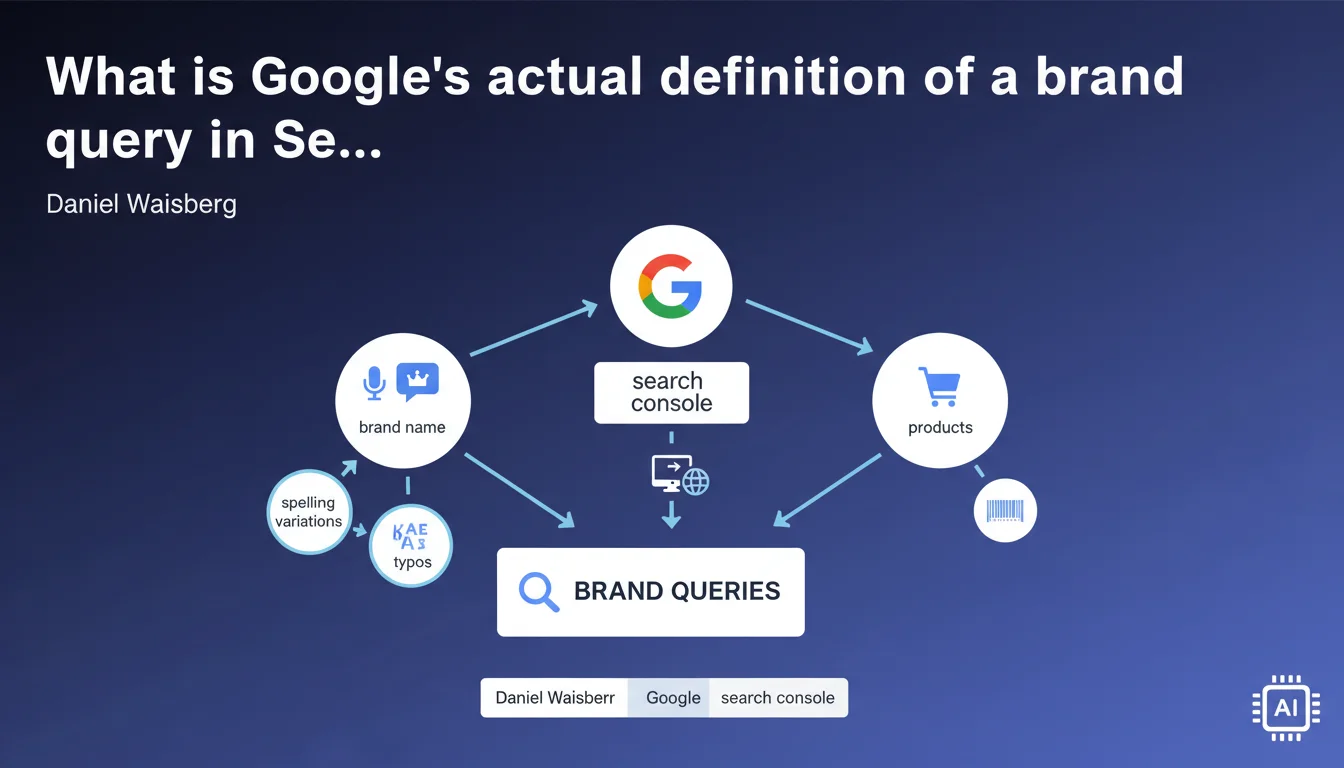
Google finally clarifies its official definition of a brand query in Search Console: any search containing your brand name, domain, or products, including misspellings and variations. This clarification directly impacts how you interpret performance data and develop your brand content strategy.
What you need to understand
Why does Google feel the need to define what a brand query is right now?
Because ambiguity was rampant. Many SEO professionals were wondering what Google actually considered a brand query in its reports, especially since dedicated filters were added to Search Console.
This official definition ends the guesswork. Google explicitly includes spelling variations and typos — a crucial point often overlooked in manual analysis.
What does Google mean by "your products" in this definition?
That's where it gets fuzzy. Google mentions products but doesn't specify how far this classification goes. Are we talking about official commercial product names only, or does it also include generic descriptors you've branded?
A concrete example: if you sell a shoe called "AirMax" at Nike, that's clear. But if you're an e-commerce retailer who created a line called "Eco-Basket," is that considered a brand product? The boundary remains porous and will likely depend on your presence in the Knowledge Graph and the brand signals Google captures.
Do spelling variations include phonetic transcriptions or just typos?
Google says variations and typos. This probably covers standard mistakes ("gogle" for "google"), but what about transliterations, common abbreviations, or nicknames given by users?
The documentation stays brief on this point. What we know: Google's algorithm is capable of recognizing search patterns associated with your entity. If a misspelled query consistently generates clicks to your site, it will likely be tagged as brand.
- Official definition: queries containing brand name, domain, or products
- Explicit inclusion: spelling variations and typos
- Fuzzy scope: the notion of "products" remains open to interpretation
- Direct impact: on filters and performance reports in Search Console
- Automatic recognition: Google relies on its entity signals and the Knowledge Graph
SEO Expert opinion
Does this definition match what we actually observe in the data?
Only partly. In practice, we find that Google sometimes classifies queries as "brand" that we wouldn't have identified manually — and vice versa.
The problem? Google doesn't reveal its sensitivity threshold. Is a query with your brand name buried among 8 other words considered branded? In practice, usually yes. But a query with just an acronym close to yours? That's random.
Can you really rely on this filter to drive your brand strategy?
With caution. The "brand queries" filter in Search Console is a convenient sorting tool, but it doesn't replace detailed manual analysis. Some SEO professionals notice inconsistencies: obviously branded queries that slip through, or generic terms mislabeled.
Let's be honest: Google works with an entity and knowledge graph logic that can differ from your own perception. If your brand is little-known or shares its name with a generic term, expect false positives or negatives.
What are the limits of this definition for multi-brand or local brands?
Google says nothing about multi-brand architectures. If you manage 15 brands under the same domain, how does Search Console segment queries? Mystery. And for local franchises with geographic variations ("Dubois Bakery Lyon," "Dubois Bakery Paris"), we don't know if Google treats them as brand variations or hybrid queries.
Another edge case: co-branding and partnerships. Is a query "Nike x Off-White" considered brand for Nike, for Off-White, or both? The documentation doesn't clarify.
Practical impact and recommendations
What should you check first in Search Console after this clarification?
First step: activate the "brand queries" filter in your performance reports and compare it with your own lists. Export the data and look for obvious inconsistencies.
Second step: identify misspelled brand queries that drive traffic. These are content opportunities often overlooked — or signals that your brand awareness has a name memorization problem.
How can you leverage this data to refine your content strategy?
If you notice high volume of branded searches with informational intent ("reviews of [brand]", "[brand] how it works"), your reassurance content may lack visibility.
Conversely, low volume of brand queries relative to total traffic can indicate two things: either your brand awareness is weak, or you're capturing a lot of generic traffic — which is actually a good SEO sign, but may reveal algorithm dependence rather than direct recognition.
What interpretation mistakes should you avoid with this new filter?
Don't confuse volume of brand queries with brand quality. A spike in searches like "[brand] scam" or "[brand] problem" will count as brand traffic, but that's obviously a red flag.
Another trap: overestimating the protection your brand traffic provides. Yes, users searching for you by name are valuable, but Google can still insert competitors in Shopping or ads on these queries. Brand traffic is never completely secured.
- Activate and analyze the "brand queries" filter in Search Console
- Export data and cross-reference with manual classification
- Identify spelling variations that drive traffic
- Spot hidden intents behind brand queries (support, reviews, comparisons)
- Measure brand vs. non-brand ratio to assess SEO dependence
- Monitor negative brand queries ("scam", "problem", "negative review")
- Create reassurance content if informational queries dominate
- Never drive strategy solely on automatically filtered data
🎥 From the same video 8
Other SEO insights extracted from this same Google Search Central video · published on 02/12/2025
🎥 Watch the full video on YouTube →
💬 Comments (0)
Be the first to comment.