
Official statement
Other statements from this video 5 ▾
- □ Does cutting content actually help you rank better?
- □ Does content length really impact your Google rankings?
- □ Should the SEO Starter Guide Really Remain a Minimalist Document for Beginners?
- □ Does Google Really Want You to Bloat Your Pages for the Helpful Content Update?
- □ Does community engagement really boost your search rankings?
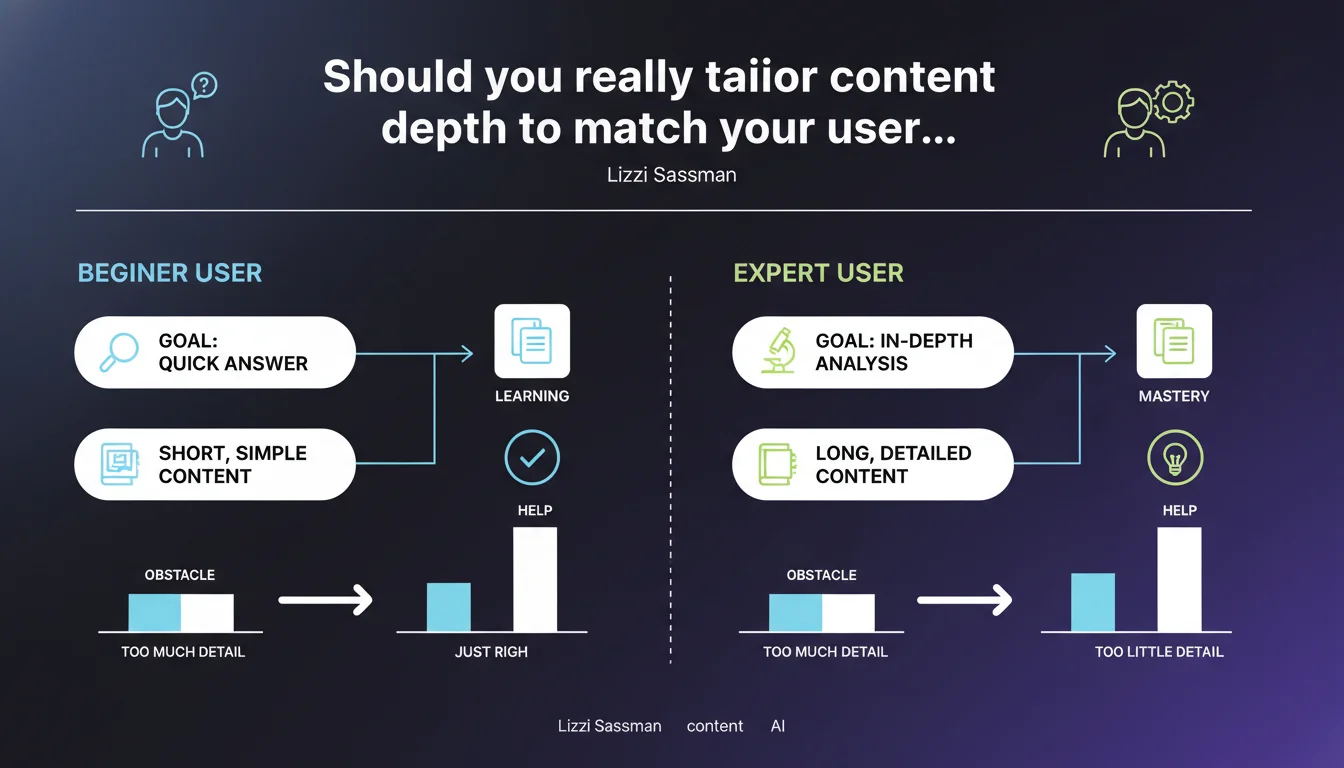
Google states that content must match the specific objective of the user for each document. Overloading content intended for beginners with technical details can harm the experience rather than improve it. The SEO challenge: align content depth precisely with actual search intent.
What you need to understand
What does it really mean to "match the user's objective"?
Google insists on a simple principle: each page must answer a specific need, without unnecessary detours. If someone searches "how to create an Instagram account", they want 5 clear steps — not a dissertation on the history of the social network or the subtleties of the algorithm.
The problem? Many sites confuse comprehensiveness with relevance. They cram their pages with advanced information thinking that "more content = better ranking". Result: a beginner gets lost in technical jargon that doesn't serve them at all.
Why does Google warn against excessive detailed information?
Because user experience takes priority over raw text volume. Content that's too dense for a beginner audience increases bounce rate, reduces meaningful engagement time, and pushes the user back to Google to find a more accessible answer.
Google detects these behavioral signals. If your visitors leave immediately because your page doesn't match their level, you won't rank higher — even with 3000 optimized words.
What's the connection between level of detail and search intent?
Search intent isn't limited to "informational vs transactional". It also includes the user's maturity level on the topic. Someone typing "SEO definition" doesn't need a guide on advanced link building strategies.
Let's be honest: many SEO contents are written for engines, not for humans. We stack secondary sections to cover every possible angle, without asking ourselves if it really serves the visitor landing on the page.
- Adapt vocabulary to your target audience's level (beginner, intermediate, expert)
- Segment content by user profile rather than mixing everything into one catch-all page
- Prioritize clarity over comprehensiveness when the intent is straightforward
- Monitor UX signals (engagement time, scroll depth, bounce rate) to detect misalignment
- Create progressive pathways: basic content → intermediate content → advanced content, rather than mixing it all together
SEO Expert opinion
Is this statement consistent with on-the-ground practices observed?
Yes and no. Google has been preaching for years about "useful" and "user-centered" content, but sites that rank in the top 3 are often those that exhaustively cover a topic — even if it goes beyond the strict scope of the query. Contradiction?
Not necessarily. The nuance is here: you must cover the topic without losing the user along the way. A beginner guide can contain links to advanced resources at the end of the page, but shouldn't drown the basics in jargon. The problem is that this boundary is fuzzy and Google provides no measurable criteria.
What concrete risks if you overload content intended for beginners?
First risk: the user drops off. They scan the page, don't immediately find what they're looking for, and leave. Google records this behavior and may interpret your page as irrelevant for that query.
Second risk: dilution of the main message. If you bury a simple answer in 10 paragraphs of context, even good content can rank poorly because Google struggles to clearly identify what you're prioritizing.
[To verify]: Google claims that "too much detailed information" can be an obstacle, but doesn't specify at what threshold or how it detects this excess. Is it based on UX metrics? On semantic complexity analysis? No concrete data.
How do you know if your content is too detailed for your audience?
No magic formula here. You need to analyze behavioral data: scroll depth, time spent on key sections, click-through rate to advanced sections. If 80% of your visitors never scroll past the first section, either they found their answer (good), or they abandoned it (bad).
Another indicator: SERP return rate. If many users quickly leave your page and return to Google, that's a signal of misalignment between content and real expectations. But again, Google doesn't share this data — you have to guess via Analytics or third-party tools.
Practical impact and recommendations
What should you concretely do to align content and user profile?
First initiative: segment your content by maturity level. If you're targeting "what is SEO", create a 100% beginner page with simple vocabulary, concrete examples, zero jargon. If you're aiming for "advanced link building strategies", then you can go technical.
Second action: analyze competing content that ranks. What depth do they adopt? What structure? If all top 3 results treat the topic in 800 simple words, and you're churning out 3000 ultra-technical words, you're probably off the mark.
Third lever: test different versions. A/B test pages with more or less detail, observe UX metrics (engagement time, scroll, bounce), and adjust. No dogma: the right level of detail is the one that generates the best engagement for your real audience.
What mistakes should you absolutely avoid?
Mistake #1: Mixing multiple expertise levels on the same page. You lose everyone — beginners drop off, experts get bored.
Mistake #2: Producing shallow content under the pretext of "not going into too much detail". Google still values depth when it's relevant. The challenge is to calibrate, not to cut.
Mistake #3: Ignoring UX signals. If your pages have high bounce rate and low engagement time, that's a red flag. Don't just produce content — verify it's working.
How do you verify your site respects this recommendation?
- Audit your top traffic pages: identify those with high bounce or low engagement, analyze if the detail level fits the query
- Map your content by intent and user level: beginner / intermediate / expert
- Create progressive pathways with internal links to more advanced content, rather than condensing everything on one page
- Monitor UX metrics via GA4, Hotjar or Clarity: scroll depth, section clicks, time spent per section
- Test multiple formats: short version vs long version, and observe which performs better in terms of engagement and ranking
- Train your writers to adapt tone and depth according to target profile, not according to an arbitrary word count
In summary: align your content depth with the real intent and maturity level of your visitors. Monitor UX signals to detect misalignments. And most importantly, segment your content by audience rather than trying to cover everything in one catch-all page.
These adjustments require careful analysis of your audience, your behavioral data, and an often complex editorial overhaul. If you don't know where to start or if you lack internal resources to drive this optimization, working with a specialized SEO agency can help you effectively structure your content strategy and avoid costly mistakes in terms of time and rankings.
❓ Frequently Asked Questions
Faut-il créer plusieurs pages pour couvrir différents niveaux d'expertise sur un même sujet ?
Un contenu court peut-il mieux ranker qu'un contenu long si il est mieux adapté ?
Comment savoir quel niveau de détail adopter pour une requête donnée ?
Le fait de simplifier un contenu risque-t-il de le faire passer pour du thin content ?
Les signaux UX comme le taux de rebond influencent-ils réellement le ranking ?
🎥 From the same video 5
Other SEO insights extracted from this same Google Search Central video · published on 23/05/2024
🎥 Watch the full video on YouTube →
💬 Comments (0)
Be the first to comment.