
Official statement
Other statements from this video 5 ▾
- □ Does content length really impact your Google rankings?
- □ Should the SEO Starter Guide Really Remain a Minimalist Document for Beginners?
- □ Does Google Really Want You to Bloat Your Pages for the Helpful Content Update?
- □ Does community engagement really boost your search rankings?
- □ Should you really tailor content depth to match your user's profile?
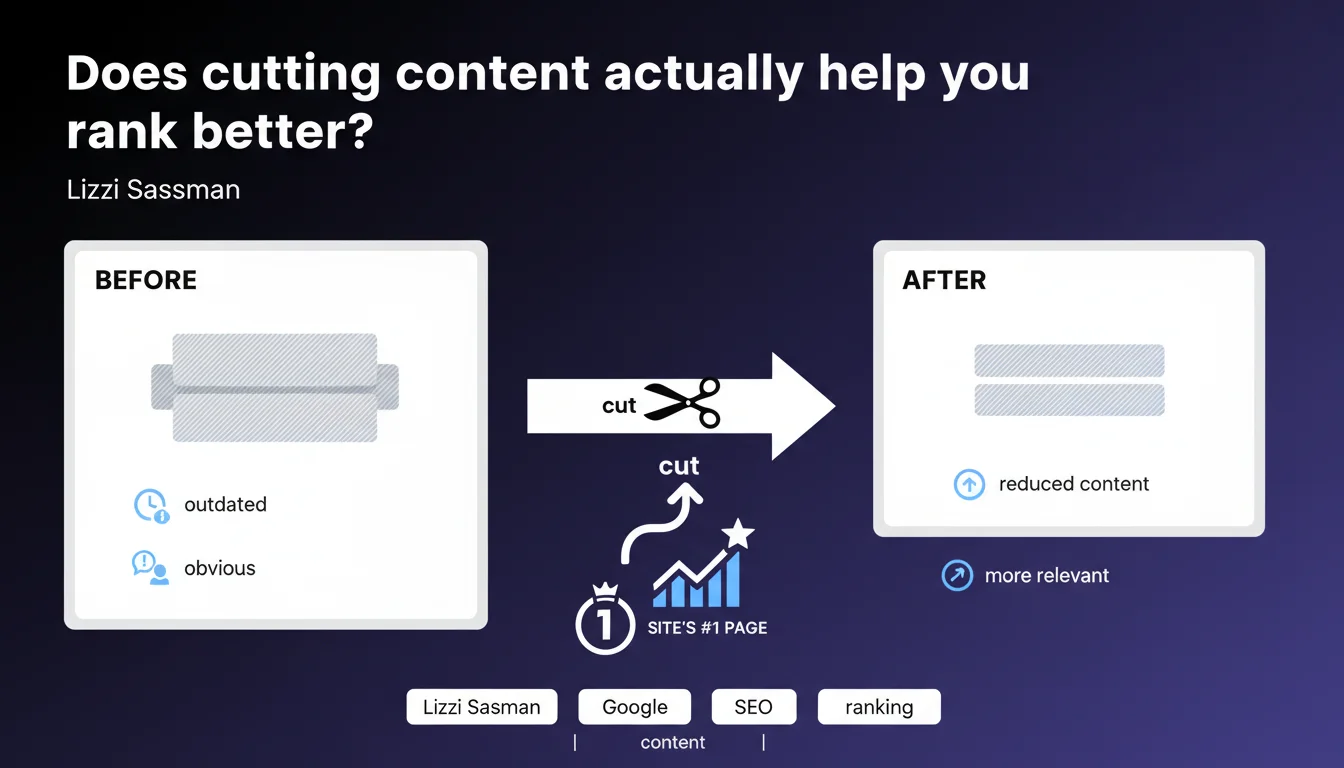
Google cut its SEO Starter Guide by 53%, removing outdated or obvious content. The result? The page became the #1 page on the entire site, surpassing even the homepage. Relevance beats volume.
What you need to understand
What exactly did Google do with its SEO Starter Guide?
Google removed 53% of the content from its official guide. The team eliminated outdated sections, advice that had become obvious, and filler that no longer added value.
It was a risky move — internally, some feared a ranking drop from cutting so much volume. But the opposite happened: the page climbed to the #1 position on the site.
Why did this reduction improve performance?
Relevance trumped length. By focusing the content on what actually delivers value, Google sent a clear signal to its own algorithm.
Less noise, more signal. The engine better understood the page's topical authority, and users found the information faster.
What does this mean for other websites?
It's real-world validation of what Google has been saying for years: quality content isn't a matter of word count. A shorter but better-targeted piece can outperform a diluted essay.
Bottom line? If your content is stalling, the problem might not be that it lacks words — it's that it has too many of the wrong ones.
- Content reduction can improve rankings when it eliminates the obsolete and superfluous
- Relevance beats text volume in Google's algorithms
- Even Google applies to its own pages the principles it preaches
- Shorter, focused content can become a site's #1 page
SEO Expert opinion
Is this claim consistent with real-world practices?
Yes, and it's actually one of the few documented cases where Google applies its own advice in a verifiable way. Too often, official statements remain vague — here, we have concrete before/after proof.
Field reports confirm it: multiple SEO audits show that cutting the fat improves performance. But the topic remains sensitive — many sites still have the "more words = better" reflex.
What nuances should we add to this conclusion?
Caution: reducing doesn't mean impoverishing. Google removed outdated or obvious content, not useful information. If you strip sections that still answer real questions, you're shooting yourself in the foot.
Another point — [To verify]: we don't know if this ranking boost comes solely from the reduction. The SEO Starter Guide benefits from domain authority and a link profile that 99.9% of sites don't have. Replicating this strategy on an average site guarantees nothing.
In what cases does this rule not apply?
For queries with high informational intent, depth matters. A 5,000-word technical guide can legitimately crush a 1,000-word version — if each section adds value.
The problem is filler: 300-word intros that go in circles, "history" sections nobody cares about, disguised repetitions. That's what you need to cut — not expertise.
Practical impact and recommendations
What should you do concretely?
Start with a content audit: identify pages that are stalling or declining despite their volume. Check if they contain outdated sections, repetitions, or obvious filler.
For each section, ask yourself: does this part actually deliver value to the user, or did I write it just to bulk up the word count? Be honest.
What mistakes should you avoid when cutting content?
Don't cut blindly. If you remove paragraphs that answer real questions or cover query variations, you risk losing long-tail traffic.
Another trap: failing to update internal links. If you delete a section, verify that other pages aren't linking to an anchor that no longer exists.
How do you measure the impact of these cuts?
Segment your modified pages in Google Search Console and track clicks and impressions over 2-3 months. If you see a rise, relevance played a role. If it stalls or drops, you may have cut too much.
Test first on low-traffic pages — less risk if things go wrong. Once you validate the method, roll it out to strategic pages.
- Audit pages that are stalling despite high text volume
- Identify and remove content that is outdated, obvious, or repetitive
- Keep all sections that answer real questions
- Check and adjust internal links after changes
- Segment modified pages in Search Console to track impact
- Test first on low-traffic pages before scaling
❓ Frequently Asked Questions
Réduire le contenu de 50% va-t-il automatiquement améliorer mon classement ?
Quel volume de texte faut-il viser pour une page ?
Comment savoir si mon contenu contient du remplissage ?
Dois-je réduire toutes mes pages longues ?
Cette stratégie fonctionne-t-elle sur des sites à faible autorité ?
🎥 From the same video 5
Other SEO insights extracted from this same Google Search Central video · published on 23/05/2024
🎥 Watch the full video on YouTube →
💬 Comments (0)
Be the first to comment.