
Official statement
Other statements from this video 5 ▾
- □ Faut-il réduire le contenu pour mieux ranker ?
- □ La longueur du contenu influence-t-elle vraiment le classement Google ?
- □ Faut-il vraiment allonger vos pages pour satisfaire la Helpful Content Update ?
- □ L'engagement communautaire améliore-t-il réellement le référencement naturel ?
- □ Faut-il vraiment adapter le niveau de détail au profil de l'utilisateur ?
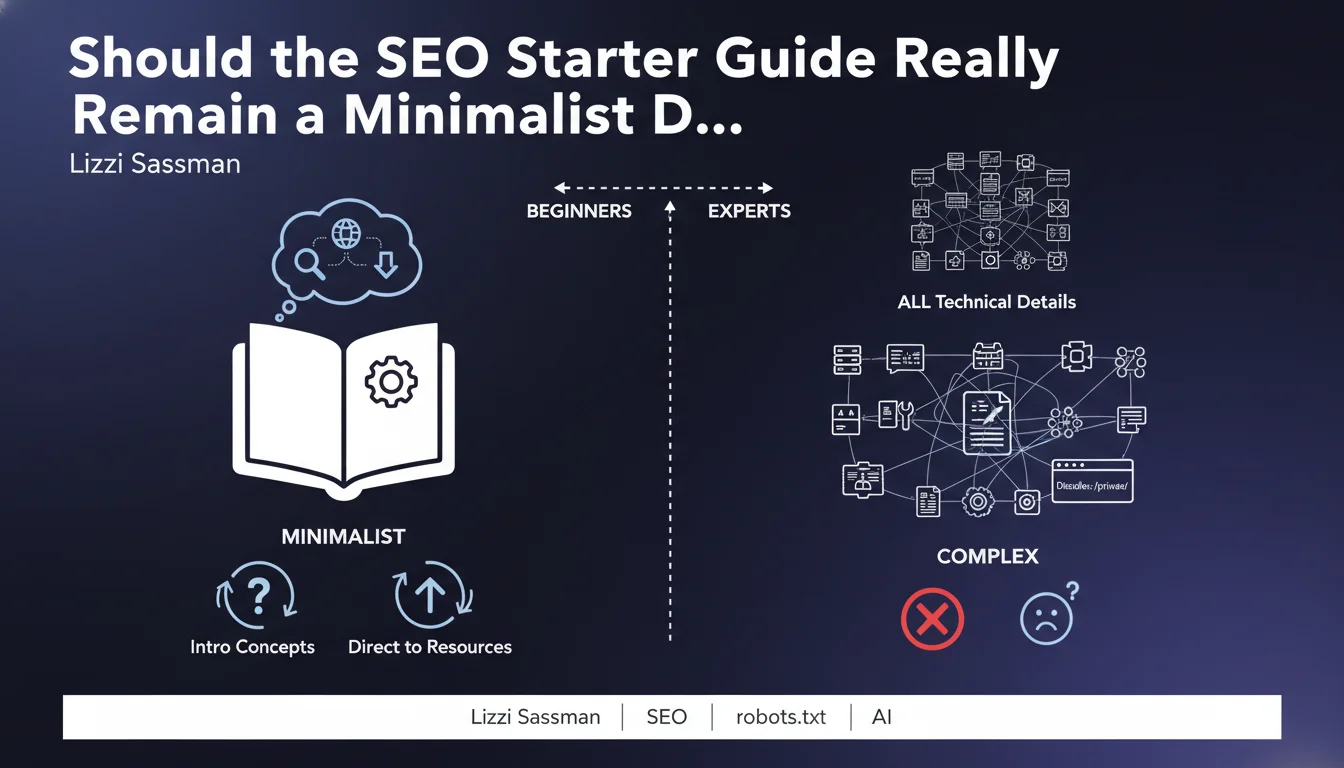
Google confirms that the SEO Starter Guide intentionally targets a beginner audience with high-level concepts, not an exhaustive technical reference. The objective: introduce the fundamentals and redirect toward in-depth resources. SEO practitioners must look elsewhere for operational details.
What you need to understand
Why Does Google Maintain Such a Basic Document?
The deliberate positioning of the SEO Starter Guide is clear: it's an entry point, not a reference manual. Google favors a simple pedagogical approach for newcomers rather than a comprehensive technical catalog.
In practice? The guide will never detail all robots.txt rules or crawl budget subtleties. It presents fundamental concepts (indexing, content, meta tags) and directs toward official documentation for advanced aspects.
Who Is the Real Target Audience of This Document?
Google aims at site owners, junior developers, and marketers discovering SEO. Not seasoned professionals who already manipulate Search Console and analyze server logs daily.
Lizzi Sassman's statement confirms that Google has no intention of making the Starter Guide a competitor to resources like comprehensive Search Central documentation or advanced technical specifications.
Should You Continue Referencing This Guide as a Professional?
Yes, but for a specific use: sharing with clients or non-SEO colleagues who need to understand the basics. For your own knowledge updates, this document has offered nothing new for years.
- The SEO Starter Guide remains intentionally introductory and generalist
- It does not replace Google's official technical documentation
- Its role: simplify concepts and guide toward in-depth resources
- Google acknowledges not covering all details (e.g., complete robots.txt syntax)
- Target audience: beginners, not experienced SEO professionals
SEO Expert opinion
Is This Minimalist Content Strategy Consistent with the Complexity of Modern SEO?
Let's be honest: there's a glaring disconnect between the simplicity of the Starter Guide and real-world reality. Google manages hundreds of ranking factors, opaque machine learning algorithms, complex JavaScript indexing rules — and offers a document that barely touches these subjects.
The question isn't whether the guide should be technical, but whether Google should offer an intermediate level between this document and dispersed Search Central documentation. Currently, the gap between the two is stark.
What Does This Statement Reveal About Google's Approach to SEO Education?
Google outsources advanced training. The implicit message: "We give you the basics, figure out the rest with the documentation, blogs, conferences." [To verify] but it appears Google prefers letting the SEO ecosystem (agencies, trainers, communities) fill this void.
This is a defensible position — Google isn't meant to train experts — but frustrating when critical information remains unclear or contradictory across different official sources.
In What Cases Does This Positioning Create Problems?
The risk: that beginners imagine that applying the Starter Guide is sufficient to be competitive. The reality? These basics are the bare minimum — insufficient against competitors exploiting advanced techniques (sophisticated schema markup, crawl optimization, advanced semantic analysis).
Another frustrating point: when Google oversimplifies in the Starter Guide, some practitioners wrongly conclude that unmentioned aspects are negligible. The guide sometimes creates blind spots in SEO understanding.
Practical impact and recommendations
What Should You Do Concretely With This Information?
First thing: stop waiting for revolutionary updates to the Starter Guide. It will remain introductory by design. To build expertise, prioritize Search Central documentation, Search Off the Record videos, case studies, and hands-on testing.
Second action: use the Starter Guide as a pedagogical tool when you need to train a client or non-SEO colleague. It's an excellent starting point to explain without drowning in technical details.
What Mistakes Should You Avoid After This Clarification?
Don't confuse "introductory document" with "complete recommendations." If your SEO strategy is limited to Starter Guide advice, you're significantly behind the competition.
Another trap: believing that because a topic isn't detailed in the Starter Guide, it's secondary. The absence of information on crawl budget, advanced robots.txt rules, or JavaScript rendering doesn't mean these topics are negligible — just that they're outside the beginner scope.
How Should You Structure Your SEO Monitoring Accordingly?
Adopt a hierarchy of sources: the Starter Guide for fundamentals shared with non-experts, Search Central documentation for technical specs, blogs and conferences for advanced use cases, and especially your own testing to validate.
- Consult the SEO Starter Guide only to explain basics to beginners
- Rely on complete Search Central documentation for technical decisions
- Cross-reference official information with real-world experience feedback
- Systematically test generic recommendations before large-scale implementation
- Maintain active monitoring of specialized sources (SEO blogs, conferences, case studies)
- Never consider a single document as absolute reference
❓ Frequently Asked Questions
Le SEO Starter Guide est-il encore pertinent pour des professionnels SEO ?
Google prévoit-il de publier un guide SEO avancé ?
Pourquoi le Starter Guide ne couvre-t-il pas tous les détails techniques ?
Un site optimisé uniquement selon le Starter Guide peut-il bien se positionner ?
Faut-il suivre les mises à jour du SEO Starter Guide ?
🎥 From the same video 5
Other SEO insights extracted from this same Google Search Central video · published on 23/05/2024
🎥 Watch the full video on YouTube →
💬 Comments (0)
Be the first to comment.