
Official statement
Other statements from this video 5 ▾
- □ Faut-il réduire le contenu pour mieux ranker ?
- □ La longueur du contenu influence-t-elle vraiment le classement Google ?
- □ Le SEO Starter Guide doit-il rester un document minimaliste pour débutants ?
- □ L'engagement communautaire améliore-t-il réellement le référencement naturel ?
- □ Faut-il vraiment adapter le niveau de détail au profil de l'utilisateur ?
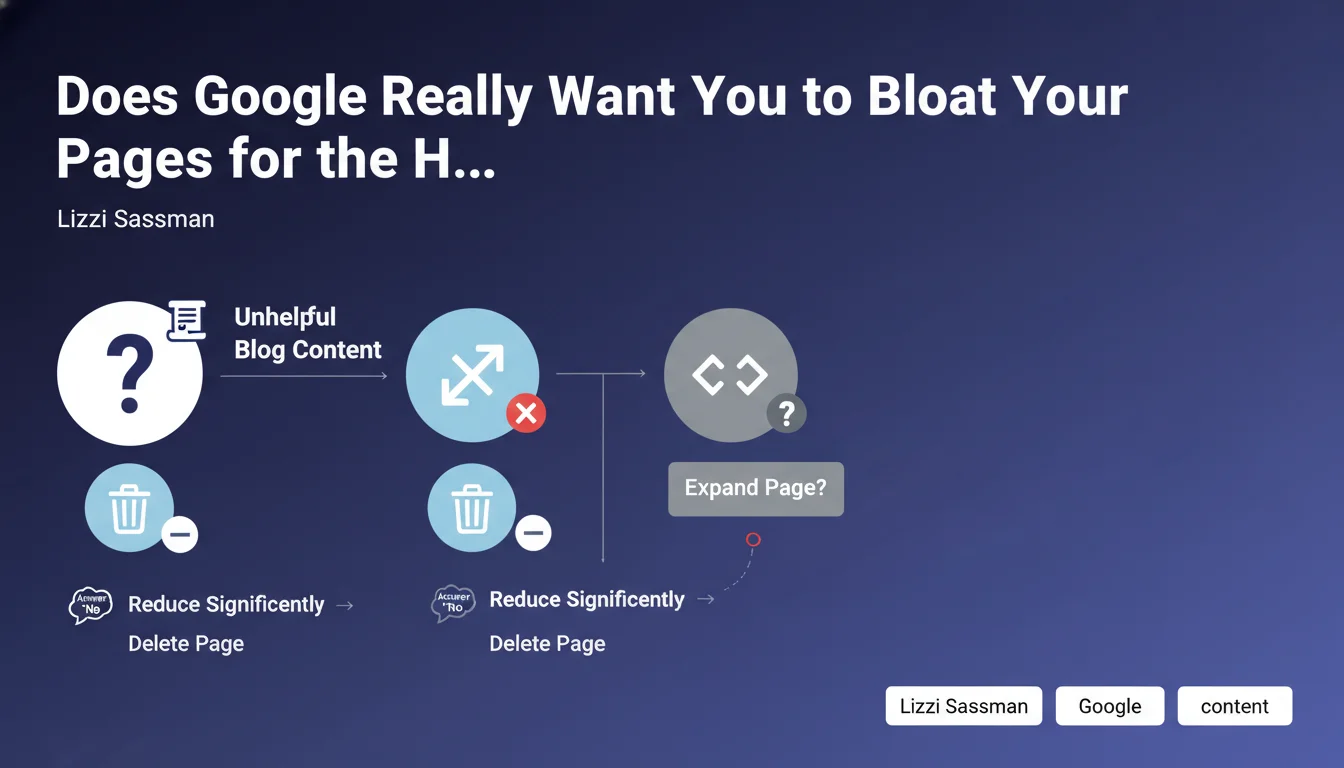
Google states that systematically expanding weak content solves nothing. It's better to drastically reduce a page that says nothing rather than dilute a short answer across 5000 words of filler. The HCU penalizes artificially inflated content, not genuinely short but relevant content.
What you need to understand
Why Does This Position Change the Game?
For years, the SEO reflex was simple: more words = better ranking. Thousands of articles bloated with endless introductions, repetitions, and unnecessary sections saturated the SERPs.
With the Helpful Content Update, Google breaks this logic. The platform states explicitly that expanding weak content improves nothing — in fact, it worsens the signal of uselessness sent to the algorithm.
What Does Google Mean by "Reduce Significantly"?
The example given is telling: a question whose answer is "no" followed by 5000 words of fluff. What Google is attacking is semantic padding — those artificial developments that dance around the topic without ever adding real value.
Reducing significantly means cutting everything that adds nothing for the user. If the real answer fits in 200 words, why write 2000? The excess only serves to dilute the relevant signal.
In Which Cases Does This Logic Apply?
Lizzi Sassman specifically targets unhelpful blog content. We're talking about weak informational articles, pages created to capture traffic without truly answering the search intent.
The statement doesn't apply to all formats. A comprehensive guide, a detailed tutorial, an exhaustive product comparison — everything requiring depth retains its legitimacy. What should disappear is cosmetic padding.
- The HCU penalizes artificially inflated content, not naturally long and useful content
- Reducing drastically means removing everything that adds no value to the answer
- This directive primarily targets weak informational blog articles, not all content types
- Google now values relevant conciseness over word count
- The decision to delete versus reduce should be made case by case, based on the content's residual value
SEO Expert opinion
Does This Statement Truly Reflect Algorithm Behavior?
Yes and no. In principle, field observation confirms that pages stuffed with useless words have plummeted after successive HCU updates. Entire sites of generic content lost 60-80% of their traffic.
But — and this is a big but — length remains a factor correlated with ranking on many competitive queries. Positions 1-3 still often show 1500-2500 words, even when the answer could fit in 300. Why? Because these longer contents actually deliver value through complementary angles, examples, and nuances.
[To verify]: Google provides no precise threshold to distinguish "long useful content" from "pointless padding." The algorithm is supposed to detect it automatically, but the exact criteria remain opaque.
What Are the Risks of Cutting Too Aggressively?
Reducing an article from 3000 to 400 words can tank your ranking if you remove sections that captured query variants. Well-structured long content often ranks for 10-20 secondary keywords thanks to its semantic coverage.
The real danger is confusing "reduce" with "impoverish." If your 2000-word page contains 500 words of real value and 1500 of filler, keep the 500 — but verify they cover all facets of user intent.
What If the Real Solution Is to Delete It Entirely?
Lizzi Sassman raises the dilemma of "delete or reduce." Let's be honest: if content has no residual value, delete it. A zombie page with no traffic and no clear intent pollutes your site in Google's eyes.
Crawl budget isn't a myth on large sites. Every useless indexed page is a useful page Googlebot could crawl instead. Fewer pages, better optimized, often outperforms 500 mediocre articles.
Practical impact and recommendations
How Do You Identify Content to Reduce Versus Delete?
Start with data. Extract via Search Console or your analytics tool every article with under 50 organic visits over 6 months. Cross-reference with average time on page: below 30 seconds, you have a problem.
For each page, ask yourself: "If I had to answer this query in 200 words, what would I say?" If the answer fits in one paragraph and the rest circles around the topic, reduce it. If you have nothing to say even in 200 words, delete it.
What Mistakes Should You Avoid When Reducing?
Don't blindly cut lengthy sections. Some detailed passages add depth and capture valuable long-tail queries. First check Search Console to see which keywords still generate impressions.
Another trap: reducing content while breaking its HTML structure. If you remove sections, verify that your heading hierarchy remains sound and your schema markup (FAQ, HowTo, etc.) stays coherent.
And above all, don't reduce content without improving what remains. If you go from 2000 to 500 words, those 500 words must be flawless: direct answer, concrete examples, clear structure, keywords well-placed.
What's the Concrete Method to Apply?
- Audit your content via Search Console: isolate pages with low traffic + low visit duration
- Sort them into 3 categories: delete, reduce drastically, rework in depth
- For pages to reduce, first identify the 2-3 paragraphs that truly add value
- Cut everything that's generic intro, repetitions, off-topic developments
- Restructure remaining content with clear subheadings and immediate answer in the first paragraph
- Ensure main keywords remain present in the first 100 words
- Redirect deleted pages with 301 to the thematically closest content
- Monitor rankings and traffic for 4-6 weeks post-modification
❓ Frequently Asked Questions
Est-ce que réduire un article peut faire baisser son positionnement ?
Comment savoir si mon contenu est considéré comme du padding par Google ?
Faut-il rediriger les pages supprimées ou les laisser en 404 ?
Combien de temps après réduction peut-on observer un impact sur les positions ?
Cette logique s'applique-t-elle aussi aux pages produits e-commerce ?
🎥 From the same video 5
Other SEO insights extracted from this same Google Search Central video · published on 23/05/2024
🎥 Watch the full video on YouTube →
💬 Comments (0)
Be the first to comment.