
Official statement
Other statements from this video 5 ▾
- □ Does cutting content actually help you rank better?
- □ Should the SEO Starter Guide Really Remain a Minimalist Document for Beginners?
- □ Does Google Really Want You to Bloat Your Pages for the Helpful Content Update?
- □ Does community engagement really boost your search rankings?
- □ Should you really tailor content depth to match your user's profile?
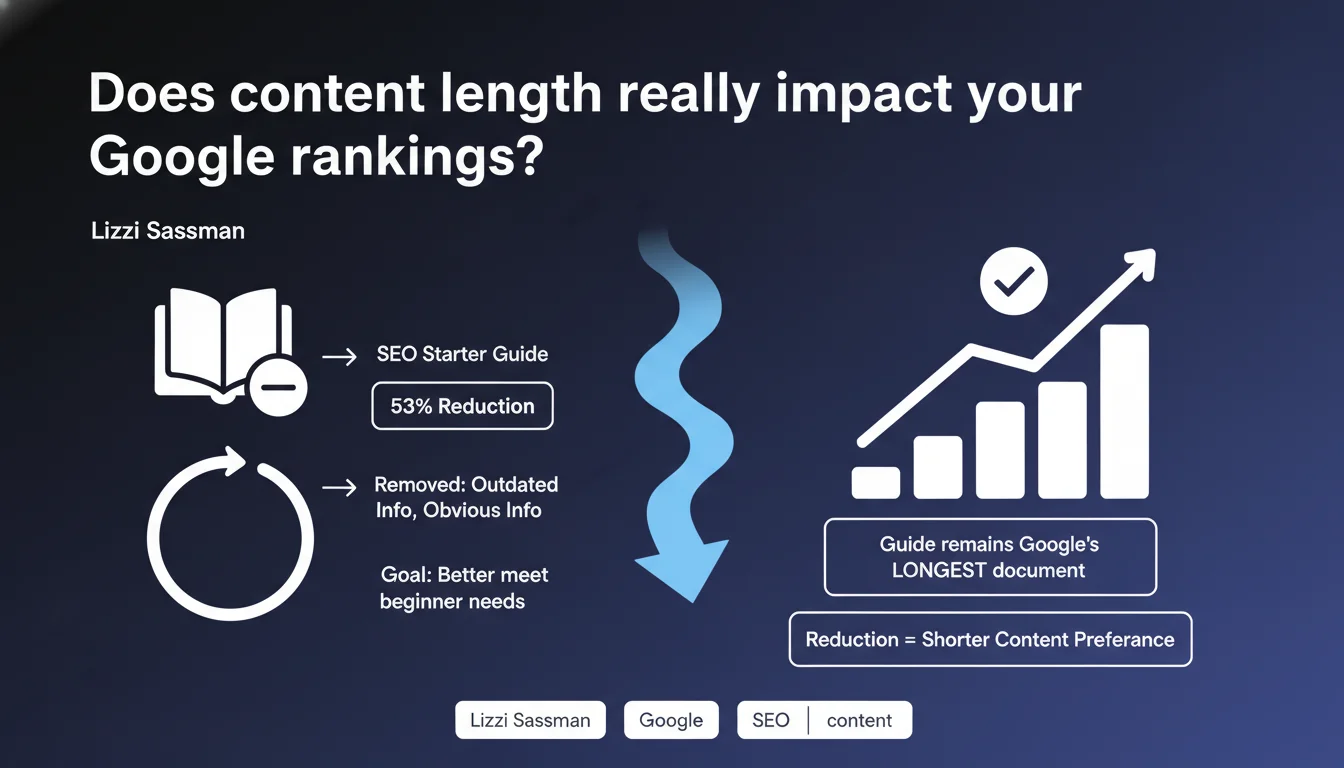
Google states it has no preference between short and long content. The overhaul of the SEO Starter Guide, reduced by 53%, aimed to remove outdated and superfluous information to better serve beginners — not to promote brevity. The message: focus on delivering value, not on word count.
What you need to understand
Why did Google cut its SEO Starter Guide in half?
Google's official guide went from its original version to a version trimmed by 53%. Some interpreted this as a signal: Google would now prioritize short, direct, stripped-down content. Lizzi Sassman quickly countered this interpretation.
The goal of this overhaul was to remove obsolete passages and obvious points that cluttered the document. Google aimed to better serve the needs of beginner users — not to establish a new doctrine on content length. The guide remains, in fact, the longest document Google offers on SEO.
What is Google's official position on content length?
Google favors neither short nor long content. The statement is clear: no algorithmic preference exists for this criterion. What matters is relevance, depth of treatment, and satisfaction of search intent.
A 500-word article can outrank a 3,000-word piece if the first one better answers the query. Conversely, some complex topics require in-depth development that 800 words simply cannot cover properly. Word count is merely a consequence of how thoroughly a topic is treated, not a goal in itself.
Does this statement change anything for SEO practitioners?
Not really. Experienced professionals have long known that length is not a direct ranking factor. But this official confirmation allows us to clarify lingering misconceptions that persist among some clients or editorial teams.
The real risk lies elsewhere: interpreting this statement as a green light to rush editorial work under the pretense that "Google accepts short content." That would be a mistake. Google is not saying that short = good. It's saying that short is not inherently bad if it meets the need.
- Google has no algorithmic preference for a specific content length
- The SEO Starter Guide reduction aimed to eliminate the outdated, not promote conciseness
- The guide remains the longest document Google offers on SEO despite the 53% cut
- Length is a natural consequence of thoroughly treating a subject
- What matters: relevance, depth, and satisfaction of search intent
SEO Expert opinion
Is this statement consistent with what we observe in the field?
Yes and no. In principle, it's consistent: testing shows that brief but dense content can indeed outrank long, diluted content. Search results for certain informational queries regularly display articles of 600-800 words on the first page that get straight to the point.
But let's be honest — in many competitive verticals, long content statistically dominates. Not because Google algorithmically favors it, but because it better addresses complex intentions and accumulates more relevance signals (semantic depth, entity coverage, user satisfaction). Correlation, not causation.
Where does this rule really break down?
In E-E-A-T-critical contexts — health, finance, law — length often becomes an unintentional proxy for expertise. A 400-word piece on a complex medical topic will almost always lack the depth needed to demonstrate the necessary authority.
Same goes for transactional content. A product page can be brief. But a buying guide that addresses the topic in just 500 words will struggle to compete against comprehensive resources of 2,000 words covering all dimensions of the purchase decision. [To verify] whether Google explicitly measures "completeness" of content, but user behavior clearly penalizes superficial treatment.
What nuance should we add to this statement?
Google is telling the truth: length is not a ranking factor. But watch out for the intellectual shortcut. Just because Google doesn't count words doesn't mean it's indifferent to how thoroughly a topic is covered.
Google's systems evaluate search intent satisfaction, semantic coverage of the topic, and user signals (time on page, bounce rate). All of this often correlates with length — without length being the cause. Short content that fails to thoroughly treat a subject will be penalized, not for its brevity, but for its incompleteness.
Practical impact and recommendations
What should you actually do with this information?
Stop setting arbitrary word count targets. Editorial briefs that specify "1,500 words minimum" without justification tied to the topic are counterproductive. They generate filler, dilute your message, and degrade user experience.
Start with search intent. How much depth of treatment does it require? A query like "how to tie a necktie" can be satisfied in 300 words and a diagram. A query like "link building strategy for international e-commerce sites" demands substantial development. Let the subject dictate the length, not the other way around.
What mistakes should you absolutely avoid?
Don't cut useful content just because it's long. If every paragraph adds value, keep it. Google doesn't penalize length — it penalizes diluted content that wastes the reader's time.
Conversely, don't artificially stuff your short content with keywords or variations to "compensate" for brevity. Brief content that perfectly answers the intent and provides a smooth user experience will always outperform verbose, bloated content.
How do you audit your existing content on this criterion?
Review your strategic pages. For each one, ask yourself: does this content thoroughly cover the topic? Or does it contain filler, tangents, and repetition? Is the length justified by how complex the subject is?
Analyze user signals: time on page, bounce rate, scroll depth. Long content with low scroll depth suggests readers are dropping off. Short content with high bounce rate suggests it doesn't fully answer the intent. Adjust based on these real data points, not dogma about length.
- Remove arbitrary word count targets from your editorial briefs
- Analyze search intent to determine the necessary depth of treatment
- Audit your existing content to identify filler or gaps
- Track user signals (time on page, scroll depth, bounce rate) to validate the relevance of your length
- Don't cut useful content just to shorten it
- Don't artificially bloat short content to compensate
- Prioritize information density over word volume
❓ Frequently Asked Questions
Google favorise-t-il les contenus courts ou longs ?
Pourquoi certains contenus longs se classent-ils mieux ?
Faut-il supprimer du contenu pour raccourcir mes pages ?
Comment déterminer la longueur idéale d'un contenu ?
Les briefs avec quota de mots sont-ils contre-productifs ?
🎥 From the same video 5
Other SEO insights extracted from this same Google Search Central video · published on 23/05/2024
🎥 Watch the full video on YouTube →
💬 Comments (0)
Be the first to comment.