
Official statement
Other statements from this video 5 ▾
- □ Does cutting content actually help you rank better?
- □ Does content length really impact your Google rankings?
- □ Should the SEO Starter Guide Really Remain a Minimalist Document for Beginners?
- □ Does Google Really Want You to Bloat Your Pages for the Helpful Content Update?
- □ Should you really tailor content depth to match your user's profile?
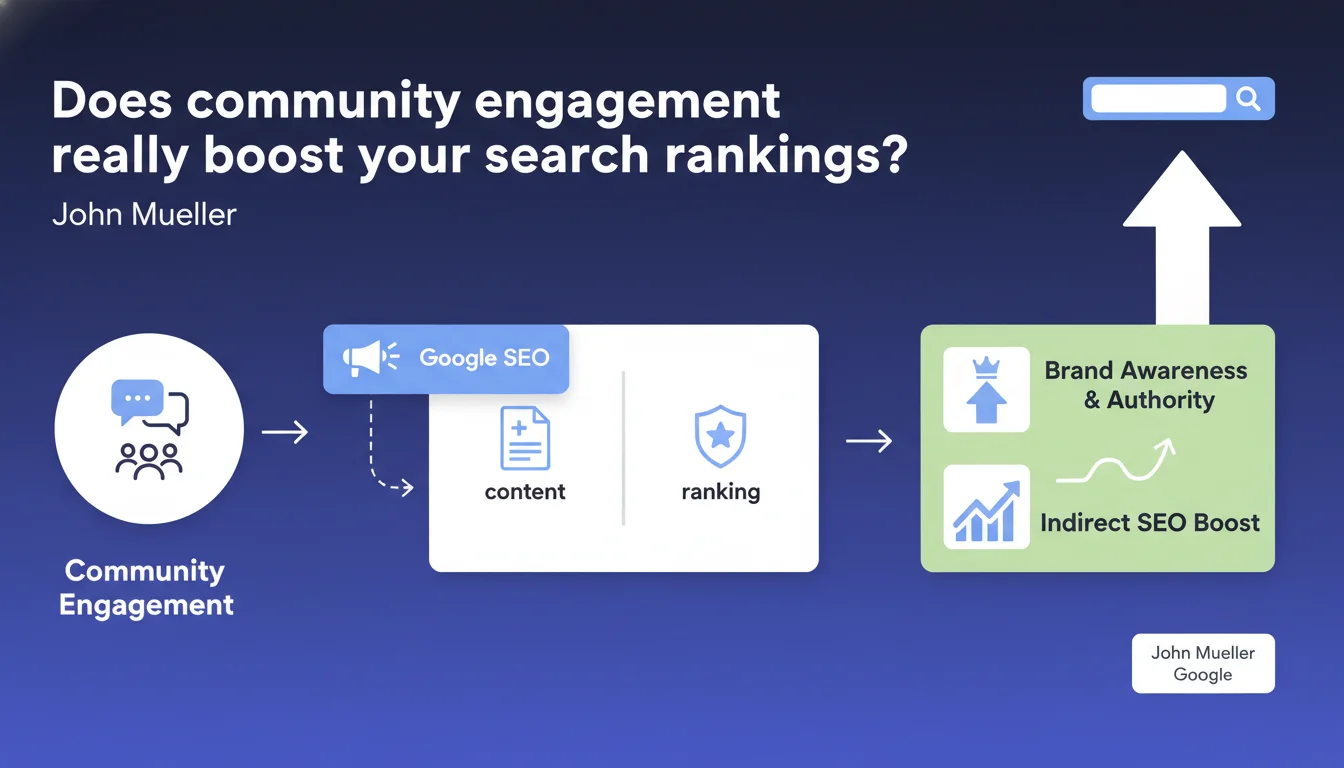
Google states that participating in communities and building your brand indirectly helps SEO by strengthening visibility and authority. The official SEO Starter Guide explicitly mentions these practices as beneficial. The key question remains: how does this indirect relationship translate into concrete search results improvements?
What you need to understand
Google officially recognizes in its SEO Starter Guide that community engagement plays a role in search rankings. This statement marks a turning point in Mountain View's communications: rather than staying focused on purely technical aspects, the search engine admits that indirect signals related to your brand influence rankings.
The wording remains deliberately vague — "helps indirectly" — but inclusion in an official document is far from trivial.
What exactly does "community engagement" mean according to Google?
Google is talking about active participation in spaces where your audience gathers: forums, social networks, professional communities, events. The idea is to create repeated touchpoints with your target audience, beyond just content published on your own site.
In practice? Answering questions on Reddit, sharing your expertise on LinkedIn, participating in specialized Facebook groups, organizing or sponsoring meetups. Any action that strengthens your visibility and credibility outside your domain.
How does this engagement translate into SEO benefits?
The mechanics remain unclear in the official statement. Google mentions strengthening authority and brand awareness, two concepts it never defines precisely. We can deduce several impact channels:
- Unlinked brand mentions: algorithms detect citations of your brand even without a direct backlink
- Brand searches: a growing volume of queries containing your name sends a demand signal
- Behavioral signals: users who already know you have higher click-through rates and session duration
- Organic backlinks: an engaged community naturally generates links to your content
- User-generated content: discussions, reviews, recommendations create an ecosystem of content around your brand
Why is Google emphasizing this aspect now?
Two plausible reasons. First avenue: Google wants to distinguish real brands from sites fabricated solely to capture SEO traffic. A brand that engages a community demonstrates legitimacy that content farms cannot easily replicate.
Second avenue: the explosion of AI-generated content forces Google to seek alternative quality signals. A brand with an active community proves there are real humans behind it, not just a script churning out articles.
SEO Expert opinion
Is this recommendation consistent with what we observe in the field?
Yes and no. Established brands with strong community presence do dominate competitive SERPs — but is this the cause or the consequence? A large company that excels in SEO has the resources to nurture communities. A startup doesn't necessarily have that luxury.
The most solid observation: sites that generate a significant volume of brand searches benefit from a measurable advantage. Google has confirmed multiple times that brand searches are a quality signal. The rest — unlinked mentions, social engagement — remains [To verify] due to lack of exploitable public data.
What nuances should we add to this statement?
Let's be honest: Google isn't saying that posting on Twitter will boost your position for "best CRM 2024". The correlation between social engagement and SEO rankings is indirect and time-delayed. You won't see immediate impact after hosting a webinar.
The real pitfall? Confusing community engagement with link spam. Participating in forums by dropping your URL in every signature, commenting on blogs with optimized anchor text, creating social profiles just for the backlink — all of that is noise Google has filtered for years.
In what cases does this strategy not work?
For purely transactional sites in niches with low engagement potential, the impact remains marginal. If you're selling industrial plumbing fittings, there's no "passionate community" to nurture. The ROI of community management will be near zero.
Another limitation: YMYL sectors where Google demands ultra-verifiable authority signals. An active forum of enthusiasts will never replace academic publications, professional certifications, or official accreditations. Engagement matters, but not as much as proven expertise.
Practical impact and recommendations
What do you need to implement concretely?
First step: identify where your audience congregates. No point creating a Discord if your target audience spends time on LinkedIn. Do some research — Reddit, Quora, Facebook groups, private Slack communities, specialized forums — and spot the active spaces in your sector.
Then participate with a contribution mindset, not a promotional one. Answer questions, share insights, publish original analysis. The goal is for your name to become a reference in these spaces. Backlinks and mentions will come naturally if you provide value.
On the content side, aim for consistency over volume. Better to publish one expert article per month that generates discussions than a daily stream nobody reads. Prioritize formats that encourage interaction: case studies, debates, surveys, contrasting analyses.
What mistakes should you absolutely avoid?
- Don't buy fake followers or artificial engagement — Google detects these patterns and may penalize
- Avoid link spam in forum signatures, blog comments, or social profiles created only for backlinks
- Don't neglect brand consistency: if your LinkedIn profile talks digital strategy and your site sells socks, the signal is inconsistent
- Don't expect immediate SEO results — impact takes 6-12 months minimum to measure
- Don't confuse social virality with SEO — a post with 10K likes guarantees nothing in terms of rankings
How do you measure the impact of these efforts?
Track your brand search volume via Google Search Console — this is the most direct signal. If this volume increases steadily, your community work is paying off. Also monitor unlinked mentions using tools like Mention, Brand24, or Google Alerts.
Analyze behavioral signals: click-through rate, time on site, bounce rate. Users who already know you have different behavior, and Google captures it. Compare performance on brand queries versus generic keywords to identify gaps.
In summary: community engagement is a long-term SEO strategy that strengthens perceived authority through indirect signals. Effective for brands capable of nurturing an audience, less relevant for purely transactional sites. Results are measured in quarters, not weeks.
Implementing a coherent engagement strategy while maintaining balance with technical optimization and content creation can quickly become complex. If you want to structure a global approach without scattering your resources, guidance from a specialized agency often accelerates results and helps you avoid costly mistakes.
❓ Frequently Asked Questions
L'engagement sur les réseaux sociaux a-t-il un impact direct sur le classement Google ?
Faut-il être présent sur toutes les plateformes communautaires ?
Combien de temps avant de voir un impact SEO de l'engagement communautaire ?
Les mentions de marque sans lien comptent-elles vraiment pour Google ?
Cette stratégie fonctionne-t-elle pour les sites e-commerce ?
🎥 From the same video 5
Other SEO insights extracted from this same Google Search Central video · published on 23/05/2024
🎥 Watch the full video on YouTube →
💬 Comments (0)
Be the first to comment.