
Official statement
Other statements from this video 9 ▾
- □ Does Google really have what it takes to index all JavaScript content?
- □ Is Google’s Web Rendering Service really keeping up with all the latest Chrome features?
- □ Is Google struggling to properly index sites that use Web Workers?
- □ Why is it essential for SEOs and developers to collaborate?
- □ Are core updates really neutral, or do they hide disguised penalties?
- □ Core Update: Does Google Really Refuse to Provide Specific Details?
- □ Are Google’s core updates really designed to enhance user experience or to reshuffle rankings?
- □ Why does Google refuse to reveal what core updates really involve?
- □ Do Google’s core updates really affect all websites?
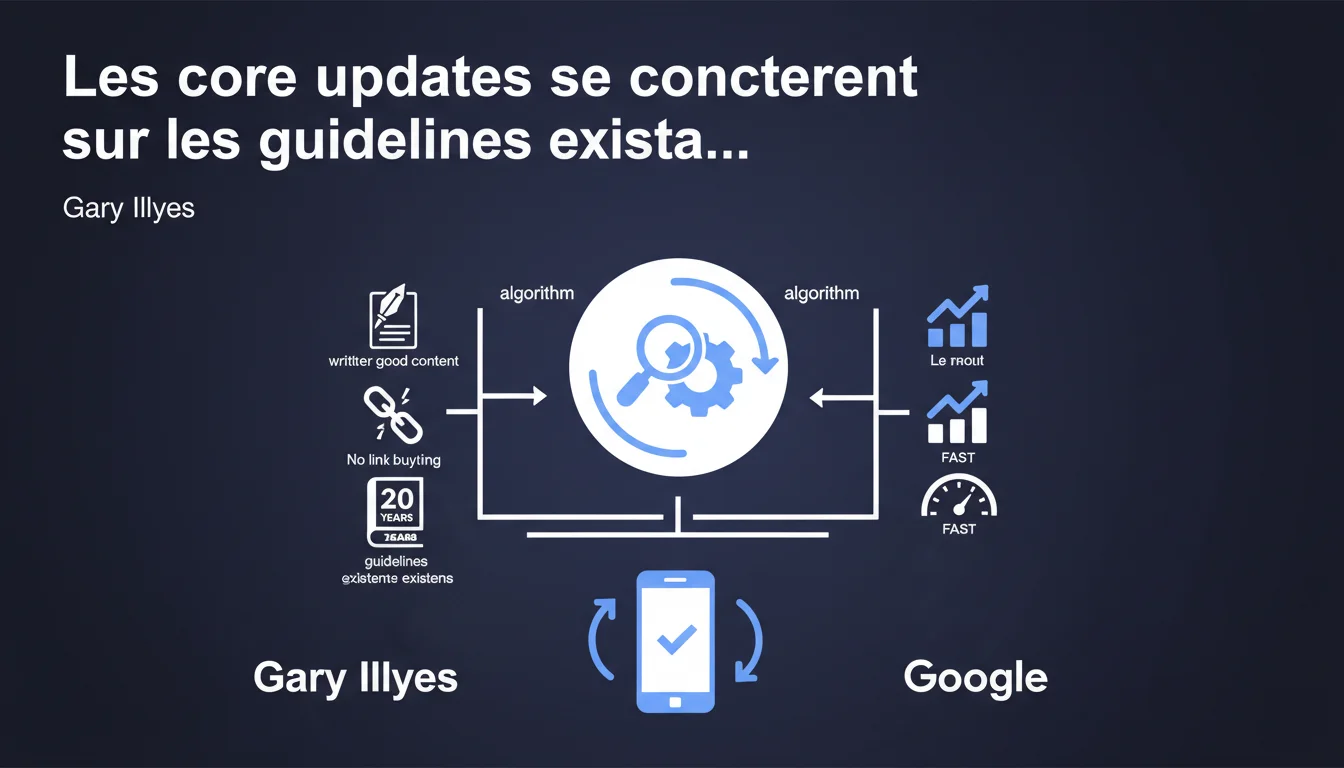
Gary Illyes claims that core updates optimize relevance and quality algorithms by relying on Google's historical guidelines: good content, no link buying. There's no active penalty, just an adjustment in evaluation criteria. The issue? This official version remains vague about the actual mechanics.
What you need to understand
What does 'optimizing relevance algorithms' really mean?
Google presents core updates as gradual adjustments to its quality evaluation systems. Specifically, the algorithm sharpens its ability to identify relevant content and filter out what involves manipulation or fluff.
This phrasing avoids the concept of punishment. According to Illyes, if your site loses traffic after an update, it’s not a penalty — other content is simply better evaluated. A subtle yet crucial nuance for understanding Google’s logic.
Why emphasize guidelines that are 20 years old?
For two decades, Google has hammered home the same principles: create useful content, avoid artificial links, prioritize user experience. Core updates do not change these rules; they strengthen their detection.
The underlying message? If your site takes a hit during an update, it’s likely because you have ignored these fundamentals. Google shifts the responsibility back to publishers rather than explaining the modified technical criteria.
Are the guidelines enough to anticipate a core update?
Not really. The public guidelines remain intentionally generic: 'good content', 'satisfactory user experience'. They never detail the thresholds, weightings, or specific signals used by the algorithms.
You can follow the official recommendations and still experience a drop in visibility — simply because the quality bar has shifted or a competitor has optimized the same criteria better.
- Core updates do not penalize — they reevaluate the relative relevance of content
- Historical guidelines remain the basis: solid content, natural links, user experience
- No new official criteria are announced during these major updates
- The fog persists around the exact quality evaluation mechanics
SEO Expert opinion
Is this statement consistent with real-world observations?
Yes and no. Sites that experience a hit during a core update often exhibit structural weaknesses: light content, dubious backlinks, poorly thought-out satellite pages. In this sense, Illyes' statement holds.
But there are also cases where sites that comply with the guidelines fall without clear explanation, while others with questionable practices remain standing. [To verify]: the idea that following the guidelines is enough to shield against fluctuations. Field data suggest that the 'quality' measured by Google doesn't always align with objective editorial quality.
Why does Google refuse to detail the modified criteria?
The official response? To avoid having SEOs optimize for the algorithm rather than for the user. In practice, this ambiguity also allows Google to modify its criteria without exposing itself to precise challenges.
This isn't a conspiracy — it's a defensive strategy. If Google announced 'we've increased the weight of content freshness', all sites would artificially update their pages. Silence protects the algorithm from targeted manipulation.
What nuances should be added to this discourse?
First point: saying that updates 'optimize relevance' without ever penalizing is playing with words. If your site loses 40% of its organic traffic, it doesn’t matter whether Google calls it a reevaluation rather than a sanction — the effect is the same.
Second nuance: the guidelines don't cover everything. Nothing on behavioral signals, few details on semantic evaluation, zero transparency on E-E-A-T quality thresholds. [To verify]: the assertion that following the published guidelines is enough to maintain your position.
Practical impact and recommendations
What should you do concretely after a core update?
Unlike corrective actions post-penalty (removing toxic links, deleting duplicate content), responding to a core update requires a comprehensive quality audit. Analyze your content page by page: does it provide real added value or just paraphrase what 50 other sites are already saying?
Look at your engagement metrics: session time, bounce rate, pages per visit. If Google is fine-tuning its relevance algorithms, it's likely relying on these behavioral signals to validate quality.
Enhance your editorial expertise: add identifiable authors, verifiable sources, original data. E-E-A-T remains vague in the guidelines, but it’s a documented improvement area emphasized by Google itself.
What mistakes should you avoid in your immediate reaction?
Don’t panic and massively delete content or urgently overhaul your site. Overreactions often cause more damage than the initial drop. Wait 2-3 weeks to see if the fluctuation stabilizes.
Avoid focusing solely on links. If the core update targets content relevance, cleaning up your backlink profile won’t change anything — unless you truly have massive artificial links harming your authority.
How can you verify that your site meets the mentioned criteria?
Start with a content audit: identify low-value pages, those that don’t meet a clear search intent, those that copy competitors without original contribution.
Examine your link profile: even though Illyes states that the update doesn’t penalize, a site stuffed with bought links remains vulnerable. Use tools like Ahrefs or Majestic to detect suspicious patterns.
Test the actual user experience: mobile navigation, loading speed, clarity of the interface. Google will never explicitly say so, but these factors likely influence the overall quality assessment.
- Audit content page by page to identify editorial weaknesses
- Analyze engagement metrics (session time, bounce rate, visit depth)
- Enhance E-E-A-T signals: identifiable authors, cited sources, demonstrated expertise
- Check your backlink profile without falling into mass cleaning paranoia
- Improve technical user experience: speed, navigation, mobile readability
- Avoid drastic reactions: no mass deletions or hasty overhauls
❓ Frequently Asked Questions
Une core update peut-elle pénaliser mon site même si je respecte les guidelines ?
Combien de temps faut-il pour récupérer après une core update ?
Dois-je supprimer massivement du contenu après une baisse de trafic ?
Les liens achetés peuvent-ils provoquer une baisse lors d'une core update ?
Google annonce-t-il toutes les core updates à l'avance ?
🎥 From the same video 9
Other SEO insights extracted from this same Google Search Central video · published on 11/01/2022
🎥 Watch the full video on YouTube →
💬 Comments (0)
Be the first to comment.