
Official statement
Other statements from this video 9 ▾
- □ JavaScript et indexation : Google est-il vraiment capable de tout indexer ?
- □ Le Web Rendering Service de Google suit-il vraiment toutes les dernières fonctionnalités de Chrome ?
- □ Pourquoi Google peine-t-il à indexer correctement les sites qui utilisent des Web Workers ?
- □ Pourquoi les SEO et développeurs doivent-ils absolument travailler ensemble ?
- □ Les core updates de Google sont-elles vraiment des rappels à l'ordre sur les guidelines ?
- □ Les core updates sont-elles vraiment neutres ou cachent-elles des pénalités déguisées ?
- □ Les core updates de Google sont-elles vraiment conçues pour améliorer l'expérience utilisateur ou pour redistribuer les positions ?
- □ Pourquoi Google refuse-t-il de révéler ce que contiennent vraiment les core updates ?
- □ Les core updates de Google affectent-ils vraiment tous les sites ?
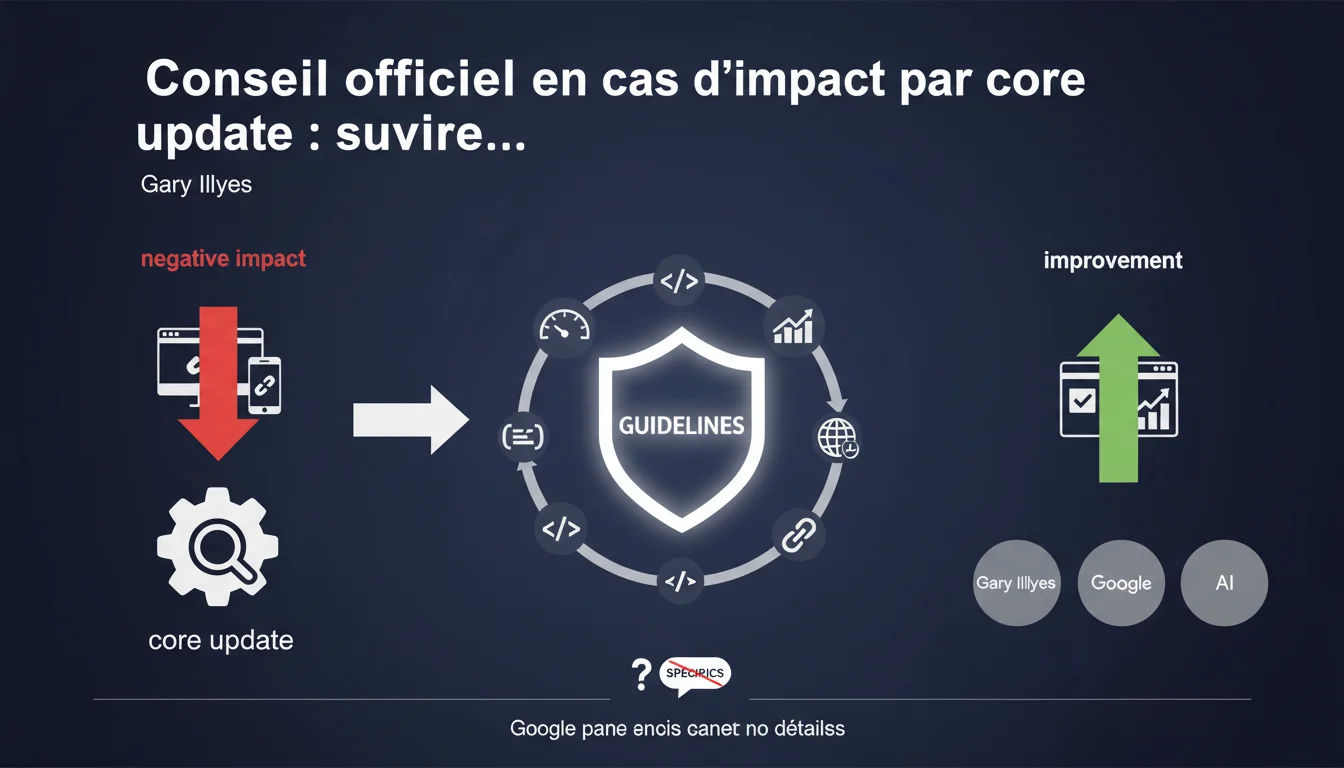
Google recommends following the Webmaster Guidelines in case of core update impact, period. No specific details will be communicated about the affected criteria. The official position remains deliberately vague.
What you need to understand
What Does This Official Advice Really Mean?
Gary Illyes confirms what Google has been repeating for years: in the face of a core update, the only official recommendation is to adhere to the Webmaster Guidelines. No specific signals, no isolated criteria, no concrete leads.
This position reflects a deliberate desire to maintain opacity over the internal mechanisms of the algorithm. Google believes that detailing the affected factors would open the door to manipulation attempts.
Why Does This Lack of Transparency Create Problems?
The Guidelines are a general framework, not a troubleshooting manual. They cover hundreds of potential criteria, from content quality to technical structure, and user experience.
When a site loses 40% of its traffic overnight, “follow the Guidelines” is like saying “look for a needle in a haystack”. The SEO practitioner finds themselves without a concrete starting point for their audit.
Does This Statement Hide Actionable Elements?
Between the lines, Google admits that a core update is not targeted. It is neither a manual penalty nor an isolated technical issue. The algorithm reassesses the overall quality of content based on hundreds of signals.
Let's be honest — this statement brings strictly no new information. It merely reiterates Google's historical position in response to legitimate webmaster questions.
- Google categorically refuses to detail the criteria affected by each core update
- The Guidelines remain the only official reference, despite their general nature
- No roadmap or recovery methodology is offered
- This opacity forces SEOs to rely on empirical observations
SEO Expert opinion
Is This Statement Consistent with Observed Practices?
On paper, yes. In reality, the core updates show recurring patterns that Google never officially acknowledges. YMYL, E-E-A-T, freshness, depth — signals consistently emerge from post-update analyses. [To be verified]: Google claims no specific signal is prioritized, but field data suggests otherwise.
The Guidelines are outdated and lack granularity in the face of recent algorithmic evolutions. They do not explicitly mention certain decisive criteria observed in recent major updates.
Why Does Google Maintain This Ambiguous Position?
Two possible explanations. First hypothesis: to prevent malicious actors from optimizing solely for the revealed criteria at the expense of actual quality. Second hypothesis — and this is where it gets tricky — Google may not fully control the side effects of its own algorithms.
The machine learning systems involved in core updates can weigh hundreds of signals in a non-linear manner. It's therefore difficult to summarize “what has changed” in three digestible bullet points.
When Does This Rule Not Apply?
This generic recommendation does not hold when a site undergoes a sudden and targeted collapse. If a specific category crashes or a type of query disappears entirely from the SERPs, the Guidelines alone will never suffice to diagnose the problem.
And this is precisely where the official approach shows its limitations. A seasoned practitioner knows they need to cross-reference Analytics data, server logs, query type positioning, and semantic analysis to isolate the affected signal — a process that Google never publicly validates or denies.
Practical impact and recommendations
What Should You Do After a Core Update?
First step: segment the impact. Which pages have dropped? Which queries? What types of content? The Guidelines provide no methodology, but granular analysis of losses remains the only reliable starting point.
Second step: audit the E-E-A-T signals on the affected pages. Demonstrated expertise, identified authors, cited sources, freshness of information. These criteria consistently appear in post-update analyses, even if Google refuses to name them explicitly.
What Mistakes Should You Absolutely Avoid?
Do not panic and make massive changes to the site without a validated hypothesis. Blind changes often exacerbate the situation. Waiting a few days helps distinguish a temporary fluctuation from a true algorithmic impact.
Also, avoid focusing on a single criterion (e.g., “all articles need to be lengthened”). Core updates assess overall quality. A site can lose traffic with long yet shallow content and regain it with short but dense and relevant formats.
How Can I Verify That My Site Meets Expectations?
Conduct a competitive benchmark on the pages that are improving. What do they have in common that your site does not? Depth of treatment, internal linking, authority signals, UX… Comparative analysis often reveals gaps that are invisible in an isolated audit.
Then measure the actual engagement metrics: reading time, scroll depth, bounce rate by page type. If your content does not hold attention, no technical optimization will compensate for this deficit in perceived value.
- Precisely segment the pages and queries impacted by the core update
- Audit the E-E-A-T signals: expertise, authority, transparency of sources
- Compare with competing content that has improved
- Analyze user engagement metrics (time spent, scroll, bounce)
- Avoid massive changes without a hypothesis validated by data
- Prioritize perceived quality over isolated technical criteria
❓ Frequently Asked Questions
Les Webmaster Guidelines suffisent-elles vraiment pour récupérer d'une core update ?
Combien de temps faut-il attendre avant de voir une récupération après modifications ?
Google communique-t-il parfois des détails spécifiques sur certaines updates ?
Peut-on anticiper une core update pour limiter les impacts négatifs ?
Faut-il contacter Google si mon site est injustement impacté ?
🎥 From the same video 9
Other SEO insights extracted from this same Google Search Central video · published on 11/01/2022
🎥 Watch the full video on YouTube →
💬 Comments (0)
Be the first to comment.