
Official statement
Other statements from this video 9 ▾
- □ Does Google really have what it takes to index all JavaScript content?
- □ Is Google’s Web Rendering Service really keeping up with all the latest Chrome features?
- □ Why is it essential for SEOs and developers to collaborate?
- □ Are Google's core updates really just reminders about the guidelines?
- □ Are core updates really neutral, or do they hide disguised penalties?
- □ Core Update: Does Google Really Refuse to Provide Specific Details?
- □ Are Google’s core updates really designed to enhance user experience or to reshuffle rankings?
- □ Why does Google refuse to reveal what core updates really involve?
- □ Do Google’s core updates really affect all websites?
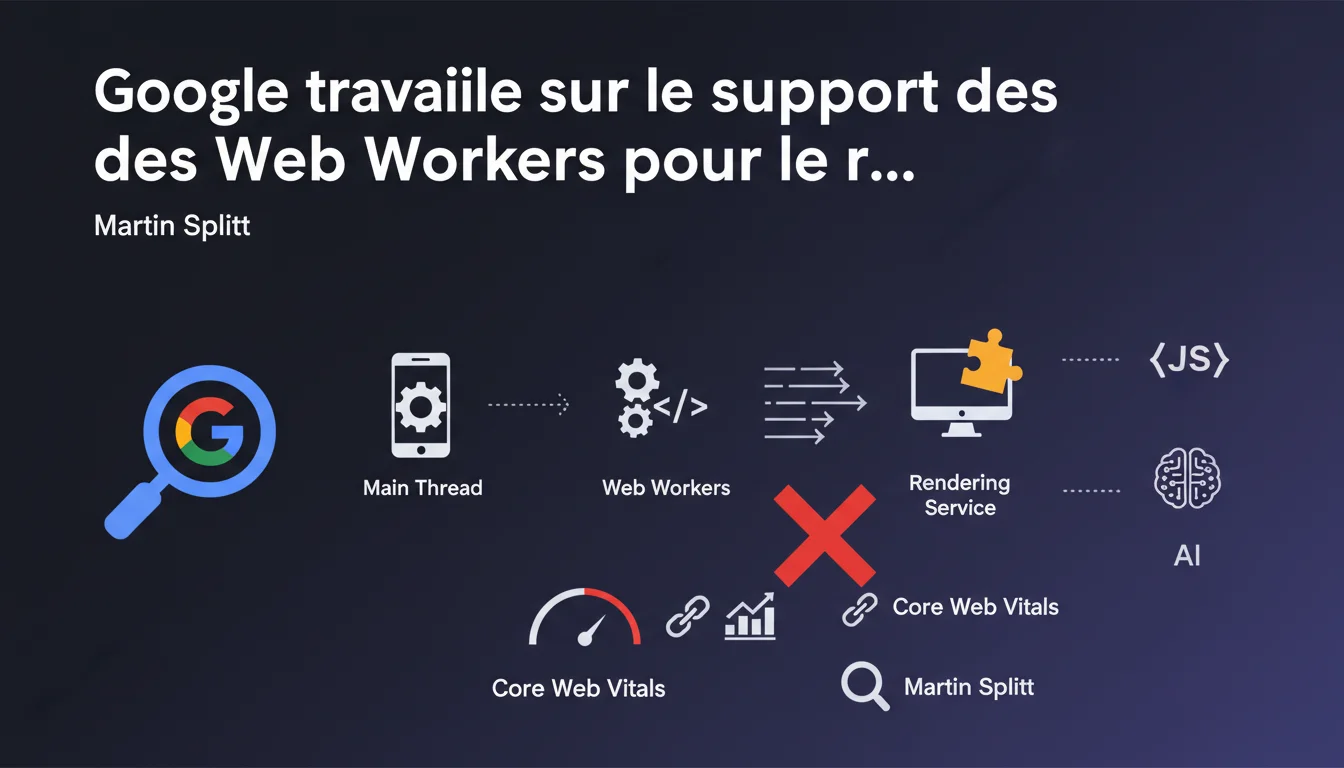
Google's rendering service does not yet properly handle Web Workers, this JavaScript technique that shifts work off the main thread. As more sites adopt this approach to improve their Core Web Vitals, Googlebot may misinterpret or miss some content. This technical lag can impact indexing.
What you need to understand
What is a Web Worker and why is this technique becoming mainstream?
A Web Worker allows the execution of JavaScript in a separate thread, freeing up the main thread of the page. In practical terms, the browser can display the interface and respond to user interactions while heavy calculations run in the background.
With the advent of Core Web Vitals, this technique has gained popularity. It particularly improves Total Blocking Time and First Input Delay by preventing the main thread from being blocked by resource-intensive scripts. The result: higher Lighthouse scores and more satisfied users.
What is the problem with Google's rendering?
Google's rendering service — which executes JavaScript to understand what actually displays on a page — does not yet handle this work separation between the main thread and Web Workers very well.
In plain terms: if your site uses Web Workers to load content, inject data, or modify the DOM, Googlebot may not see this content or might interpret it partially. The bot expects the main thread to finish its job, but if part of this work happens elsewhere, in a Worker, it may miss it.
What are the concrete implications for indexing?
If your critical content — products, articles, structured data — relies on Web Workers to display, you risk incomplete indexing. Google could see a stripped-down version of your page.
This does not mean that all sites using Workers are penalized. But if you notice discrepancies between what you see in your browser and what the URL Inspection Tool in Search Console shows, this rendering limitation could be the cause.
- Web Workers enhance Core Web Vitals by offloading the main thread
- Google's rendering does not yet follow this modern architecture
- Risk of partial indexing if content relies on Workers to display
- Google has announced it is working on this support, but with no specific timeline
SEO Expert opinion
Does this statement indicate a technical delay for Google?
Let's be honest: yes. Web Workers have been around for years, and their use has intensified with modern frameworks and the obsession with Core Web Vitals. Google's public acknowledgment of this lack of support speaks volumes.
The issue lies in the gap between Google's performance recommendations — optimize your JavaScript, improve your metrics — and the ability of its own crawler to understand the techniques being used to achieve these goals. We are being pushed towards modern architectures, but the bot remains behind.
How significantly does this problem currently impact sites?
[To be verified] The actual extent of this problem remains unclear. Google does not provide any metrics on the number of sites affected, nor any concrete examples of content poorly indexed due to Workers.
From field experience, most sites that use Workers do so for peripheral tasks — analytics, personalization, delayed asset loading — rather than for main content. But with the rise of frameworks like Angular or React that can delegate rendering to Workers, the risk is growing.
When will this improved support be deployed?
Google says it is "working on it." No timeline, no commitments. [To be verified] We do not know whether this is a priority project or a long-term effort that will take months or even years.
What is certain is that this statement serves as an official recognition of the problem. It can be a useful argument if you notice indexing issues related to this architecture — at least, you know it’s not a conspiracy theory.
Practical impact and recommendations
How can you check if your site is impacted?
First step: identify if you are using Web Workers. Open Chrome's DevTools, go to the Sources tab, and see if any .worker.js files appear or if any Workers are listed under the Application > Service Workers / Web Workers tab.
Then, compare two renderings: that of your browser in incognito mode (to avoid extensions) and that from the URL Inspection Tool in Search Console. Examine the rendered HTML and the screenshot. If content is missing on Google's side, you’ve found your culprit.
What strategies should you adopt while awaiting full support?
If you notice a problem, you have several options. The safest: disable Web Workers for critical content. Yes, it may degrade your Core Web Vitals, but it’s better to be indexed with a mediocre Lighthouse score than not indexed at all.
Another approach: hybrid rendering. Display essential content via the main thread, and reserve Workers for progressive enhancements — loading secondary modules, background calculations, post-load personalization. The basic content remains visible to Googlebot.
Finally, consider Server-Side Rendering (SSR) or Static Generation for strategic pages. If the base HTML is already complete on the server side, it doesn’t matter what your Workers do afterwards — Google sees the essentials right from the first load.
What should you do if the optimizations become too complex?
Finding the right balance between user performance and Google indexing is not straightforward. You must juggle with technical constraints — Workers, SSR, hydration, Core Web Vitals — and continuously monitor how the bot renders.
If your team lacks time or expertise in these areas, hiring a specialized SEO agency can speed up diagnosis and implementation of tailored solutions. An external perspective often identifies levers you hadn’t considered, saving you months of trial and error.
- Check for the presence of Web Workers in your tech stack
- Compare browser rendering with Search Console rendering (URL Inspection Tool)
- Audit critical content: is it visible without Workers?
- Test hybrid rendering or SSR for strategic pages
- Regularly monitor indexing discrepancies via crawl logs
- Document architectural choices to anticipate Google’s future evolution
❓ Frequently Asked Questions
Les Web Workers empêchent-ils complètement l'indexation de mon contenu ?
Dois-je abandonner les Web Workers pour améliorer mon SEO ?
Google a-t-il donné une date pour le support complet des Web Workers ?
Les Service Workers posent-ils le même problème que les Web Workers ?
Comment surveiller si Google indexe bien mon contenu généré par Workers ?
🎥 From the same video 9
Other SEO insights extracted from this same Google Search Central video · published on 11/01/2022
🎥 Watch the full video on YouTube →
💬 Comments (0)
Be the first to comment.