
Official statement
Other statements from this video 14 ▾
- □ Do ccTLDs Really Give You a Geographic SEO Advantage?
- □ Does your domain extension really impact SEO rankings?
- □ Should you really avoid cheap domain extensions for your SEO?
- □ Why does Google treat certain ccTLDs the same way as generic domain extensions?
- □ Do .edu and .gov domains really provide an SEO advantage?
- □ Does a .coffee or .tech domain really boost your search rankings?
- □ Should you always verify a domain's history before buying it?
- □ Why can't you detect manual actions before buying an expired domain?
- □ Do keywords in your domain name really matter for SEO rankings?
- □ Do hyphens in domain names really hurt your SEO rankings?
- □ Should you prioritize branding over exact keywords in your domain name?
- □ Does your choice between www and non-www really impact your search rankings?
- □ Is it time to ditch the m. subdomain for mobile?
- □ Should you really avoid publishing a 'Coming Soon' page on a new domain?
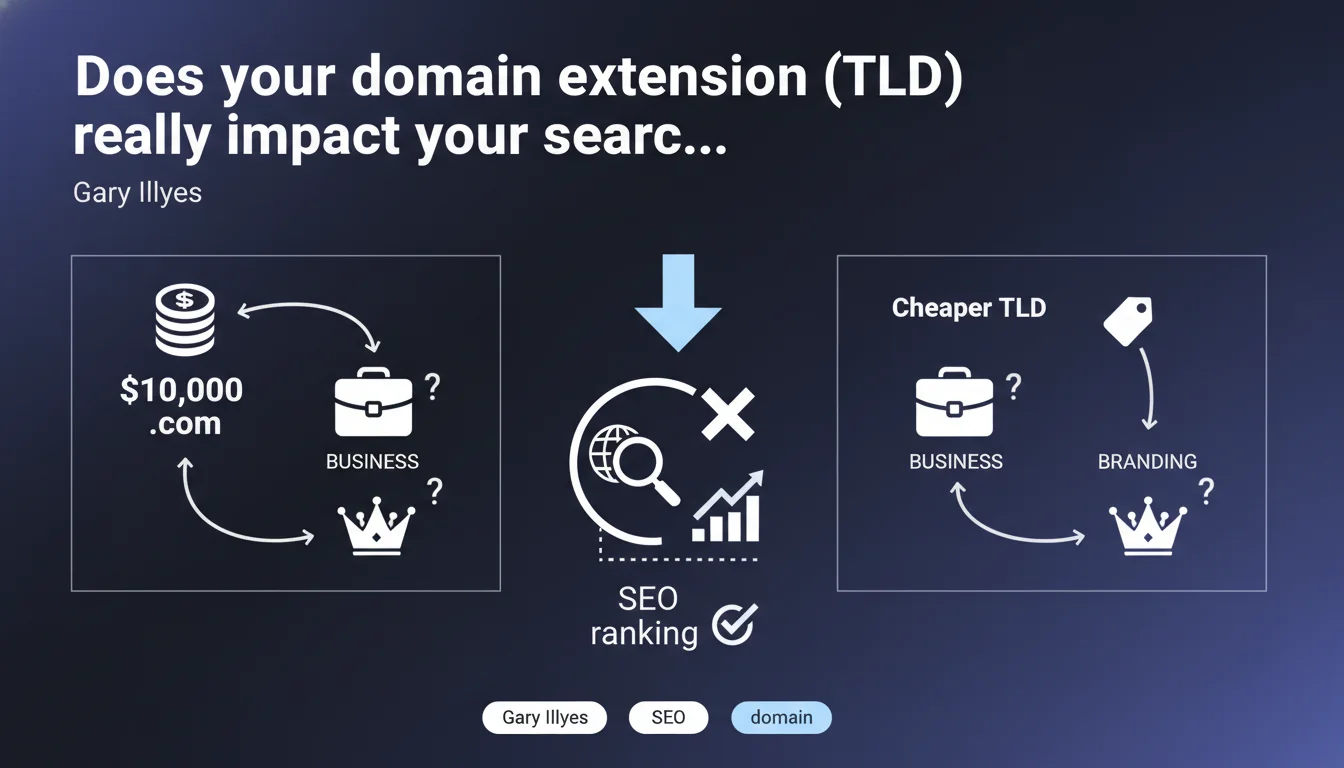
Google states that choosing a TLD (.com, .io, .tech, etc.) is primarily a branding and business strategy decision rather than an SEO one. A domain's price does not directly influence your rankings in search results. What matters to Google is content quality and site authority, not the extension you choose.
What you need to understand
Does Google differentiate between premium TLDs and standard TLDs?
Gary Illyes' statement is clear: there is no inherent SEO advantage associated with any particular TLD. Whether you invest $10,000 in a premium .com or opt for a .tech at a few euros, Google treats these domains equivalently in its algorithm.
This position reflects a philosophy Google has defended for years — the TLD is not a direct ranking signal. What differentiates two sites in the search engine's eyes is their content, technical architecture, backlinks, and thematic relevance.
Why do some TLDs appear to perform better than others?
The illusion of .com or .org performing better often comes from a correlation bias. Established sites with solid track records and authority built over years predominantly use these historical extensions.
New gTLDs (.io, .ai, .app) statistically haven't had time to accumulate the same critical mass of trust signals. It's not the TLD that penalizes; it's the lack of history and quality backlinks.
How much does branding compensate for the lack of SEO advantage?
If Google doesn't favor a TLD, users certainly have ingrained reflexes. A .com inspires more spontaneous trust than a .xyz in certain sectors — which can impact click-through rate (CTR) in the SERPs.
A higher CTR sends positive signals to Google about the perceived relevance of your page. Indirectly, the TLD choice can influence rankings through user behavior, even if it's not a direct ranking factor.
- No TLD is privileged in Google's algorithm
- A domain's price plays no role in rankings
- New gTLDs are neither penalized nor favored
- Branding and user perception remain indirect factors to consider
- The observed correlation between .com and performance comes from history, not the TLD
SEO Expert opinion
Is this statement consistent with what we observe in practice?
In practice, yes — but with important nuances. I've seen sites with .io, .co, or .tech achieve dominant positions on competitive queries, without the TLD being a hindrance. The ranking signal lies elsewhere: architecture, content, backlinks.
That said, certain geographic TLDs (ccTLDs) benefit from preferential treatment in localized searches. A .fr will naturally be favored for a query geolocalized to France, even if Google claims not to favor a TLD per se. This is a subtlety that Gary Illyes' statement doesn't explicitly address.
What limitations should we place on this assertion?
Google doesn't tell everything. Certain TLDs are historically associated with spam (.tk, .ml, .ga) and can trigger distrust filters — not officially documented, but observable. [To verify]: Google has never published a TLD blacklist, but experienced SEOs observe patterns.
Another point: a premium branded domain (example: insurance.com) benefits indirectly from a semantic relevance advantage. Google denies this is a direct factor, but a well-leveraged exact match domain (EMD) can facilitate thematic targeting.
In what cases does TLD choice become strategic despite everything?
For an international project, a multi-ccTLD strategy (.fr, .de, .es) remains valid if you want to maximize geographic relevance. A subdomain or subdirectory can work, but the ccTLD sends a stronger signal to users and Google.
For a tech startup targeting English-speaking audiences, a .io or .ai can strengthen brand positioning — and that's a business decision, exactly as Gary Illyes says. SEO will follow if you build the necessary authority.
Practical impact and recommendations
Should you switch TLDs if your site is already online?
No, unless you have a compelling business or branding reason. Migrating a domain for a hypothetical SEO gain is a false good idea — you risk losing authority signals you've accumulated, even with perfect 301 redirects.
If your site performs well with a .tech or .co, don't touch it. Focus your efforts on levers with measurable and proven impact: content quality, user experience, link strategy.
What criteria should you prioritize when choosing a new domain?
First ask yourself about branding and memorability. A short name, easy to spell, with a recognized TLD (.com, .fr, .io depending on the sector) is always a safe bet. SEO will follow if you build correctly.
Avoid exotic or free TLDs (.tk, .ml) that carry a spam stigma — even if Google claims not to penalize them, your audience might hesitate to click. And low CTR in the SERPs is an indirect negative signal.
- Prioritize clarity and memorability of the full domain name
- Don't pay an exorbitant price for a TLD if your budget is limited — invest in content
- Use a ccTLD (.fr, .de) if your target audience is geographically anchored
- Avoid TLDs historically associated with spam (.tk, .ml, .ga)
- If you're torn between two equivalent TLDs, choose the one that strengthens your brand image
- Don't migrate an existing domain for purely SEO reasons — the risks outweigh the gains
❓ Frequently Asked Questions
Un .com se positionne-t-il mieux qu'un .io dans Google ?
Les nouveaux gTLD (.tech, .app, .ai) sont-ils pénalisés par Google ?
Faut-il privilégier un ccTLD (.fr, .de) pour un site local ?
Le prix d'un domaine premium influence-t-il le référencement ?
Peut-on utiliser un TLD exotique sans risque pour le SEO ?
🎥 From the same video 14
Other SEO insights extracted from this same Google Search Central video · published on 20/07/2023
🎥 Watch the full video on YouTube →
💬 Comments (0)
Be the first to comment.