
Official statement
What you need to understand
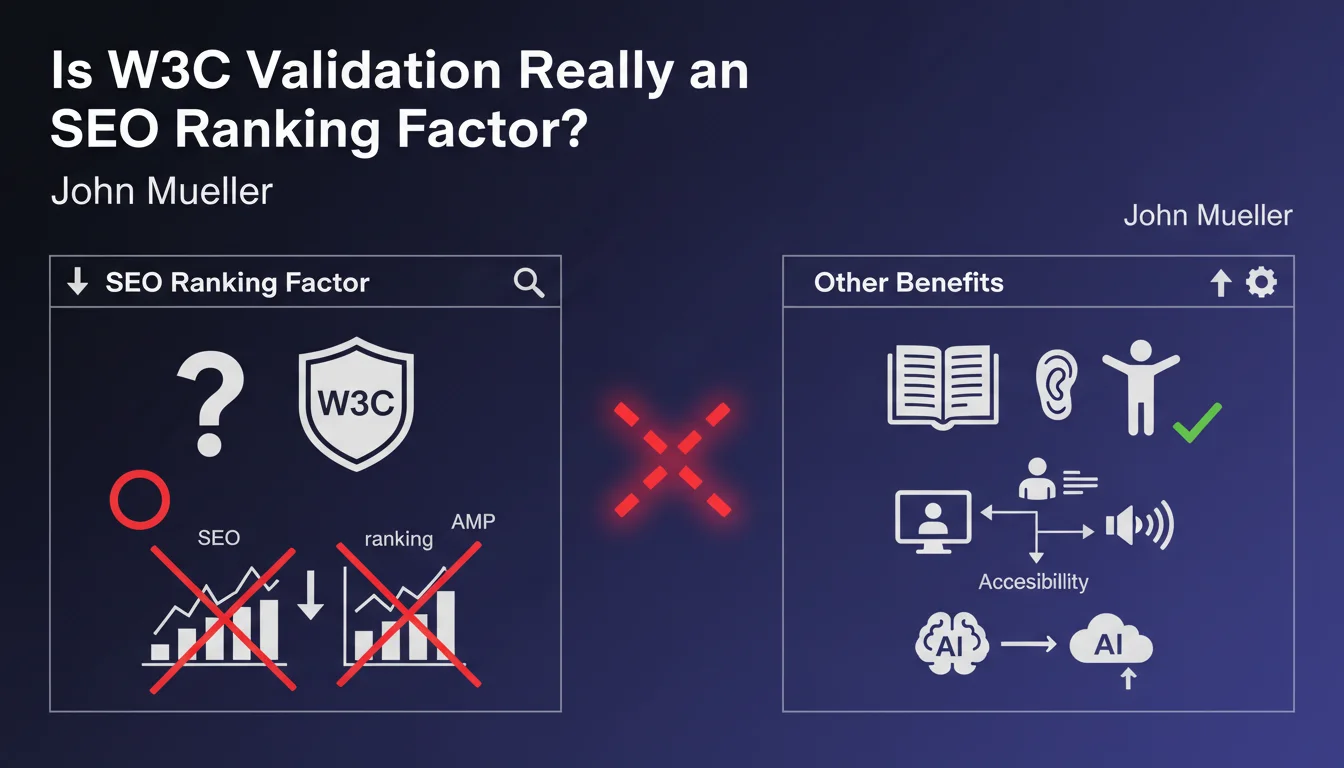
Google has clarified its position regarding W3C validation: it is not a direct ranking factor in the search algorithm. A page that perfectly complies with W3C standards will not automatically achieve better positioning.
This statement addresses a belief still widespread in the SEO community. Many believe that valid HTML code is rewarded by Google, but this is not the case in reality.
However, Google acknowledges that the W3C validator remains a useful tool for detecting certain technical errors that, in turn, can indirectly affect search rankings. These include major structural problems in the code.
- W3C validation is not a ranking criterion used by Google's algorithm
- Invalid code does not directly penalize your rankings
- The validator can reveal significant structural errors
- Accessibility and code quality remain recommended best practices
- Major errors detected can have an indirect SEO impact
SEO Expert opinion
This position from Google is consistent with what is observed in the field. Many poorly coded but relevant sites rank very well, while technically perfect sites can stagnate if their content is weak.
However, an important nuance must be made: certain code errors detected by the W3C validator can have indirect but real SEO consequences. For example, an unclosed tag can break the content display, prevent proper crawling of certain sections, or disrupt the extraction of structured data.
In practice, clean code facilitates the work of robots and improves user experience. These factors do influence search rankings, even if pure W3C validation is not measured.
Practical impact and recommendations
Following this clarification, here are the concrete actions to implement in your SEO strategy:
- Don't waste time aiming for 100% W3C validation as a priority SEO objective
- Use the W3C validator as a diagnostic tool to detect major structural errors
- Fix critical errors as a priority: unclosed tags, broken HTML structures, hierarchy problems
- Focus your efforts on user experience, page speed, and content quality
- Systematically test that your content is properly crawlable and indexable despite any minor errors
- Maintain clean code to facilitate maintenance and evolution of your site
- Prioritize accessibility which improves UX for all users, including search engines
- Verify structured data which must be valid to be exploited by Google
In summary: W3C validation is an indicator of technical quality, but not a ranking criterion. Focus on errors that actually impact crawling, indexing, and user experience.
The technical optimization of a site requires a comprehensive approach taking into account numerous interdependent parameters. Between managing HTML code, information architecture, performance, and Core Web Vitals signals, it becomes complex to prioritize the right actions. Support from a specialized SEO agency provides a complete technical audit and a personalized roadmap, ensuring that your efforts focus on optimizations with the most real impact on your visibility.
💬 Comments (0)
Be the first to comment.