
Official statement
What you need to understand
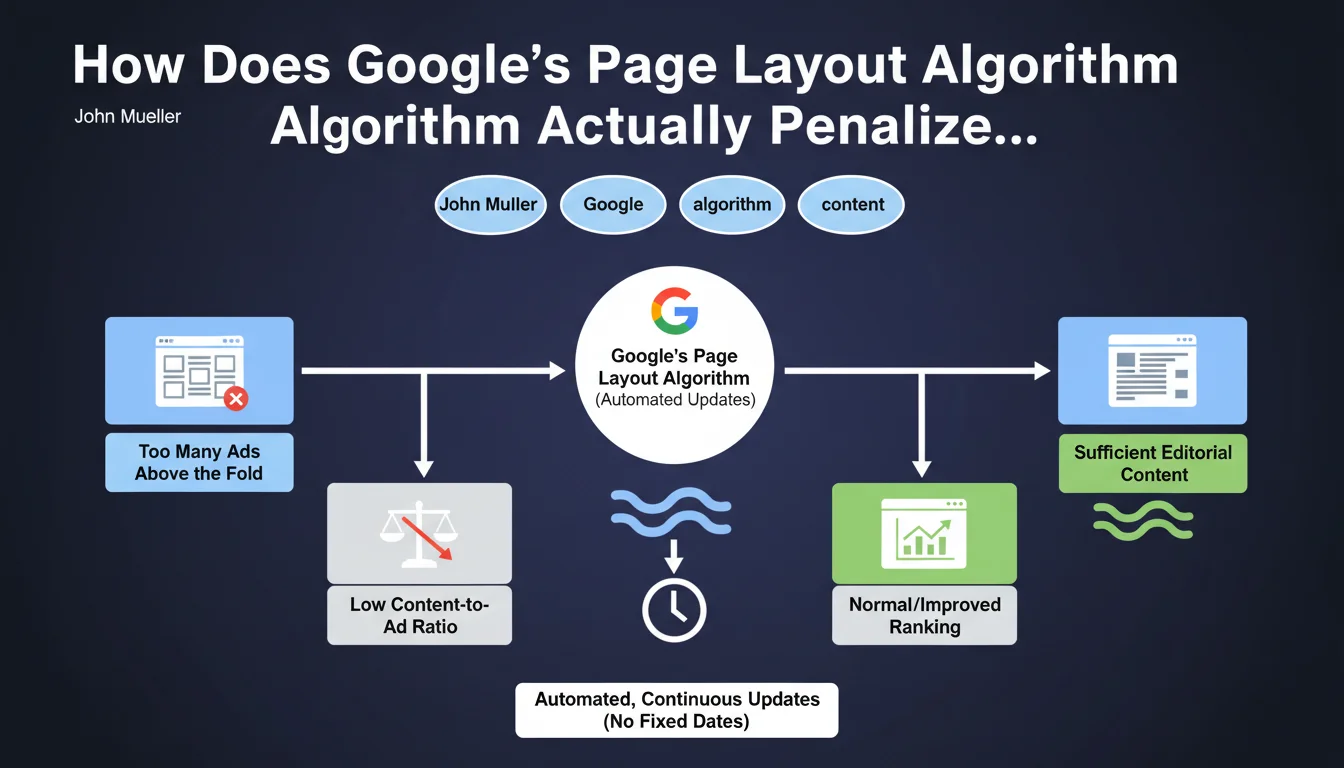
The Page Layout filter, introduced by Google in 2012, specifically targets websites that overload the visible portion of their pages with advertising. The objective is clear: to preserve user experience by ensuring immediate access to editorial content.
Contrary to popular belief, this filter does not count the number of ads present on a page. Rather, it evaluates the proportion of advertising space that occupies the "above the fold" area compared to actual editorial content.
The penalty is triggered when ads invade the screen so much that it becomes difficult for users to distinguish the main content or access it without scrolling down the page. It's a matter of balance and visual hierarchy.
- The filter measures space occupied, not the quantity of ads
- The critical area is what's immediately visible when the page loads
- The penalty targets sites where editorial content is difficult to access or identify
- The goal is to protect user experience against aggressive monetization
SEO Expert opinion
In practice, this filter seems to be applied with some flexibility. Many very well-positioned sites still display significant advertising density above the fold, suggesting that the triggering thresholds are relatively tolerant.
It's important to understand that Google seeks a delicate balance: penalizing obvious abuse without sanctioning sites that need to monetize quality content. Context matters tremendously: a news site with a few well-integrated banners won't be treated like a site where you have to search for content amid a forest of advertisements.
In reality, this filter is part of a broader logic of page experience evaluation, now measured notably through Core Web Vitals and user experience criteria. It should no longer be viewed as an isolated filter but as an element of a coherent whole.
Practical impact and recommendations
- Audit your content-to-advertising ratio in the immediately visible area of your main pages
- Test your pages on different screen resolutions to identify where the fold actually sits
- Ensure that main content is clearly visible without scrolling, even with ads present
- Favor well-integrated advertising formats rather than aggressive banners
- Create a clear visual distinction between editorial content and advertising spaces
- On mobile, be even more conservative with above-the-fold advertising
- Avoid interstitials that hide main content during initial display
- Monitor your rankings and traffic after any changes to your advertising strategy
- Analyze the advertising density of your well-positioned competitors to calibrate your own practices
Optimizing the balance between monetization and user experience is a delicate exercise that requires a nuanced approach. It's not simply about removing ads, but about rethinking the visual architecture of your pages.
Implementing an advertising strategy optimized for SEO requires in-depth analysis of multiple factors: user behavior, impact on Core Web Vitals, variations across devices, and balance with your revenue objectives. Given this complexity, support from a specialized SEO agency can prove valuable in finding the right balance between technical performance, user experience, and profitability, while avoiding pitfalls that could harm your visibility.
💬 Comments (0)
Be the first to comment.