
Official statement
What you need to understand
302 and 301 redirects are two types of HTTP redirects that tell search engines how to handle a URL change. The 301 signals a permanent move, while the 302 indicates a temporary move.
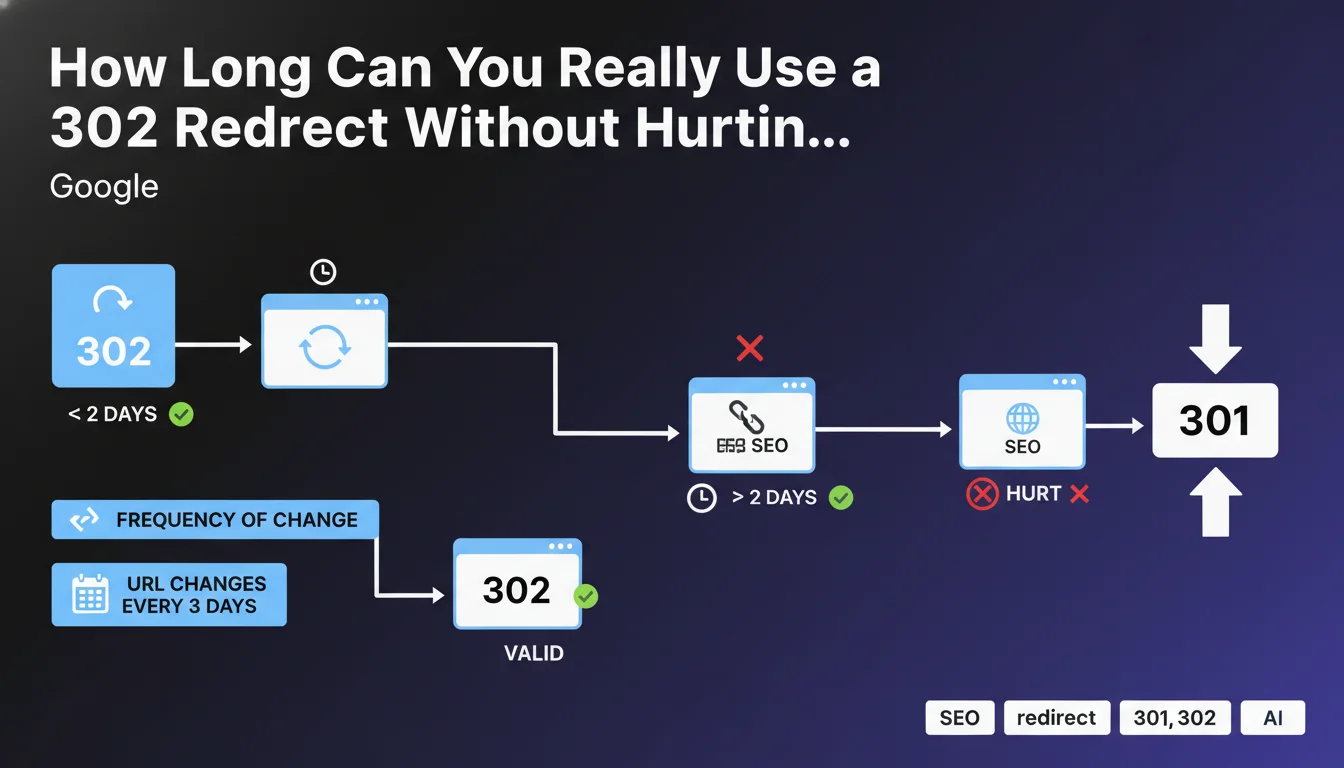
According to Bing representatives, a 302 redirect remains appropriate for up to 2 days of temporary change. Beyond that, you should switch to a 301. However, this rule becomes more flexible if the URL changes regularly (for example every 3 days), in which case the 302 remains relevant.
Google adopts a much stricter position by recommending limiting 302s to a few hours maximum. Beyond this very short timeframe, Google advocates systematically using a 301, except in specific cases where the URL changes frequently.
- 302 redirect according to Bing: acceptable up to 2 days for a one-time change
- 302 redirect according to Google: limited to a few hours maximum
- Common exception: regular modification frequency that justifies maintaining a 302
- General rule: the 301 becomes mandatory for any move exceeding the recommended duration
SEO Expert opinion
This divergence between Google and Bing reveals a fundamental difference in how these engines process temporary signals. In practice, Google tends to quickly convert 302s into 301s when they persist beyond a few successive crawls.
My experience shows that Google begins transferring PageRank and ranking signals within 48-72 hours on a 302, treating it de facto as a 301. This field observation confirms their strict official position. The risk of using a 302 too long isn't so much a penalty as a period of uncertainty where SEO signals can fluctuate.
The case of frequently changing URLs (rotating promotions, event-based content) does indeed constitute the legitimate exception. In these situations, the 302 sends the right semantic signal to engines, indicating they should not replace the source URL in the index.
Practical impact and recommendations
- Audit your existing 302 redirects: identify all 302s active for more than 6 hours and convert them to 301s
- Define a clear policy: document legitimate use cases for 302s in your organization (planned maintenance, short A/B tests, rotating content)
- Automate monitoring: set up alerts to detect 302s persisting beyond the expected timeframe
- Temporary promotions case: if your promotion lasts more than 24 hours, create a dedicated URL rather than using a 302
- A/B testing and personalization: favor client-side methods (JavaScript) rather than server-side 302s for marketing tests
- Migrations and redesigns: always use 301s, even if you think "maybe we'll go back to the old version"
- Technical documentation: train your development teams on the difference between 301 and 302 to avoid implementation errors
- Post-deployment monitoring: after any redirect changes, monitor the evolution of your positions in Search Console for 2-3 weeks
Optimal redirect management requires close coordination between technical, marketing, and SEO teams. The stakes are multiple: PageRank preservation, position maintenance, user experience, and coherent technical architecture.
For complex sites or during major migrations, this orchestration can quickly become tricky. Support from a specialized SEO agency helps secure these critical transitions, benefiting from proven expertise on hundreds of similar projects and professional monitoring tools to anticipate any negative impact.
💬 Comments (0)
Be the first to comment.