
Official statement
Other statements from this video 5 ▾
- □ Pourquoi Google déconseille-t-il l'utilisation du cache et de l'opérateur site: pour déboguer ?
- □ L'outil d'inspection d'URL est-il vraiment l'arme ultime pour déboguer vos problèmes d'indexation ?
- □ L'outil d'inspection d'URL peut-il vraiment diagnostiquer tous vos problèmes d'indexation ?
- □ Faut-il vraiment demander une exploration manuelle via l'outil d'inspection d'URL ?
- □ Pourquoi vérifier le HTML rendu peut-il révéler des erreurs invisibles dans votre code source ?
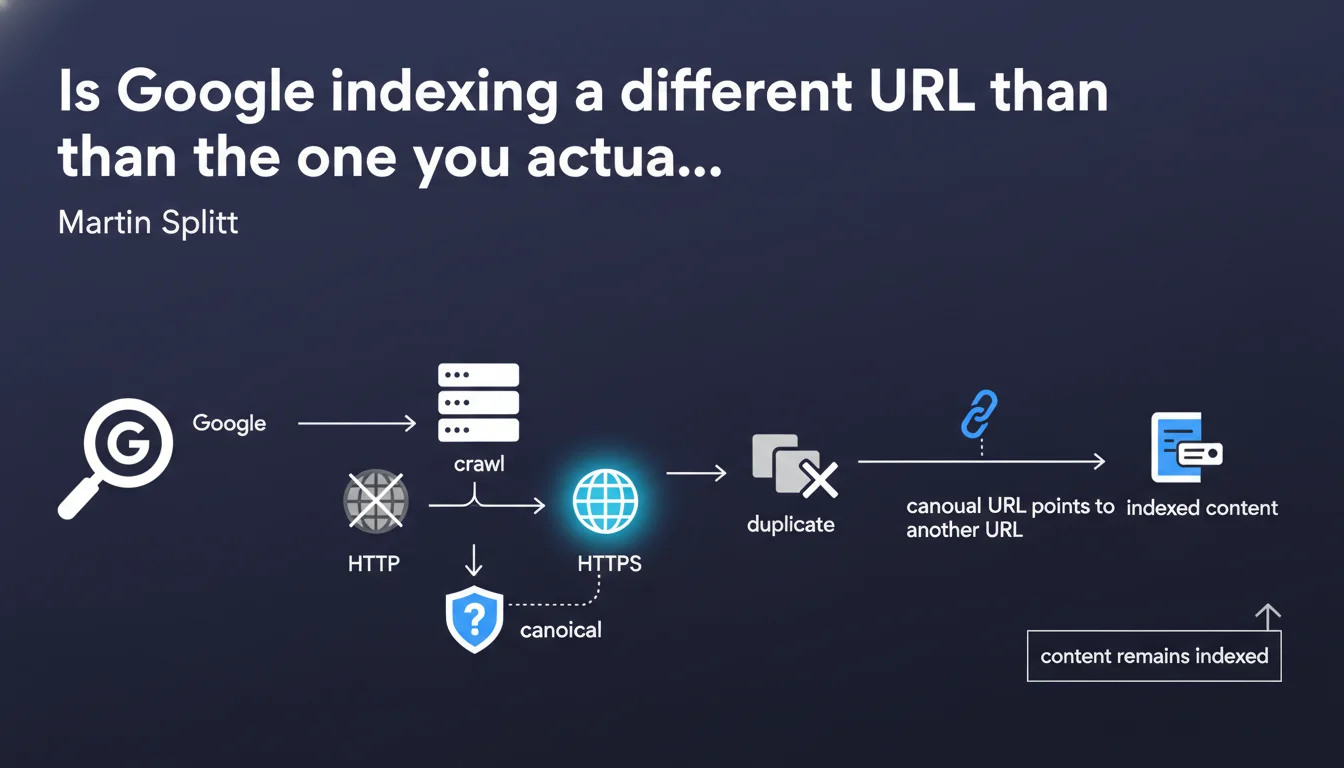
Google may ignore a crawled URL in favor of another canonical version (HTTP vs HTTPS for example). Even if it's not the URL you defined as canonical, the content remains indexed and can appear in results. The canonical signal is interpretive, not absolute.
What you need to understand
What is canonicalization and why does Google sometimes ignore it?
Canonicalization allows Google to group different versions of the same page under a single URL. Concretely, if your site exposes identical content via multiple URLs (www/non-www, HTTP/HTTPS, with or without trailing slash), Google chooses a canonical URL that it considers representative.
The problem is that Google doesn't blindly follow your directives. It interprets the rel=canonical signal, redirects, site structure — and makes a decision. Splitt confirms here that Google can ignore your page in favor of another version, even if it's not the one you expected.
What does "the content remains indexed" mean if the URL is ignored?
This is the crucial nuance: the crawled URL can be ignored, but the content itself remains taken into account. Google doesn't throw your page in the trash — it consolidates it under another canonical URL that it has chosen.
Result: your content can appear in the SERPs, but under a different URL than the one you thought was canonical. For a well-structured site, that's not a disaster. For a site with uncontrolled variants, it's chaos.
What are the typical cases where Google substitutes a canonical URL?
The HTTP/HTTPS case mentioned by Splitt is the most common: if Google detects both versions, it will systematically favor HTTPS (except in aberrant configuration). But there are other classic scenarios:
- www vs non-www: Google chooses based on majority signals (redirects, internal links, canonicals).
- Trailing slash or not:
/pagevs/page/— if both return 200, Google selects one. - URL parameters:
/product?utm_source=...vs/product— Google often ignores tracking parameters. - Separate mobile pages:
m.site.comvswww.site.com— Google will consolidate under the desktop version if it's index-first.
SEO Expert opinion
Is this statement consistent with real-world observations?
Absolutely. We observe daily cases where Google ignores explicit canonicals in favor of its own signals. Canonicalization is not a strict directive — it's a strong suggestion that Google can override if other signals contradict it.
Concrete example: a site with rel=canonical pointing to the HTTP version, but with an active SSL certificate and poorly configured HTTPS redirects. Google will favor HTTPS and ignore the canonical. The webmaster tears their hair out seeing the wrong URL indexed, but for Google, it's consistent.
What nuances should be added to this statement?
Splitt says "the content remains indexed and will be able to appear." That's true, but watch out for indirect SEO consequences. If Google consolidates under an unexpected URL, ranking signals (backlinks, anchor text, authority) can be diluted across multiple versions.
[To verify]: Google claims to intelligently merge signals from all variants to the chosen canonical. In practice, we observe ranking losses when canonicalization is chaotic. Consolidation is never perfect — some backlinks point to ignored URLs, and their juice doesn't always flow back properly.
In which cases does this rule not apply strictly?
Google may temporarily index two versions of the same page during a transition phase (HTTP to HTTPS migration for example). For a few weeks, you see HTTP and HTTPS coexisting in the index — then Google decides and deindexes the obsolete version.
Another edge case: faceted or filtered pages. Google may index multiple variants (color, size, price) even if you canonicalize everything to the parent page. It detects distinct content and decides that pages deserve to be treated separately. This isn't always an error on its part — sometimes your canonical was too aggressive.
Practical impact and recommendations
How do you detect if Google chose a canonical URL different from the one expected?
Search Console remains the reference tool. Go to Coverage or Pages, then filter on "Excluded" URLs with the pattern Duplicate, user-declared canonical URL different. Google explicitly states which URL it preferred.
Also check the URL Inspection tab: type the URL you thought was canonical, and Google will display the canonical URL it actually retained. If it differs, you have a conflict.
What should you do concretely to avoid these problems?
Start by standardizing your URLs. A single protocol (HTTPS), a single domain variant (www or non-www, never both), consistent handling of trailing slashes. Implement strict 301 redirects for all non-canonical variants.
Next, align all signals: canonical tags, XML sitemap, internal linking, hreflang files — all must point to the same URL version. If your XML sitemap lists the HTTP version while your canonicals point to HTTPS, Google will get confused.
- Audit your redirects: all non-canonical variants must redirect with 301 to the canonical version.
- Verify that your self-referencing canonicals point to the final URL, with no intermediate redirects.
- Standardize internal linking: never link to URLs that redirect or aren't canonical.
- Clean your XML sitemap: remove all non-canonical URLs, keep only final versions.
- Monitor Search Console: set up alerts if the number of "Duplicates" spikes suddenly.
- Test with URL Inspection: verify a few strategic pages to confirm that Google retains the expected URL.
What mistakes should you absolutely avoid?
Don't multiply contradictory canonicals. If page A canonicalizes to B, and B to C, Google risks ignoring everything and choosing an arbitrary fourth URL. The chain of canonicals, like redirects, must be direct.
Don't neglect dynamic URL parameters. If your site generates infinite variants (?page=1, ?sort=price, etc.), configure URL parameters in Search Console or implement clean canonicals. Otherwise, Google will crawl thousands of duplicates.
❓ Frequently Asked Questions
Google peut-il indexer deux versions d'une même page simultanément ?
Si Google ignore mon canonical, est-ce que je perds du ranking ?
Dois-je forcer Google à respecter mon canonical avec une redirection 301 ?
Comment savoir quelle URL Google a choisie comme canonique ?
Les canonicals cross-domain fonctionnent-ils de la même manière ?
🎥 From the same video 5
Other SEO insights extracted from this same Google Search Central video · published on 07/12/2023
🎥 Watch the full video on YouTube →
💬 Comments (0)
Be the first to comment.