
Official statement
Other statements from this video 6 ▾
- □ La commande site: est-elle vraiment fiable pour vérifier l'indexation de vos pages ?
- □ L'indexation site: suffit-elle à confirmer que Google reconnaît vraiment votre site ?
- □ Pourquoi l'absence de résultats avec la commande site: révèle-t-elle un problème critique d'indexation ?
- □ Faut-il vraiment soumettre son sitemap via Google Search Console pour régler ses problèmes d'indexation ?
- □ Faut-il utiliser l'outil d'inspection d'URL pour vérifier l'indexation de vos pages ?
- □ Pourquoi tester le classement sur des mots-clés pertinents ne suffit-il pas à valider votre stratégie SEO ?
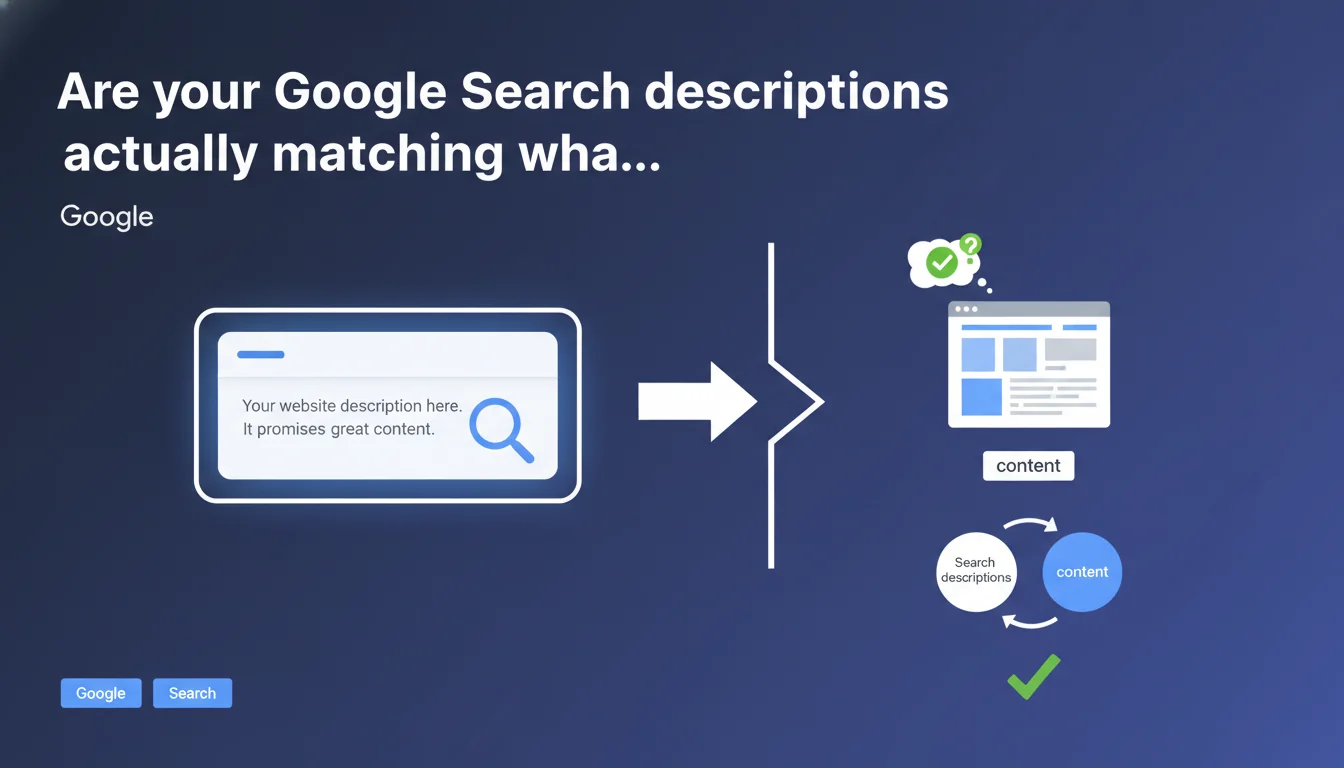
Google emphasizes that descriptions displayed in search results must precisely match the actual content of your pages. This recommendation aims to reduce gaps between what the snippet promises and what users actually find. In practice, this means regularly reviewing your meta description tags and avoiding any misleading or vague wording.
What you need to understand
Why does Google insist so heavily on description accuracy?
This directive stems from the logic of user experience quality. When an internet user clicks on a search result, they expect to find exactly what the snippet promised them. A gap between description and actual content generates frustration, increases bounce rate, and degrades behavioral signals.
Google has long prioritized sites whose metadata matches the displayed content. However, the wording here remains deliberately vague: we talk about "verifying" without specifying exact criteria or consequences for non-compliance.
Which elements does Google consider as "descriptions"?
The meta description tag is the first element in question, but not the only one. Google sometimes generates its own snippets by drawing from page content — text excerpts, structured data, rich snippets.
If your meta description is vague or misleading, Google can completely ignore it and create a snippet from other areas of the page. The problem? You lose control over the message displayed in the SERPs.
What are the concrete risks if descriptions are inaccurate?
Google specifies no formal penalty. No announced algorithmic sanction. Yet, negative behavioral signals (low CTR, high bounce rate, short visit duration) can indirectly affect rankings.
More direct: a misleading description can qualify as deceptive content under quality guidelines, especially in YMYL sectors. In that case, manual action remains possible, though rare.
- Snippets must reflect the actual page content
- Google can generate its own descriptions if yours are deemed inadequate
- No explicit algorithmic penalty, but indirect impact via user metrics
- Increased risk in YMYL sectors where trust is critical
SEO Expert opinion
Is this directive consistent with observed field practices?
Yes and no. Google will rewrite your meta descriptions in approximately 60 to 70% of cases, even when they're perfectly aligned with your content. The engine sometimes estimates that a page excerpt matches the query better than your carefully crafted tag.
Result: you're asked for precision, but Google reserves the right to ignore you. [Needs verification] whether there's a particular signal indicating that Google favors certain meta descriptions over others beyond simple contextual relevance.
In which cases does this rule become truly critical?
Let's be honest — on a standard blog or corporate site, a slightly misaligned meta description won't cause anything dramatic. The real risk concentrates on transactional pages and regulated sectors.
E-commerce: promising "free shipping" in the snippet when it's only valid above €50 is suicide in terms of bounce rate. Health, finance, legal: any imprecision can be interpreted as manipulation.
Should you optimize meta descriptions for CTR or accuracy?
Both. But accuracy takes priority if you must choose. A CTR artificially inflated by an appealing but misleading description will result in massive pogo-sticking. Google picks up this signal within days.
The sweet spot: an attractive description that uses the exact terms from your content and makes a deliverable promise. No clickbait, no empty phrases like "Discover everything you need to know about…".
Practical impact and recommendations
What do you concretely need to check on your pages?
Start with an audit of existing meta descriptions. Export them via Screaming Frog or your preferred crawl tool. For each important page, compare the meta description with the H1, first paragraphs, and main arguments of the content.
Eliminate any unfulfilled promise: "Complete guide" when you only cover 3 aspects, "Free" when it's freemium, "Updated" with an obsolete date.
What mistakes must you avoid absolutely?
Don't duplicate meta descriptions across similar pages. Google hates that and then generates its own snippets, often mediocre. Each page deserves a unique description that reflects its specificity.
Avoid keyword stuffing: "SEO SEO agency SEO expert SEO consultant" hasn't worked for years. Write for humans first, robots second.
- Export all meta descriptions via a crawler
- Compare each description with the actual page content
- Remove unfulfilled or exaggerated promises
- Verify description uniqueness (zero duplication)
- Test snippets displayed in Search Console
- Monitor behavioral metrics (CTR, bounce rate) after modifications
❓ Frequently Asked Questions
Google peut-il pénaliser un site pour des meta descriptions inexactes ?
Pourquoi Google réécrit-il mes meta descriptions même quand elles sont précises ?
Faut-il rédiger une meta description pour chaque page du site ?
Comment vérifier que mes snippets affichés correspondent à mes meta descriptions ?
Une description attractive mais légèrement exagérée est-elle acceptable ?
🎥 From the same video 6
Other SEO insights extracted from this same Google Search Central video · published on 24/02/2022
🎥 Watch the full video on YouTube →
💬 Comments (0)
Be the first to comment.