
Official statement
Other statements from this video 6 ▾
- □ La commande site: est-elle vraiment fiable pour vérifier l'indexation de vos pages ?
- □ L'indexation site: suffit-elle à confirmer que Google reconnaît vraiment votre site ?
- □ Comment vérifier que vos descriptions dans Google Search reflètent vraiment votre contenu ?
- □ Pourquoi l'absence de résultats avec la commande site: révèle-t-elle un problème critique d'indexation ?
- □ Faut-il vraiment soumettre son sitemap via Google Search Console pour régler ses problèmes d'indexation ?
- □ Faut-il utiliser l'outil d'inspection d'URL pour vérifier l'indexation de vos pages ?
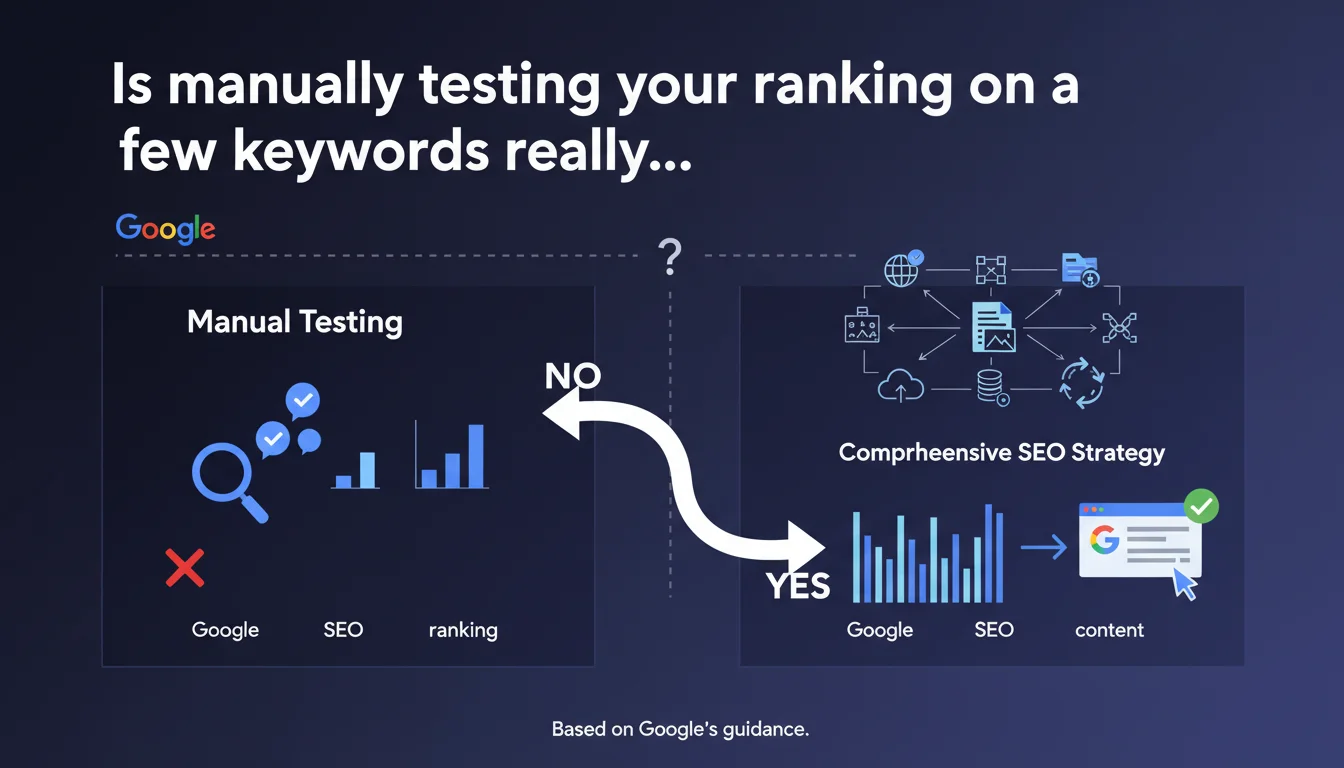
Google recommends checking that your site appears in search results for relevant keywords once indexation is confirmed. This basic statement raises more questions than it answers: which keywords? How often? With which tools? The advice deliberately remains vague about the concrete methodology you should adopt.
What you need to understand
Does Google really recommend testing everything manually?
This statement is part of the basic guidelines for checking a site's visibility. Google suggests a two-step approach: first confirm indexation via Search Console, then verify ranking on targeted queries.
The problem? Google specifies neither the frequency of verification, nor the recommended tools, nor even how to define what a "relevant keyword" actually is. For a site targeting hundreds or thousands of queries, this approach quickly becomes impractical without automation.
What exactly does Google mean by "relevant keywords"?
Google uses a deliberately generic formula. A relevant keyword could be a transactional query for an e-commerce site, an informational question for a blog, or a local search for a physical location.
Relevance depends on your business intent and your revenue model—but Google provides no objective criteria to qualify this relevance. It's up to you to define your priorities based on your business objectives and content strategy.
Should this verification only happen after indexation?
Google positions this step after confirming that your site is recognized and indexed. Technically logical: impossible to rank if pages aren't in the index.
But in reality, many practitioners test ranking continuously, sometimes before all pages are even indexed. Automated tracking tools don't make this temporal distinction that Google suggests here.
- Indexation is a prerequisite, but guarantees no ranking
- The notion of "relevant keywords" remains subjective and depends on business context
- Google recommends no specific tool or methodology for this test
- Manual monitoring becomes impossible at scale for substantial sites
- This statement completely ignores the temporal dimension and SERP volatility
SEO Expert opinion
Is this recommendation realistic for a professional website?
Let's be honest: nobody tests their ranking manually by typing queries into Google. All professionals use third-party tools (SEMrush, Ahrefs, Monitorank) or automated scripts via the Search Console API.
Google knows this very well, but carefully avoids recommending specific tools—which would make this statement far more actionable. Result? Advice that's theoretically correct but inapplicable without infrastructure. [To verify]: Does Google consider testing your ranking via third-party tools compliant with this recommendation?
What are the practical limitations of this approach?
First issue: personalized results. When you test a query, Google displays results influenced by your history, location, and preferences. A ranking in position 3 for you might be position 12 for another user.
Second issue: SERP volatility. Positions fluctuate daily, sometimes hour by hour depending on the sector. Testing your ranking once after indexation gives you only a snapshot with no statistical value.
Does this statement really reflect best practices observed in the field?
In practice, experienced SEO professionals don't "check" ranking—they monitor it continuously with automated alerts. Google's approach suggests a one-time, almost binary verification: "does my site appear or not?"
But what really matters is positional evolution, share of voice against competitors, and correlation between rankings and organic traffic. Google oversimplifies a process that, in professional environments, relies on real-time dashboards and far more sophisticated composite metrics than "I'll type my query and see what happens".
Practical impact and recommendations
How do you test your ranking effectively without personalization bias?
Use private browsing mode as a bare minimum, but know that Google will always factor in your IP geolocation. For more neutral results, use tools that simulate queries from different locations and devices.
Search Console remains your official reference: the Performance report shows you actual queries generating impressions, with average positions. It's more reliable than a one-off manual test, even though data is aggregated over several days.
Which keywords should you prioritize in your checks?
Focus on queries with high commercial intent or those matching your conversion objectives. For an e-commerce site, that's product terms with transactional qualifiers. For a blog, informational queries with significant volume.
Establish a priority matrix crossing search volume with business value. Test your top 20-30 critical queries first, then expand progressively. No point monitoring 500 keywords if only 50 generate 80% of your qualified traffic.
What verification frequency should you adopt based on your sector?
For highly competitive sectors (finance, insurance, legal) or volatile ones (news, trends), daily automated monitoring is essential. Positions can shift overnight following an algorithm update or competitor action.
For stable niches or evergreen content, weekly or biweekly verification suffices. What matters is detecting trends over several weeks rather than reacting to every minor daily fluctuation.
- Set up alerts in Search Console for sudden position drops on your priority queries
- Use a rank tracking tool that records position history and detects trends
- Test your main queries from different geographic locations if your business is multi-regional
- Compare your visibility against direct competitors on the same keywords
- Document correlations between position changes and actual traffic to identify truly strategic queries
- Don't mistake temporary fluctuation for an algorithm penalty: analyze over 7-14 days minimum
- Verify that your ranking pages actually match the search intent detected in Search Console
❓ Frequently Asked Questions
Dois-je vraiment attendre que toutes mes pages soient indexées avant de tester mon classement ?
La Search Console suffit-elle pour suivre mon classement ou dois-je utiliser des outils tiers ?
Comment savoir si un mot-clé est vraiment pertinent pour mon business ?
Les positions affichées dans les outils de rank tracking sont-elles fiables ?
Pourquoi mes positions varient-elles autant d'un jour à l'autre ?
🎥 From the same video 6
Other SEO insights extracted from this same Google Search Central video · published on 24/02/2022
🎥 Watch the full video on YouTube →
💬 Comments (0)
Be the first to comment.