
Official statement
What you need to understand
What exactly is the Speakable tag and what purpose does it serve?
The Speakable tag is a structured data markup developed by Google to identify sections of a web page that are particularly suitable for voice reading by intelligent assistants.
It allows content creators to explicitly indicate which portions of text are optimized to be read aloud on devices like Google Home or other smart speakers. The goal is to improve user experience during voice searches.
Why did Google confirm a malfunction on Google Home Hub?
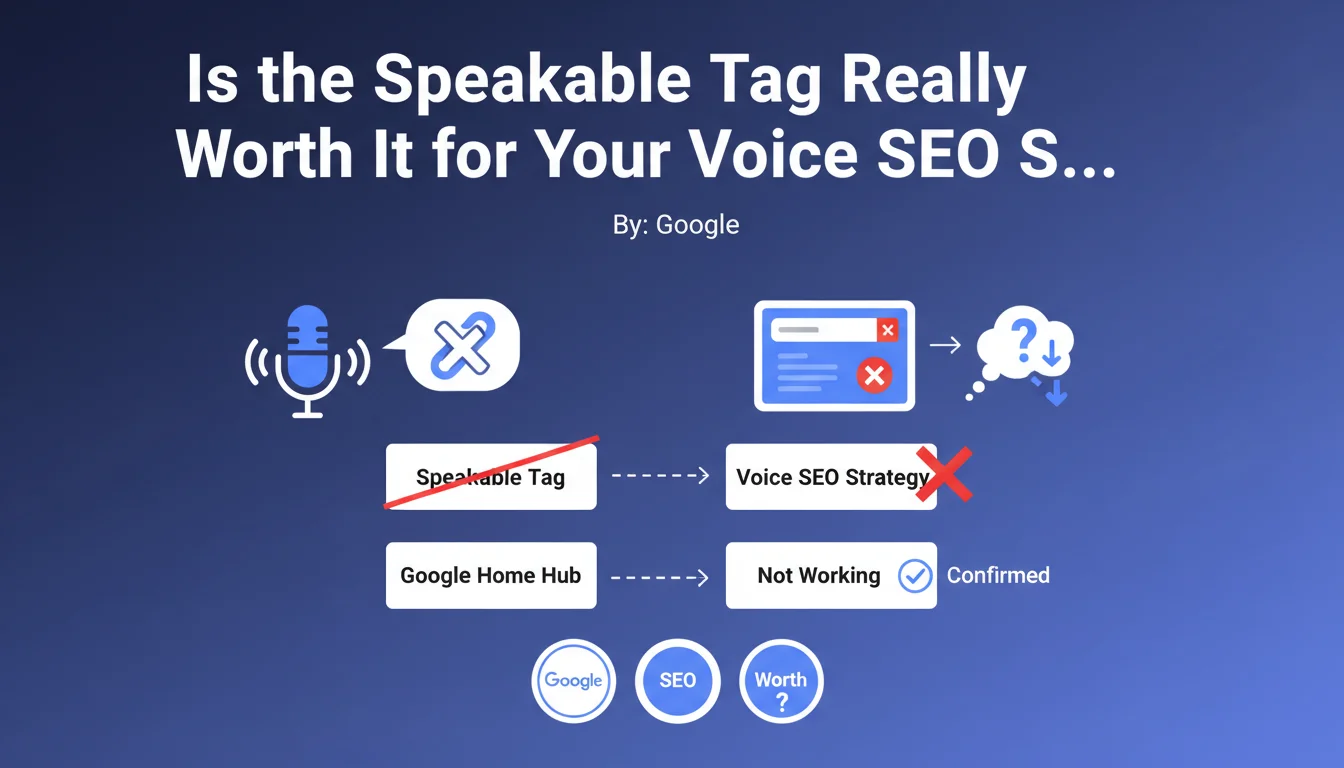
Google acknowledged that the Speakable tag was not working properly on the Google Home Hub, a device with a touchscreen combining visual display and voice responses.
This limitation reveals that even Google's official features can experience implementation problems or compatibility issues between different devices in the ecosystem. This highlights the importance of not investing heavily in technologies still in progressive rollout phase.
How available is this feature in France?
In France, the situation is doubly limited: the Speakable tag is not yet supported for French-language content, and Google Home Hub was not available on the French market at the time of this statement.
For French SEO practitioners, this technology therefore remains largely experimental and not a priority in a current optimization strategy.
- The Speakable tag identifies content optimized for voice reading
- Malfunctions have been confirmed on certain Google devices
- Availability remains very limited in France (language and hardware)
- This is a technology still in development phase
SEO Expert opinion
Does this statement reveal a broader trend about emerging technologies?
This situation perfectly illustrates the lifecycle of SEO innovations: Google regularly announces new features that then require several years before reaching real maturity and global deployment.
I consistently observe that technologies related to voice search follow a geographic and linguistic wave deployment, with a clear priority for American English. Secondary markets often have to wait 18 to 36 months before complete availability.
Should we completely ignore voice SEO in France then?
Even though the Speakable tag remains non-priority, voice SEO as a whole deserves attention. Voice queries follow different patterns: complete questions, natural formulations, search for direct answers.
Optimizing your content with structured question-and-answer formats, FAQs, and concise responses improves overall SEO, regardless of the consultation medium. These practices also benefit featured snippets and traditional search rankings.
What strategy should you adopt when Google announces new features?
My recommended approach is one of measured pragmatism: follow developments, experiment on pilot projects, but never stake the core of an SEO strategy on unconfirmed features or those in beta phase.
Always prioritize proven SEO fundamentals (quality content, technical performance, link building) that generate certain results, then allocate 10-15% of your resources to experimenting with promising new technologies.
Practical impact and recommendations
What should you actually do with the Speakable tag today?
For French websites, the recommendation is clear: do not implement the Speakable tag as long as it is not officially supported for French-language content. The technical investment would not be cost-effective.
Instead, focus your efforts on optimizing content for conversational searches: structure your articles with explicit questions, provide direct and concise answers, use natural language rather than technical jargon.
How can you prepare your site for the future of voice SEO without taking risks?
The best approach is to adopt practices that benefit both traditional and voice SEO. Implement standard Schema.org markup (Article, FAQPage, HowTo) which is already fully functional and valued by Google.
Structure your content with a clear hierarchy, short paragraphs, and answers to common questions from your audience. This approach simultaneously improves your visibility in traditional results and your potential for future voice queries.
What mistakes should you avoid in your voice SEO strategy?
The main mistake would be to invest heavily in immature technologies at the expense of fundamental optimizations. I have observed several sites lose traffic because they had neglected their basic SEO to experiment prematurely.
Also avoid creating content optimized exclusively for voice to the point of degrading the traditional reading experience. Balance remains essential: your content must remain pleasant to read on screen while being easily vocalizable.
- Do not implement Speakable for French content currently
- Favor standard and proven Schema.org tags (FAQ, HowTo, Article)
- Structure content with natural question-and-answer formats
- Write short paragraphs and direct answers (40-60 words)
- Maintain balance between voice optimization and traditional readability
- Follow Google's official announcements on French-language support
- Allocate maximum 10-15% of SEO budget to voice experimentation
- Systematically measure ROI of any new technical implementation
💬 Comments (0)
Be the first to comment.