
Official statement
What you need to understand
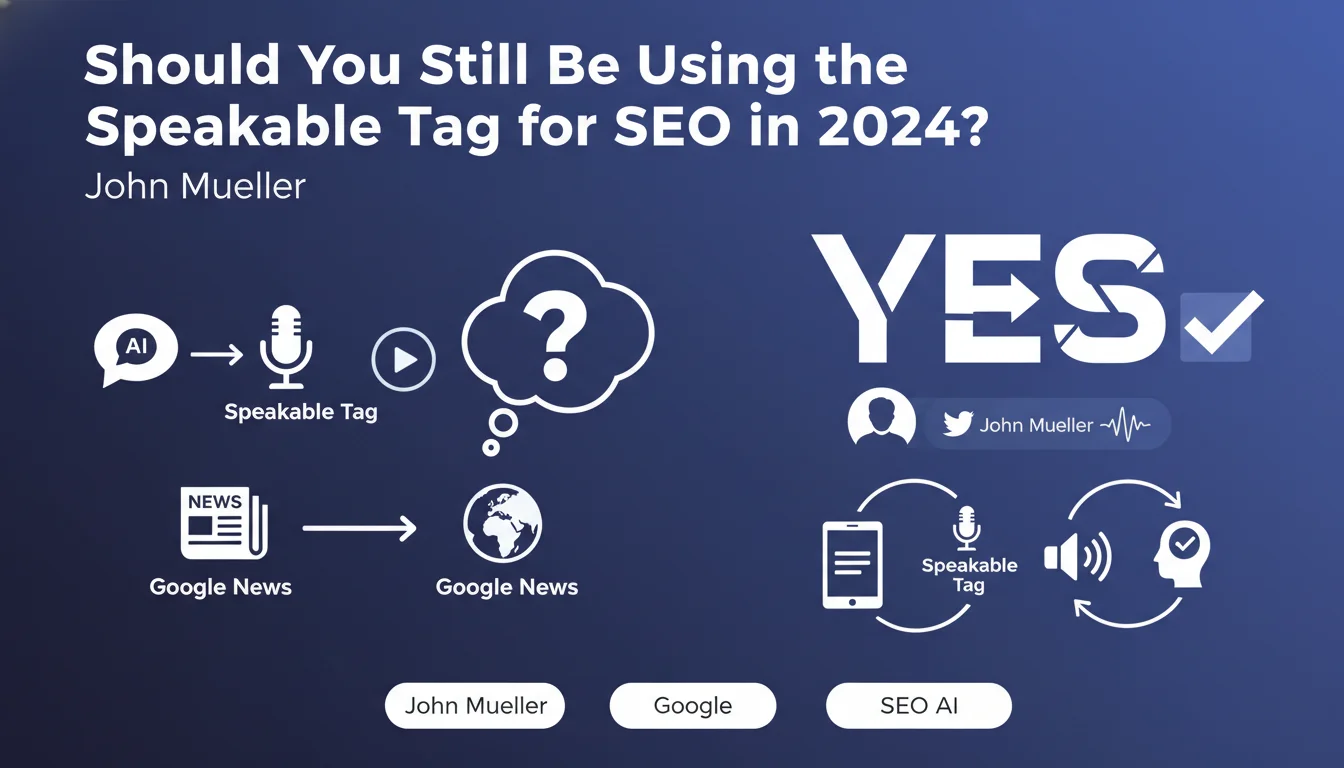
The Speakable tag is a structured data markup that identifies content sections most suitable for voice reading by intelligent assistants. Launched over two years ago, it was meant to facilitate the indexing of content optimized for voice search.
This statement follows confusion created by an internal Google News message suggesting that the tag had become obsolete. John Mueller clarified the situation by confirming that the Speakable markup remains officially supported by Google.
However, it's important to note that this feature has experienced a very limited geographical rollout and is still not available in France, which explains its low impact on European SEO strategies.
- The Speakable tag is not obsolete according to Google
- Its use remains geographically limited (mainly to the United States)
- It specifically targets news and informational content
- Its adoption remains very marginal in the global SEO ecosystem
SEO Expert opinion
This clarification perfectly illustrates the gap between Google's official announcements and the reality on the ground. While technically the tag is not obsolete, its practical impact is virtually nil for the majority of websites, particularly in Europe.
The lack of deployment in France and many countries raises a legitimate question about the relevance of investing development time in this implementation. Google often maintains features in "experimental" mode for years without generalization.
My analysis suggests that Google is testing different approaches for voice content delivery, and Speakable could be gradually abandoned in favor of more sophisticated algorithms capable of automatically identifying relevant passages without manual markup.
Practical impact and recommendations
- Don't invest resources in implementing Speakable if you're targeting the French or European market
- Focus on proven voice optimizations: featured snippets, position zero, and direct answers
- Implement FAQ Schema markup instead which has a measurable impact on both voice and traditional search
- Optimize your content for conversational queries with natural question-and-answer formulations
- If you're targeting the American market with news content, test Speakable on a few pilot articles
- Monitor official announcements regarding the geographical expansion of this feature
- Prioritize universal structured data (Article, NewsArticle, Organization) that have a demonstrated ROI
💬 Comments (0)
Be the first to comment.