
Official statement
What you need to understand
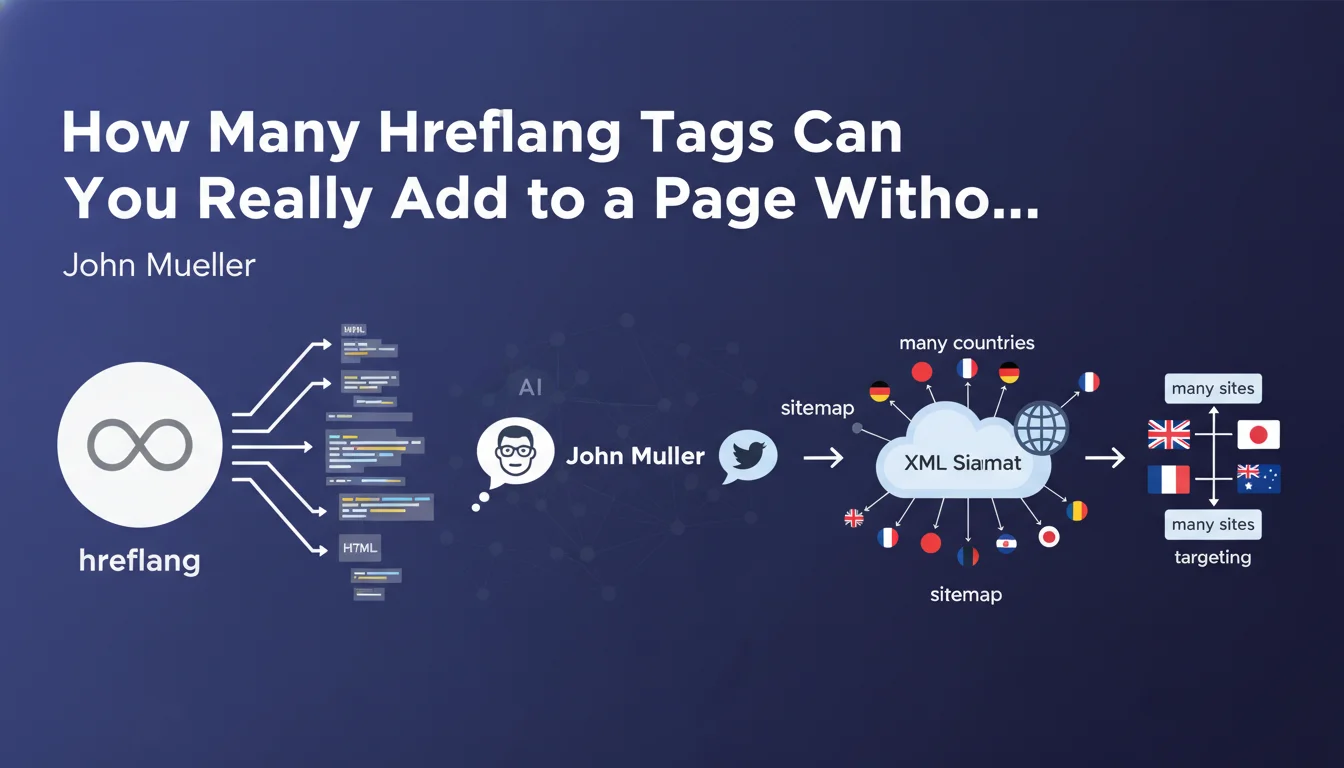
The hreflang tag is an HTML element that allows you to indicate to search engines the alternative linguistic and geographical versions of a web page. It plays a crucial role in international SEO by directing users to the correct version of content.
A major difference exists between Google and Bing regarding the treatment of this tag. While Bing favors automatic language detection through textual content analysis, Google considers hreflang as a primary signal for understanding a site's multilingual architecture.
For SEO practitioners working on international sites, this divergence raises an important strategic question. Should you invest time and resources in implementing hreflang if all search engines don't use it in the same way?
- Hreflang is essential for Google, which represents over 90% of searches in most countries
- Bing relies more on automatic content analysis to detect language
- The tag prevents duplicate content issues between linguistic versions
- It improves user experience by directing to the correct local version
- Incorrect implementation can cause more problems than it solves
SEO Expert opinion
After 15 years of observing Google's behaviors, this position on hreflang is totally consistent with what we see in the field. International sites that correctly implement this tag benefit from better geographical targeting and a significant reduction in cannibalization issues between linguistic versions.
It's interesting to note that Bing's approach, while different, is not without logic. Automatic detection based on content can indeed work for very distinct languages. However, it shows its limits for similar translated content (US vs UK English) or for sites serving different regions with the same language.
In practice, we observe that sites without hreflang but with clearly differentiated content can survive, but they lose targeting precision. Sites with nearly identical content in multiple languages systematically suffer without this tag.
Practical impact and recommendations
- Systematically implement hreflang on all your multilingual or multi-regional sites, regardless of Bing's position
- Choose the implementation method suited to your infrastructure: HTML tags in the head, HTTP headers for PDFs, or XML sitemap for large sites
- Use correct ISO 639-1 language codes (fr, en, de) combined if necessary with ISO 3166-1 Alpha 2 country codes (fr-FR, fr-CA, en-GB)
- Ensure that each URL with hreflang points to all alternative versions, including itself (self-referencing canonical)
- Verify the bidirectionality of links: if page A points to B, then B must point to A
- Avoid mixing implementation methods (HTML + sitemap) for the same URLs, this creates confusion
- Don't use hreflang to point to URLs that are noindexed or blocked by robots.txt
- Regularly monitor Search Console to detect hreflang errors that can accumulate during site updates
- Continue to optimize the linguistic quality of your content: hreflang doesn't replace authentic and well-translated content
- Audit your existing implementations with specialized tools to identify inconsistencies
- For complex sites with numerous linguistic and regional variations, consider that optimal hreflang management requires specialized technical expertise. International architectures contain many pitfalls (hreflang chains, conflicts with canonicals, regional variant management). In this context, engaging a specialized SEO agency in international SEO can prove judicious to guarantee flawless implementation and rigorous monitoring, thus avoiding costly visibility errors.
💬 Comments (0)
Be the first to comment.