
Official statement
What you need to understand
What is the actual behavior of Google's structured data testing tool?
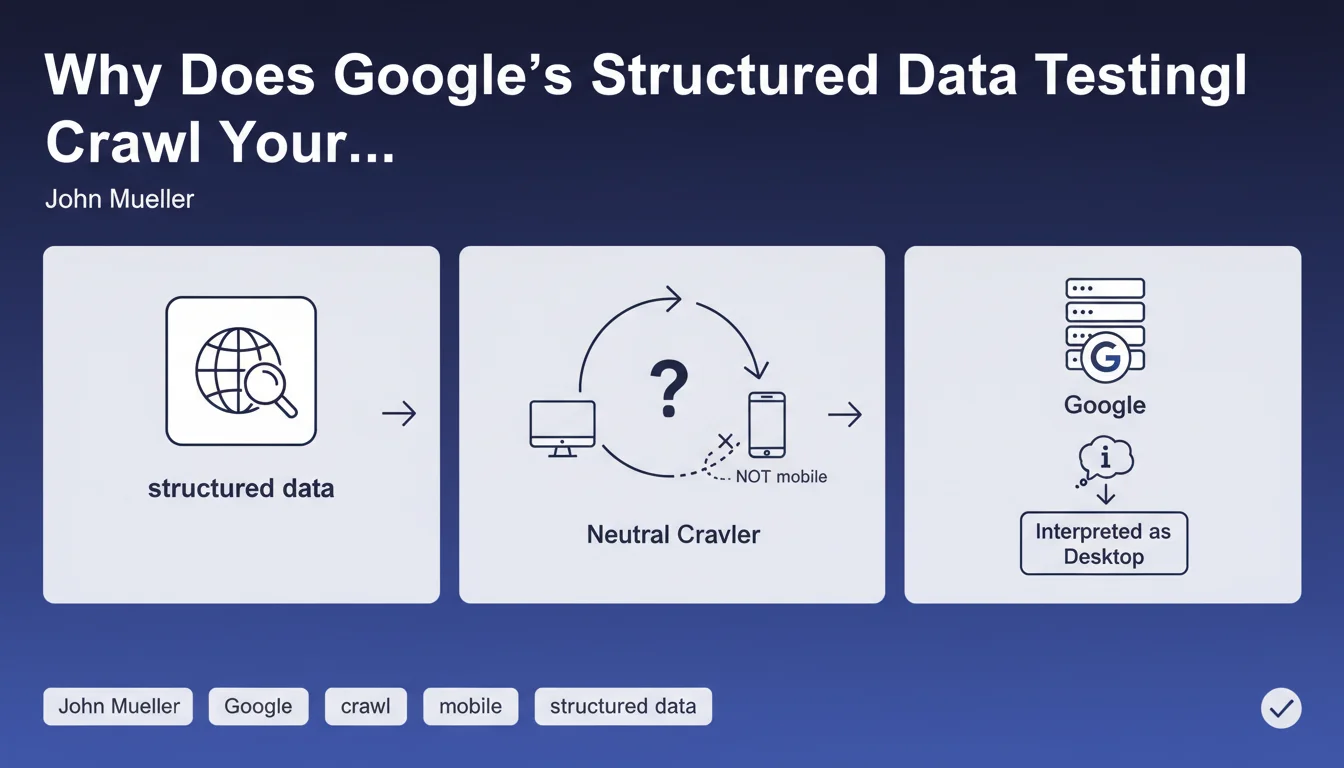
The structured data testing tool uses a neutral crawler that is generally interpreted by websites as a desktop crawler. This means it doesn't behave like the classic mobile Googlebot that now indexes the majority of sites.
This technical peculiarity can have significant consequences on the results displayed in the tool. If your site uses responsive design or serves different content depending on the device type, the tool may not reflect what Googlebot actually sees during mobile-first indexing.
Why does this distinction between desktop and mobile matter in 2024?
With generalized mobile-first indexing, Google primarily uses the mobile version of your site for indexing and ranking. If the testing tool displays the desktop version, there may be significant discrepancies in the structured data detected.
This situation can create confusion: you might validate your structured data with the tool, but mobile Googlebot could see a different version during the actual crawl.
What are the concrete implications of this behavior?
- The tool doesn't necessarily reflect what mobile Googlebot actually sees on your site
- Tests can be misleading if your site serves differentiated desktop/mobile content
- Structured data validation requires cross-verification with other tools
- The tool's results must be compared with Search Console reports
- This technical limitation underscores the importance of maintaining consistency between mobile and desktop versions
SEO Expert opinion
Does this statement reveal a structural problem in Google's tools?
This information confirms a known inconsistency among Google's various tools. The structured data testing tool hasn't evolved at the same pace as indexing practices, creating operational friction for SEO professionals.
This gap between the diagnostic tool and the reality of crawling perfectly illustrates why you should never rely on a single validation point. Search Console remains the reference tool because it reflects what Google actually indexes.
What nuances should be added to this observation?
It's crucial to understand that this limitation only concerns the standalone testing tool. The enhancement reports in Search Console do use data collected by mobile Googlebot and are therefore reliable.
Moreover, if your site uses pure responsive design without differentiated rendering, this distinction has little impact. The problem mainly arises for sites with adaptive content or JavaScript implementations that behave differently depending on the user-agent.
In which cases does this limitation actually pose a problem?
This difference becomes critical when you use client-side rendering with modern JavaScript frameworks. These frameworks can detect the user-agent and adapt rendering, thus creating a divergence between what the tool sees and what mobile Googlebot indexes.
Sites with adaptive serving (different serving depending on device) are also affected. If your structured data is integrated differently between mobile and desktop, the tool will only show you part of the reality.
Practical impact and recommendations
How can you properly verify your structured data while accounting for this limitation?
The most reliable method is to use Search Console as your source of truth. Regularly consult the enhancement reports that reflect what mobile Googlebot actually detects.
Complement this approach by using the URL Inspection tool in Search Console. This tool tests the URL with the real mobile Googlebot and shows you exactly which structured data is detected.
For immediate testing, use browser extensions like Schema Markup Validator or third-party tools that properly simulate mobile crawling. Also remember to test in private browsing mode to avoid caches.
What mistakes should you avoid when validating your structured data?
- Don't rely solely on the structured data testing tool to validate your implementation
- Don't assume that a successful validation in the tool guarantees correct indexing
- Don't forget to verify consistency between mobile and desktop versions of your structured data
- Don't neglect error reports in Search Console which are more representative of reality
- Don't implement different logic for structured data based on user-agent without justification
- Don't consider the absence of errors in the tool as proof of perfect optimization
What strategy should you adopt to ensure reliable implementation?
Favor a unified approach where the same structured data is served regardless of the site version. This eliminates divergence risks and considerably simplifies maintenance.
Implement a multi-tool validation process: testing tool for initial diagnosis, Search Console for actual indexing verification, and URL inspection for spot checks. This triangulation ensures you have a complete picture.
Document your implementations and perform regular audits as site evolutions can introduce regressions. Automated monitoring can alert you to problems detected in Search Console.
💬 Comments (0)
Be the first to comment.