
Official statement
What you need to understand
What does this Google statement actually mean?
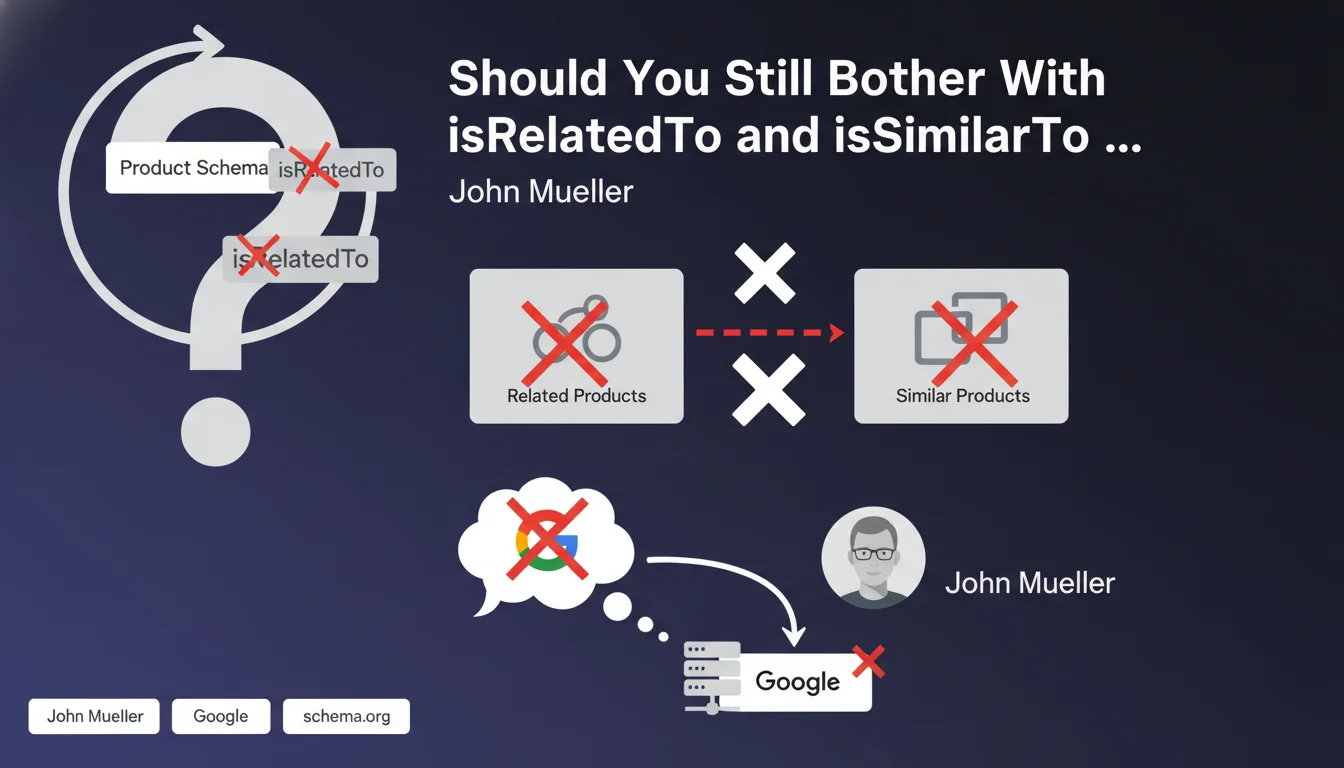
John Mueller confirmed on Twitter that Google currently ignores the isRelatedTo and isSimilarTo attributes in Schema.org Product markup. These two properties normally allow you to create semantic relationships between products.
Concretely, if you've added these fields to indicate related or similar products in your online store, Google doesn't factor them into its algorithm. This information therefore doesn't contribute to the ranking of your product pages.
Why do these attributes exist if Google doesn't use them?
The Schema.org vocabulary is a standard created by a consortium including Google, but also Bing, Yahoo, and Yandex. Not all available fields are necessarily exploited by each search engine.
These attributes can serve other purposes: internal structuring of your data, exploitation by other search engines, or third-party applications. Schema.org offers a broad palette from which each player selects the elements that interest them.
What are the key takeaways?
- Google doesn't use isRelatedTo and isSimilarTo in its processing of Product Schema
- These attributes remain valid in the Schema.org standard and can serve other purposes
- This non-use is officially confirmed, not just a simple observation
- Other search engines might exploit this data differently
- The situation could evolve in the future depending on Google's needs
SEO Expert opinion
Is this statement consistent with observed practices?
Absolutely. In 15 years of SEO practice, I've found that Google doesn't value product relationships via Schema. A/B tests on major e-commerce sites have never shown a measurable impact from these attributes.
Google favors its own recommendation and semantic analysis algorithms rather than relying on relationships declared by websites. This approach allows it to maintain its independence and avoid manipulation.
What nuances should be added to this information?
First, the absence of direct impact doesn't equal a prohibition. Filling in these fields remains a good practice for data structuring, particularly for your own internal systems or APIs.
Second, this situation could evolve. Google constantly tests new ways to exploit structured data. Anticipating by properly structuring your data can give you a competitive advantage if Google decides to activate these signals.
In what cases can these attributes still be useful?
If you have an API-first architecture where Schema.org serves as a unified data model, these attributes retain their usefulness. They structure your product relationships in a standardized way.
For international sites targeting search engines like Yandex or Baidu, check their specific documentation. Some search engines exploit properties ignored by Google.
Practical impact and recommendations
What should you actually do with this information?
Don't remove these attributes if they're already in place. They don't harm your SEO and can serve other purposes. The maintenance cost is minimal.
On the other hand, don't devote priority development time to implementing these fields if it's not already done. Focus your resources on Schema properties that Google actually uses.
What are the real priorities for Product Schema?
Focus on properties that generate rich snippets and improve CTR: name, image, offers (with price and priceCurrency), availability, aggregateRating, and review.
These elements have a direct and measurable impact on your visibility in search results. Google displays them visually, which enriches your snippets and attracts users' attention.
How do you audit and optimize your existing Schema markup?
- Use Google's Rich Results Test to validate your current Product tags
- Check in Search Console that your products are eligible for rich snippets
- Prioritize properties that generate enriched displays (price, ratings, availability)
- Maintain isRelatedTo and isSimilarTo if they exist, but don't develop them as a priority
- Document this specificity in your technical repository to avoid misunderstandings
- Monitor Google guideline updates that could reactivate these attributes
- Regularly test the display of your product pages in SERPs
💬 Comments (0)
Be the first to comment.