
Official statement
What you need to understand
Why is artificial pagination problematic for SEO?
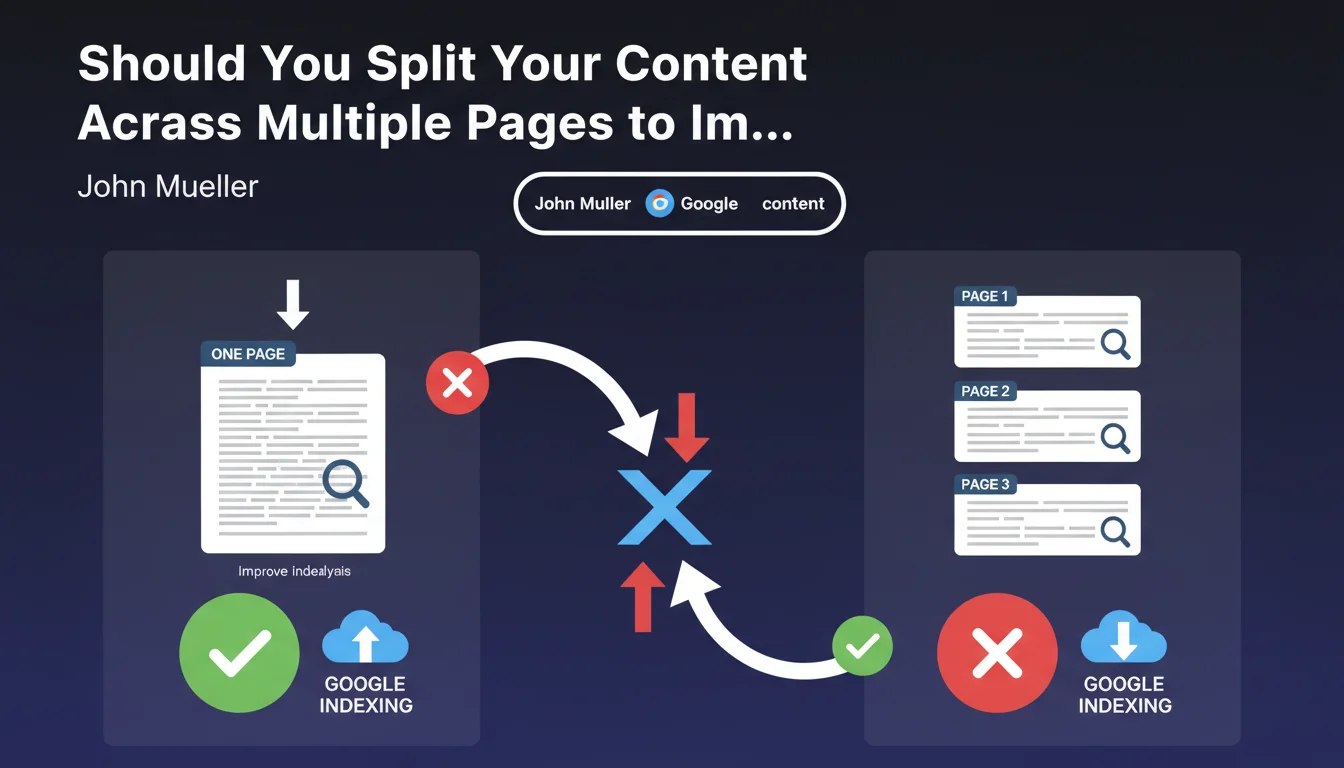
Google analyzes the complete content of a page to understand its theme and relevance. When content is artificially divided across multiple pages, each page contains less text, which reduces the semantic signals available to the algorithm.
This content dilution prevents Google from properly assessing the expertise and depth of each page. The search engine prefers substantial content that covers a topic comprehensively rather than scattered fragments.
What's the difference between legitimate pagination and artificial pagination?
Legitimate pagination responds to a real user need: product lists, blog archives, search results. It improves the experience by avoiding pages that are too long to load.
Artificial pagination consists of splitting an article or guide into multiple pages solely to inflate the number of indexed pages, without functional justification. This practice is counterproductive.
What is the impact on search result rankings?
Pages with insufficient content volume are perceived as less authoritative and less comprehensive. They have less chance of ranking for competitive queries.
Google values content that demonstrates in-depth expertise (E-E-A-T criteria). Fragmented content cannot compete with complete and substantial resources.
- Artificial pagination dilutes the semantic signals of each page
- Google prefers to analyze complete and substantial content
- Text volume directly influences Google's ability to assess expertise
- Fragmented pages have less chance of ranking well
- Legitimate pagination remains acceptable when it responds to a user need
SEO Expert opinion
Is this statement consistent with practices observed in the field?
Absolutely. Analyses of high-performing sites consistently show that long and complete content (1500+ words) outperforms fragmented content. The current trend is toward long-form content.
Strategies of multiplied "thin content" across multiple pages are regularly penalized during algorithm updates. Google clearly prioritizes quality over quantity of indexed pages.
In which specific cases does pagination remain relevant?
For e-commerce sites with large catalogs, pagination is essential. Lists of 200 products on a single page would harm user experience and technical performance.
Blog archives and forums also benefit from natural pagination. The key is that each paginated page contains enough unique and useful content.
What are effective alternatives to artificial pagination?
The recommended approach is to create complete pillar content (cornerstone content) that covers a topic in depth. These pages can then be enriched with internal links to specific sub-topics.
The semantic cocoon strategy allows content to be organized hierarchically without artificially fragmenting it. A substantial parent page distributes its authority to thematic child pages, each addressing a specific aspect with sufficient depth.
Practical impact and recommendations
How do you restructure a site that uses artificial pagination?
Start by identifying fragmented content that should be consolidated on a single page. Use Google Analytics to spot series of pages with low visit time and high bounce rate.
Merge this content into complete and substantial articles. Implement 301 redirects from the old fragmented pages to the new consolidated page to preserve link equity.
What mistakes should you absolutely avoid when creating content?
Never split an editorial article (guide, tutorial, analysis) into multiple pages under the pretext of increasing page views. This practice degrades user experience and SEO performance.
Avoid the trap of "1 keyword = 1 page" at all costs. Favor content that covers a complete semantic field rather than creating 10 superficial pages on variations of the same concept.
How can you verify that your content architecture is optimal?
Analyze the distribution of word count per page on your site. If you have many pages between 200-500 words, that's a warning signal. Aim for at least 800-1000 words for editorial content pages.
Check the engagement rate (time on page, scroll depth) of your content. Low engagement on short pages often indicates they should be consolidated or enriched.
- Audit pages with less than 500 words and assess their relevance
- Consolidate fragmented content into complete resources
- Implement 301 redirects to preserve link equity
- Aim for 1500+ words for strategic pillar content
- Use pagination only for functional needs (catalogs, archives)
- Enrich existing pages rather than multiplying new pages
- Implement a hierarchical semantic cocoon strategy
- Monitor engagement metrics to identify content to improve
💬 Comments (0)
Be the first to comment.