
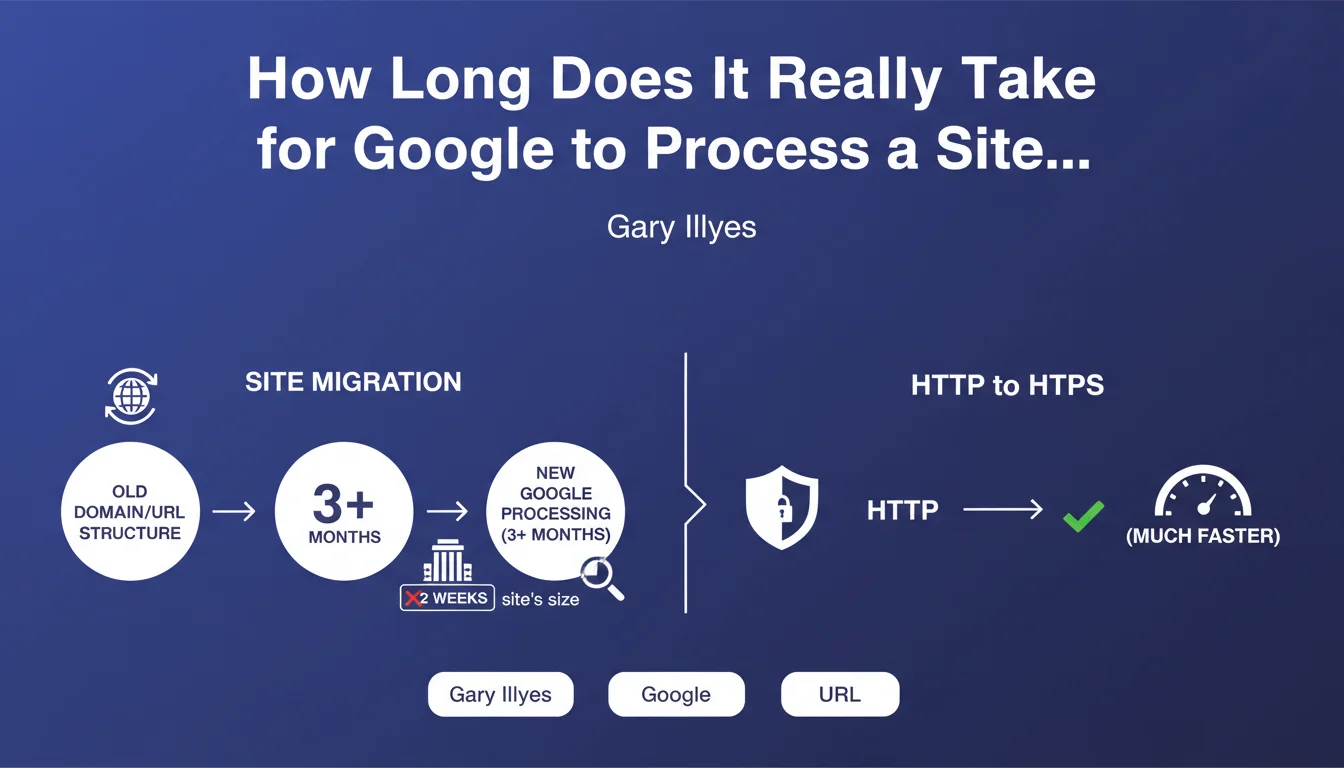
Official statement
What you need to understand
What Actually Impacts SEO During a Migration?
Contrary to common belief, simply changing the domain name is not in itself a major risk factor for SEO. Google considers this operation relatively neutral when properly managed with 301 redirects.
The real impacts come from structural modifications: CMS changes, design overhauls, URL restructuring, internal linking modifications, or content rewriting. These elements fundamentally transform how Google crawls, indexes, and evaluates your site.
Why Are These Structural Changes So Critical?
Each structural modification creates a new technical footprint that Google must relearn. A new CMS changes the HTML code, loading speed, and sometimes the semantic structure. A redesign modifies the user experience signals that Google monitors.
These changes can be positive or negative. A well-planned migration can fix technical issues, improve performance, and boost SEO. Conversely, a poorly executed migration can destroy years of optimization.
What Approach Should You Adopt to Minimize Risks?
The official recommendation advocates for a phased migration. Rather than changing everything simultaneously, it's safer to proceed sequentially: first the domain, then the CMS, then the structure.
This approach allows you to isolate problems and precisely identify the source of performance variations. If you lose 20% of traffic after changing everything at once, it's impossible to know whether it's the domain, the CMS, or the structure that's causing the problem.
- Changing the domain alone is relatively neutral for Google
- Impacts come from CMS, structure, design, and content modifications
- A migration can improve SEO if it fixes existing problems
- Migrating in stages allows you to identify and quickly correct issues
- Changing everything simultaneously makes diagnosis impossible in case of decline
SEO Expert opinion
Is This Phased Approach Always Practical in Reality?
The theory of sequential migration is excellent on paper, but it often faces business constraints. Separating a migration into multiple phases implies additional costs, technical resources mobilized for longer, and sometimes temporarily unsatisfactory compromises.
For small and medium-sized sites, a well-prepared atomic migration with a comprehensive preliminary audit often remains more realistic. The key lies in the quality of preparation: exhaustive URL mapping, pre-production testing, heightened post-migration monitoring.
What Are the Real Risks of a Grouped Migration?
The main danger is not so much the immediate ranking loss, but rather the inability to diagnose quickly. When multiple variables change simultaneously, you lose traceability of causes and effects.
In my experience, I've observed sites lose 40% of traffic after a complete migration, with teams unable to determine whether the problem came from misconfigured redirects, the new template that slowed down the site, or the new less-optimized URL structure.
When Does Phased Migration Become Essential?
For high organic traffic sites (over 100,000 SEO visits monthly), caution absolutely justifies the sequential approach. The financial risk of a prolonged decline is too significant to take shortcuts.
Similarly, sites with complex architecture (facets, filters, elaborate pagination) or a history of penalties must absolutely migrate in phases. Technical complexity multiplies potential failure points.
Practical impact and recommendations
What Should You Concretely Do Before Starting a Migration?
The first step is to conduct a comprehensive SEO audit of the existing site. Identify your most performing pages, analyze your link profile, map your current structure. This snapshot will serve as a reference to measure the impact of each change.
Then create an exhaustive redirect plan: each existing URL must have a clear destination. Prioritize direct 301 redirects rather than redirect chains. Test this mapping on a staging environment before production deployment.
If you opt for sequential migration, precisely plan the phases and their timelines. Allow at least 4 to 6 weeks between each stage to observe metric stabilization and complete indexing by Google.
What Mistakes Should You Absolutely Avoid During Migration?
The most common mistake is accidentally blocking indexing: restrictive robots.txt, forgotten noindex tags, misconfigured new CMS settings. Systematically verify these elements from launch.
Another classic trap: neglecting structured content migration. Schema.org data, Open Graph tags, image alt attributes must be preserved or improved, never lost in the transition.
Also avoid modifying editorial content at the same time as technical changes. If you need to rewrite pages, do it either before or after the technical migration, never during.
How Do You Effectively Monitor an Ongoing Migration?
Set up a daily monitoring dashboard: overall organic traffic, traffic by page type, positions on your strategic keywords, crawl rate in Search Console, 404 errors, and server response time.
Configure automatic alerts to be notified immediately in case of sudden drops. A 20% decrease in organic traffic within 48 hours requires urgent intervention to identify and correct the cause.
- Conduct a comprehensive SEO audit before migration to establish a reference baseline
- Create exhaustive mapping of all 301 redirects and test it in pre-production
- Verify that robots.txt and meta robots do allow indexing after migration
- Preserve all structured content elements (schema, tags, attributes)
- Separate technical migration from editorial content modifications
- Monitor key KPIs daily during the 6 weeks post-migration
- Configure automatic alerts to quickly detect anomalies
- Validate proper functioning of redirects and absence of 404 errors
- Submit new URLs via XML sitemap in Search Console
- Analyze server logs to verify that Googlebot properly crawls the new site
A website migration represents a complex technical project with multiple dimensions. Success depends on meticulous preparation, rigorous execution, and careful monitoring of indicators.
The sequential approach recommended by Google offers optimal security for large-scale projects, even though it requires more resources. For critical sites generating significant revenue via the organic channel, this caution is fully justified.
The technical complexity and expertise required to orchestrate these operations without compromising your visibility may justify support from a specialized SEO agency, capable of securing each step and intervening quickly in case of detected anomalies.
💬 Comments (0)
Be the first to comment.