
Official statement
What you need to understand
What exactly is negative SEO through canonical tags?
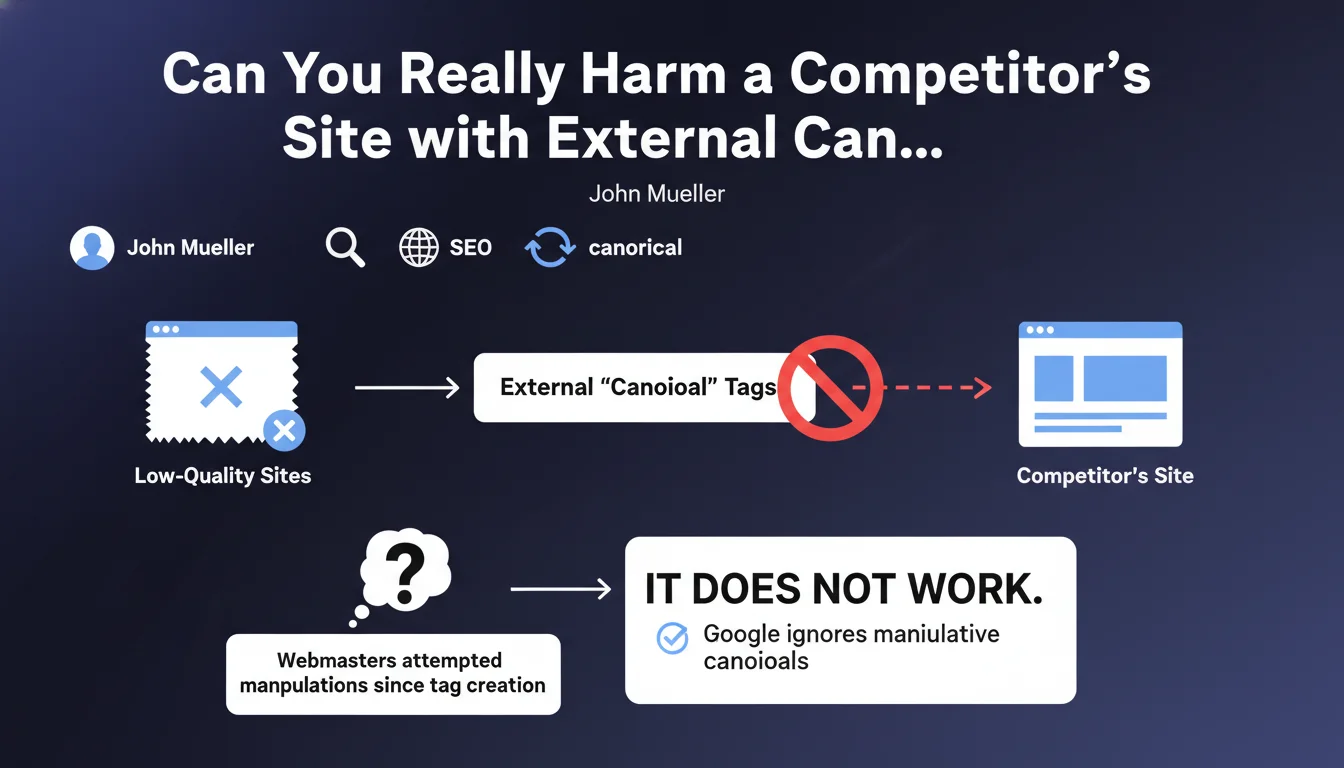
Negative SEO through canonical tags involves placing canonical tags on third-party low-quality sites that point to a competitor's site pages. The malicious objective is to trick Google by suggesting that the targeted site's content is a duplicate of mediocre content.
This technique relies on the hope that Google will follow these external signals and devalue the targeted site. However, John Mueller confirms that this manipulation has not worked since the creation of this tag.
Why is Google immune to this type of manipulation?
Google never takes into account external canonical tags coming from sites it does not consider legitimate or trustworthy. The search engine uses numerous signals to determine whether a canonical directive is valid and relevant.
Google's algorithms analyze signal consistency, the quality of issuing sites, and suspicious patterns. A multiplication of canonicals coming from spam sites is immediately identified as suspicious.
Does this statement mean I should ignore external canonicals altogether?
No, legitimate canonicals between trusted sites work perfectly. For example, a site that syndicates your content can legitimately point to your original version via a canonical tag.
The statement concerns only malicious manipulation attempts. You should therefore continue to use this tag correctly in your own duplicate content management strategies.
- External canonical tags from low-quality sites cannot harm your SEO
- Google automatically filters negative SEO attempts via canonical
- Legitimate canonicals between trusted sites remain effective and recommended
- This protection has existed since the creation of the canonical tag
- No corrective action is necessary if you are subjected to this attack
SEO Expert opinion
Is this statement consistent with real-world observations?
Absolutely. In 15 years of experience, I have never observed a real penalty caused by malicious external canonicals. Documented cases of effective negative SEO primarily concern massive toxic backlinks or content scraping, never canonical tags.
Google's robustness against this manipulation is explained by the very nature of the canonical tag: it's a suggestion signal, not an absolute directive. Google always retains its final decision-making power.
What nuances should be added to this statement?
However, there is a gray area: legitimate syndication sites that incorrectly use the canonical tag. If a trusted partner with strong authority points to your content but misuses this tag, it can create confusion.
Similarly, if you manage multiple legitimate domains and your cross-canonicals are misconfigured, this can indeed cause indexing problems. But this is not external negative SEO, it's an internal configuration error.
In which scenarios should you still monitor external canonicals?
Monitoring remains relevant in cases of syndication partnerships or content licensing. If you authorize republication of your content, verify that the canonicals correctly point to your original URLs.
Use Search Console to identify declared canonicals versus those selected by Google. If Google systematically ignores your legitimate canonicals, this indicates a trust or signal consistency problem that needs to be resolved.
Practical impact and recommendations
What should you do if you discover malicious canonicals pointing to your site?
The answer is simple: absolutely nothing. Google ignores them automatically, so any corrective action would be a waste of time. Don't waste energy contacting these sites or submitting disavows.
Instead, focus your efforts on optimizing your own canonical signals. Ensure that your internal tags are correctly configured and consistent with your site structure.
How can you verify that your own canonicals are correctly configured?
Use Search Console to compare the canonical URLs you declare with those Google actually selects. A systematic discrepancy indicates a configuration problem or contradictory signals.
Audit your canonical tags with tools like Screaming Frog to detect loops, redirect chains, or canonicals pointing to 404 pages. These technical errors are far more damaging than any external negative SEO.
- Completely ignore malicious canonicals from third-party low-quality sites
- Regularly verify consistency between your declared canonicals and those selected by Google in Search Console
- Audit your internal canonical tags to detect configuration errors (loops, chains, 404s)
- Document your syndication partnerships and verify that canonicals are correctly implemented
- Use self-referencing canonicals on your main pages to reinforce the signal
- Never configure a canonical to an external domain without a valid strategic reason
- Monitor orphan pages or URL variations that do not point to the canonical version
Negative SEO via external canonical tags is totally ineffective according to Google, and this protection has existed since the tag's creation. You can therefore safely ignore these manipulation attempts.
Focus on correctly configuring your own canonicals, as internal errors can genuinely impact your indexation. Technical management of canonicals, especially on complex sites with syndication or multilingual versions, requires deep expertise. If you notice persistent discrepancies between your directives and Google's choices, support from a specialized SEO agency can prove invaluable for diagnosing contradictory signals and optimizing your architecture in a coherent manner.
💬 Comments (0)
Be the first to comment.