
Official statement
Other statements from this video 5 ▾
- 2:08 Why has Google moved its official blog to HTTPS and what does it mean for your SEO?
- 5:59 Do mobile interstitials really harm Google's mobile-friendly signal?
- 7:02 Do legal interstitials truly escape Google's penalties?
- 13:59 Are intrusive interstitials really a ranking signal comparable to mobile-friendliness?
- 23:45 Does Google really treat AMP Cache URLs as original URLs for ranking?
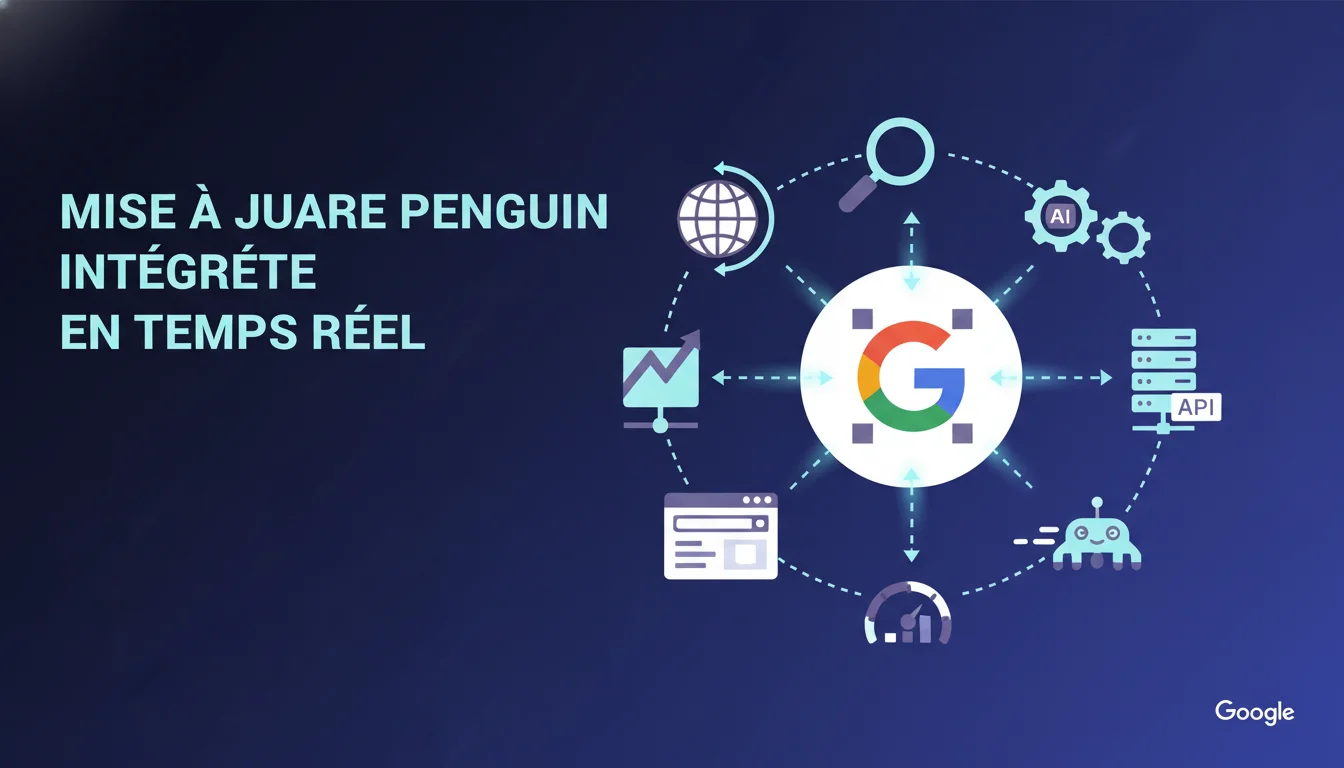
Penguin is no longer a periodic update but a permanent filter embedded in Google’s main algorithm. Sites penalized for manipulative or spammy backlinks now see their corrections accounted for as soon as Googlebot revisits, without waiting for a global refresh. This means disavowing toxic links or cleaning up your link profile can yield visible results in a few weeks, rather than months.
What you need to understand
What changes with real-time Penguin?
Before this integration, Penguin operated in waves. A penalized site had to wait for the next refresh - sometimes six months, a year - to see the impact of its link cleanup. This delay made diagnosis complex and recovery endless.
With its integration into the main algorithm, Penguin continuously evaluates links. Each time Googlebot indexes a page, it reassesses the quality of the backlinks pointing to it. If you have disavowed spammy domains or removed manipulative links, the engine can adjust your rankings as soon as the next crawl, without waiting for a global event.
Why did Google choose this approach?
The main reason: to reduce the frustration of legitimate webmasters. A site affected by negative SEO or outdated practices could remain stuck for months, even after corrective action. The real-time aspect allows for greater responsiveness and encourages prompt corrections rather than passive waiting.
Another advantage for Google: constant pressure on manipulators. There is no more predictable timeframe. Link spam tactics become risky continuously, not just before a scheduled update.
How can I tell if my site is under Penguin?
This is where it gets tricky. No specific Search Console notification indicates an algorithmic Penguin penalty. You need to cross-reference multiple indicators: a sudden drop in organic traffic correlated with a questionable link profile, targeted declines on competitive queries where you had over-optimized anchors, and no notified manual actions.
The diagnosis relies on analyzing the backlink profile (ratio of toxic to healthy domains, anchor distribution, spam patterns) and the visibility history. If you have engaged in aggressive link building - buying links, PBNs, comment farms - and your traffic has dropped without technical or content-related reasons, Penguin is likely the culprit.
- Penguin now operates continuously, not in separate waves: corrections to backlinks are evaluated over the crawl.
- No Search Console notification: diagnosis relies on link profile analysis and traffic trends.
- Reduced recovery time: a link cleanup can yield results within a few weeks after reindexing, versus several months before.
- The disavow file remains the main tool to report toxic backlinks that you cannot manually remove.
- Permanent risk: new link spam tactics face penalties as soon as detected, with no predictability window.
SEO Expert opinion
Does this statement align with on-the-ground observations?
Yes and no. The principle of real-time is validated by numerous field reports: sites that have cleaned their backlink profiles have seen traffic rebounds in 4 to 8 weeks, where it used to take 6 to 12 months. This is consistent with an ongoing reassessment during crawls.
But the reality is more nuanced. The timeline depends on crawl frequency. A site crawled daily will notice the impact faster than one crawled once a month. Google’s real time is not your real time if your crawl budget is low. [To verify]: Google never specifies how many crawls are necessary for a link correction to be fully acknowledged.
What are the gray areas that Google doesn't specify?
First gray area: the granularity of Penguin. Does the filter act page by page, on the entire domain, or by thematic cluster? Google remains vague. In practice, penalties often appear at the site section level (a spammy blog penalizes the entire domain) rather than on an isolated page.
Second gray area: the weighting of link signals. Penguin detects manipulation patterns, but which patterns exactly? Over-optimized anchors, massive reciprocal links, expired domains repurposed as PBNs, abnormal acquisition velocity... probably all of these. But the thresholds are never disclosed, making backlink auditing more art than science.
In what cases does this rule not apply as expected?
First case: if you are under manual action at the same time, disavowing links will not be sufficient. The manual action requires a reconsideration request via Search Console, and the timing has nothing to do with automatic crawling. Many SEOs confuse the two.
Second case: active and indexed backlinks. Disavowing a link via the Google Disavow Tool does not remove it from the web. If the link remains in place and indexed, Google must recrawl it to acknowledge that it has been disavowed. If the source page is never recrawled, the link continues to exist in the index. This is why manual removal is often preferred over pure disavowal.
Practical impact and recommendations
What should you do to comply with real-time Penguin?
First step: audit your entire backlink profile. Use Search Console, Ahrefs, Majestic, or Semrush to extract all referring domains and their anchors. Classify them by risk: paid links, low-quality directories, spam comments, site-wide footers, suspicious PBNs. The key criteria: thematic relevance and naturalness of the anchor.
Second step: attempt manual removal before disavowal. Contact the webmasters of toxic sites to request link removal. Keep a record (emails, screenshots). If there is no response within 2 weeks or if you receive a refusal, add the domain to the disavow file. This process takes time but is safer than blind mass disavowal.
What mistakes should you absolutely avoid?
Error number one: disavowing links without analysis. Many SEOs panic and disavow everything that seems "odd". The result: they kill legitimate editorial backlinks that supported their rankings. Real-time Penguin amplifies this error, as the impact is immediate.
Error number two: doing nothing while waiting for "it to pass". Previously, one might hope that a Penguin refresh would dilute the impact. Now, every day with active toxic links is a lost day for rankings. Passivity is costly.
How can I verify that the corrections are taking effect?
Monitor two key metrics: the average position on your target queries (Search Console, Reporting API) and the organic click-through rate. If you have disavowed toxic links and Googlebot has recrawled your site, you should observe a gradual rebound within 4 to 8 weeks.
You can also use the URL inspection tool in Search Console to force a crawl of key pages after submitting the disavow file. This accelerates the consideration process, even if Google doesn’t guarantee anything. Document every action (disavow date, pages crawled, position changes) to correlate cause and effect.
- Extract and audit the entire backlink profile via Search Console and third-party tools (Ahrefs, Majestic)
- Classify the links by risk level: obvious spam, questionable, legitimate
- Contact webmasters for manual removal of toxic links before disavowal
- Submit a Google disavow file (disavow.txt) for non-removable links
- Force crawl of key pages via the Search Console inspection tool
- Monitor traffic and position changes over 4 to 8 weeks post-disavowal
❓ Frequently Asked Questions
Combien de temps faut-il pour qu'un fichier de désaveu soit pris en compte par Penguin ?
Penguin en temps réel signifie-t-il que les pénalités disparaissent instantanément après nettoyage ?
Faut-il désavouer tous les liens d'annuaires ou de forums ?
Peut-on récupérer complètement d'une pénalité Penguin ou reste-t-il une trace ?
Dois-je désavouer les backlinks de mes concurrents qui font du negative SEO sur mon site ?
🎥 From the same video 5
Other SEO insights extracted from this same Google Search Central video · duration 39 min · published on 13/10/2016
🎥 Watch the full video on YouTube →
💬 Comments (0)
Be the first to comment.