
Official statement
Other statements from this video 5 ▾
- □ Google indexe-t-il vraiment le HTML et le PDF de manière indépendante ?
- □ Comment gérer efficacement le contenu dupliqué entre HTML et PDF ?
- □ Google privilégie-t-il vraiment le HTML face au PDF en cas de contenu dupliqué ?
- □ Faut-il vraiment inclure un lien vers son site dans chaque PDF publié ?
- □ Faut-il vraiment choisir entre HTML et PDF selon le support de consultation ?
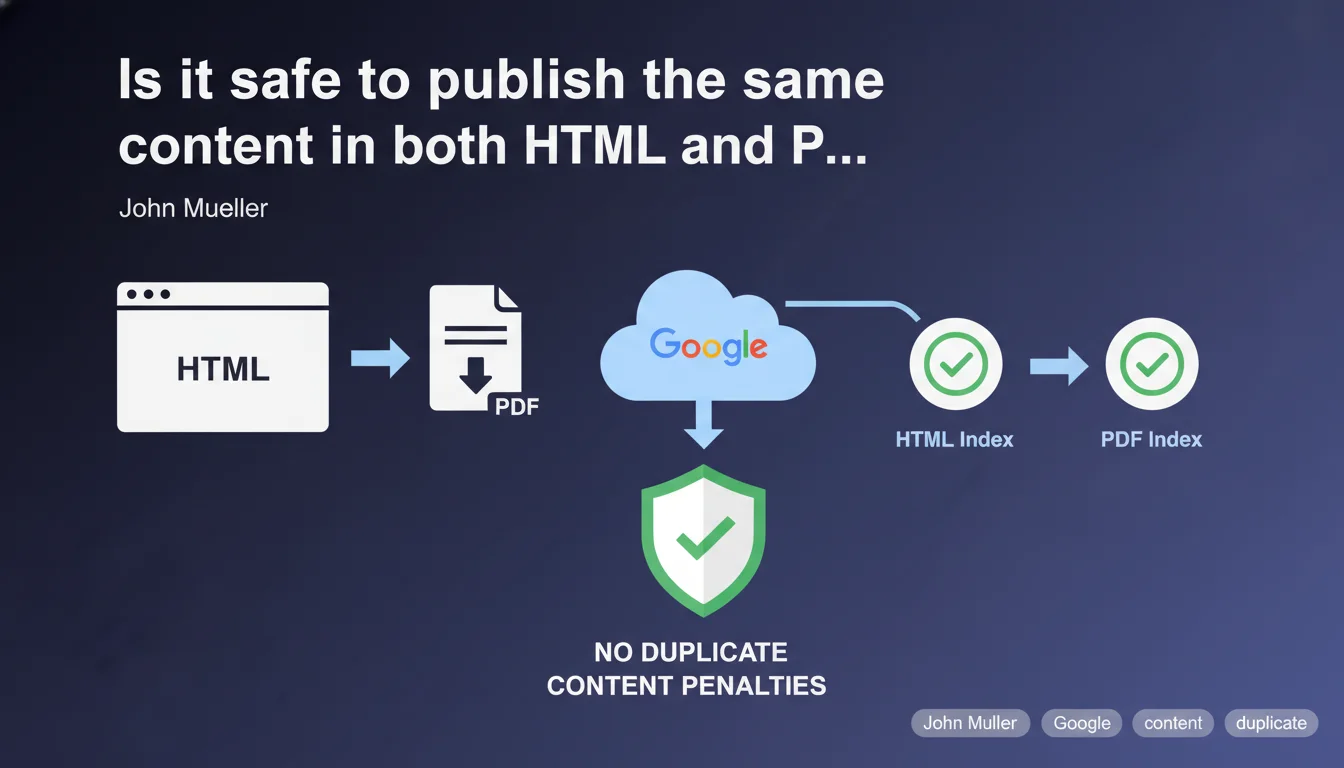
Google officially allows simultaneous publication of the same content in both HTML and PDF formats. Both versions can be indexed separately without duplicate content penalties. This clarification removes the ambiguity surrounding a common practice that has long been a source of concern for SEO professionals.
What you need to understand
Why was this clarification necessary?
The question of duplicate content between different formats has been lingering in the SEO community for years. Many websites offer downloadable resources (whitepapers, guides, reports) while displaying the same content on standard web pages.
The uncertainty stemmed from the classic anti-duplicate content doctrine. If Google indexes both versions, which one will it prioritize? Is there a risk of cannibalization? Mueller settles it: it is perfectly acceptable.
What does "indexed separately" mean in practice?
Google treats HTML and PDF as two distinct entities. Each can appear in search results depending on the search context. Users specifically looking for a downloadable PDF may find your file, while others will see the HTML page.
This dual presence is not considered manipulation. Google understands that both formats address different user needs: quick online consultation versus download for offline reading or printing.
What are the limits of this permission?
Mueller speaks of "the same content." This does not cover situations where you multiply slightly different versions to attempt ranking on more keywords. The permission concerns functional duplication, not strategic duplication.
- Both formats (HTML and PDF) can coexist without duplicate content penalties
- Google indexes and displays each version based on the user's search context
- This practice addresses distinct and legitimate user needs
- The permission does not extend to multiple strategic duplications
SEO Expert opinion
Does this statement really change the game?
Let's be honest: many sites were already publishing their content in dual format without observing flagrant penalties. This statement formalizes a tolerance that already existed in practice.
What is interesting is the explicit confirmation. We move out of the gray area. But be careful — Mueller is not saying it is optimal for SEO, just that it is "acceptable." Important nuance.
What risks remain despite this authorization?
The first pitfall: signal dilution. If your backlinks are distributed between the HTML version and PDF, neither benefits from full power. External links pointing to the PDF? Your HTML page benefits less from them.
Second point: user experience in the SERPs. Google may display both results for your domain, but it can also show only one depending on its diversification algorithm. You don't control this decision. [To verify]: no public data specifies the exact selection criteria between the two formats.
In what cases does this practice remain problematic?
If your PDF is poorly optimized (no extractable text, scanned images), Google will index it poorly or not at all. You then create a phantom version that consumes crawl budget without adding value.
Another limitation: indexed PDFs may appear with degraded user experience on mobile. The visitor who clicks from their smartphone ends up downloading a file instead of accessing a responsive page. The bounce rate skyrockets.
Practical impact and recommendations
Should you systematically offer a PDF version of your content?
No. This possibility only becomes relevant if the PDF brings real usage value: printing, offline consultation, easy sharing. A standard blog article does not need a PDF.
Reserve this duplication for long, structured content: whitepapers, case studies, comprehensive guides, reports. Content that users want to keep.
How do you optimize this HTML/PDF coexistence?
First, ensure your PDF is technically indexable. Extractable text, complete metadata (title, author, description), reasonable file size. A 50 MB PDF will never be crawled well.
Next, think about internal linking. From your HTML page, offer PDF download in a visible manner. This consolidates signals and directs the user according to their current need.
Finally, monitor performance in Search Console. If the PDF captures impressions but shows a catastrophic CTR, it is polluting your results. Then consider a noindex on the PDF.
- Verify that the PDF contains extractable text and complete metadata
- Limit this practice to long-form content with high added value
- Offer a visible link to the PDF from the HTML version
- Monitor the performance of both versions in Search Console
- Apply a noindex to the PDF if its CTR degrades overall performance
- Optimize the PDF file size to facilitate crawling and downloading
What strategy should you adopt to avoid shooting yourself in the foot?
The rule: one dominant format. Decide which version you want to see rank as priority. Usually, it is HTML — better UX, more control, easier tracking.
The PDF then becomes a complement, not a competitor. You can even noindex it if you want to guarantee that only the HTML page appears in search results, while still keeping it accessible for direct download.
Dual HTML/PDF publication is permitted, but must serve a clear user logic. Always prioritize one main format to concentrate your SEO signals, and monitor metrics to detect any unintentional cannibalization.
These decisions between formats, crawl budget management, and technical optimization can quickly become complex at scale. If your site offers numerous downloadable resources or if you are noticing inconsistencies in your organic performance, support from a specialized SEO agency can help you structure a coherent strategy and avoid common pitfalls of multi-format duplication.
❓ Frequently Asked Questions
Le PDF et le HTML vont-ils se cannibaliser dans les résultats de recherche ?
Dois-je utiliser une balise canonical entre le PDF et le HTML ?
Est-ce que publier un PDF améliore mon référencement ?
Que faire si mon PDF ranke mieux que ma page HTML ?
Les PDFs sont-ils bien crawlés par Google sur mobile ?
🎥 From the same video 5
Other SEO insights extracted from this same Google Search Central video · published on 12/12/2023
🎥 Watch the full video on YouTube →
💬 Comments (0)
Be the first to comment.