
Official statement
What you need to understand
What does the end of Penguin version numbering actually mean in practice?
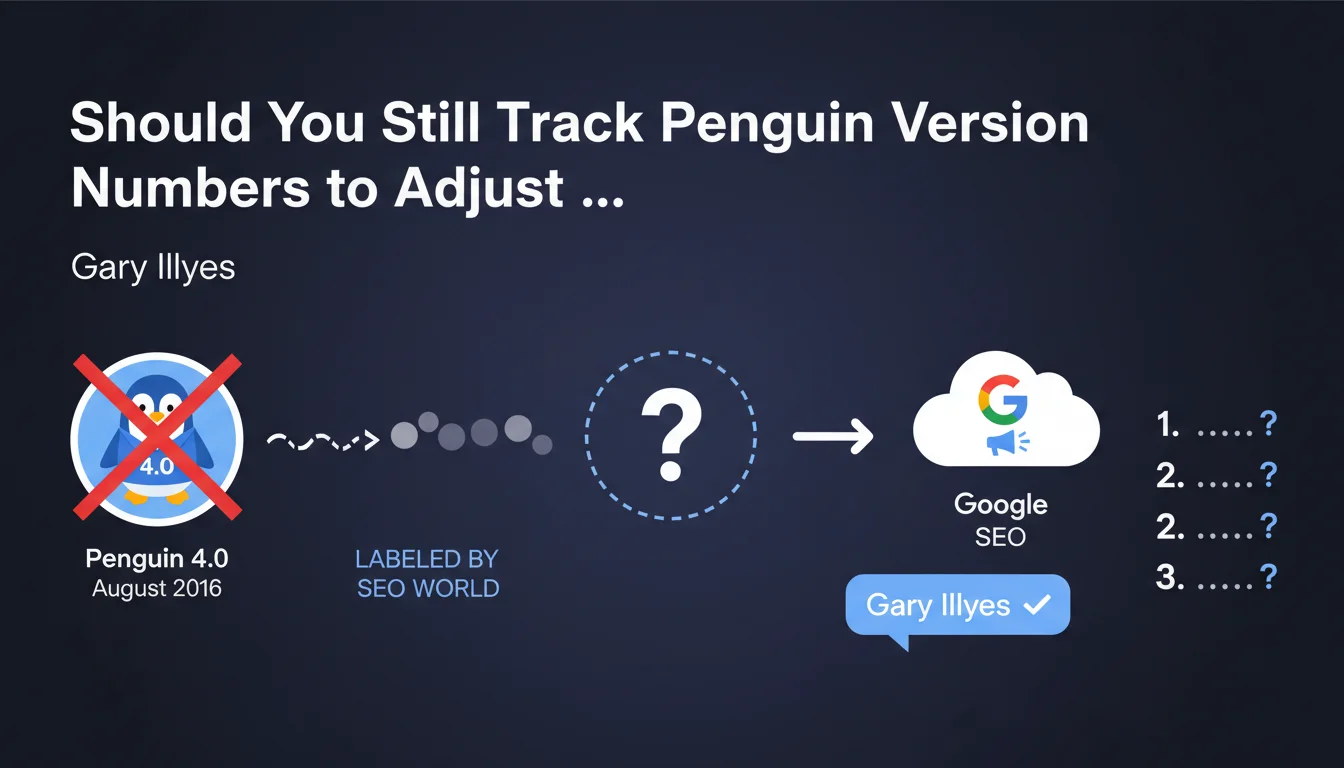
Gary Illyes confirmed that Google will no longer release numbered versions of its Penguin filter after version 4.0 deployed in August 2016. This version 4.0 marked the integration of Penguin into the core algorithm in real-time.
This decision ends a practice where the SEO community itself often assigned numbers to updates, sometimes without official confirmation from Google. From now on, Penguin operates continuously and transparently, without prior deployment announcements.
Why did Google make this decision?
Integrating Penguin into the main algorithm aims to make penalties and recoveries more fluid. Sites no longer have to wait months between two updates to see the impact of their corrections.
This approach reflects Google's desire to normalize link quality as a permanent ranking factor, just like content or technical aspects. Gone are the major rollouts that shook up organic search.
What are the implications for SEO performance monitoring?
- End of strategic waiting: you can no longer wait for a Penguin update to fix your link problems
- Continuous monitoring required: link profile must be audited regularly, not sporadically
- Progressive recovery: corrections made may show effects gradually, without an identifiable spike
- Less visibility: it becomes difficult to attribute a drop or increase specifically to Penguin
SEO Expert opinion
Is this real-time approach actually applied in practice?
Based on my observations across several hundred sites, Penguin's real-time effect is effective but progressive. Penalized sites that clean up their link profile generally see improvements within 4 to 8 weeks, not instantaneously.
However, the promise of a fully real-time algorithm remains relative. Google continues to recrawl and reevaluate links according to its own schedule, which can create unavoidable delays. Sites with a low crawl budget may wait longer.
What nuances should be added to this statement?
Although Google no longer announces numbered versions, algorithmic adjustments continue to take place. These modifications simply no longer carry the "Penguin" label but still affect link evaluation.
The SEO community tends to attribute any backlink-related fluctuation to Penguin, which creates confusion. In reality, many other factors (disavow, automated spam, domain quality) intervene simultaneously.
In what cases does this rule not apply completely?
Manual actions related to links remain distinct from algorithmic Penguin. If your site receives a manual penalty via Search Console, you will still need to submit a reconsideration request and wait for a human decision.
Furthermore, some heavily spammed sectors may still experience coordinated waves of demotion that resemble the old Penguin updates, even if Google no longer officially presents them as such.
Practical impact and recommendations
What should you do concretely to adapt to this change?
Adopt a preventive rather than reactive approach regarding your link profile. No longer count on update windows to correct your mistakes. Integrate link auditing as a recurring monthly task.
Regularly use Search Console and tools like Ahrefs or Majestic to monitor newly acquired backlinks. Quickly identify toxic links before they accumulate enough negative signal to impact your rankings.
- Set up automatic alerts for new backlinks detected on your domain
- Perform a complete audit of your link profile at least every 2-3 months
- Maintain an up-to-date disavow file, submitted to Google regularly if necessary
- Document the history of your actions (disavow, removal, acquisition) to track evolution
- Prioritize quality over quantity in your link acquisition strategy
What mistakes should you avoid in this new context?
Don't fall into the trap of inaction on the grounds that Penguin is automated. Some SEOs mistakenly think that a link profile "self-regulates" over time. This is false: toxic links remain toxic.
Also avoid mass disavowing as a precaution. The disavow tool should be used surgically, only on clearly problematic links. Excessive use can cause you to lose valuable link juice.
How can you effectively monitor Penguin's impact on your site?
Set up a consolidated SEO dashboard that correlates multiple metrics: organic traffic evolution, positions on strategic keywords, crawl rate, and new backlinks. Patterns become visible when you cross-reference this data.
Particularly monitor progressive visibility drops on specific pages rather than across the entire site. Penguin can target certain sections if they concentrate artificial links, unlike a global manual penalty.
- Segment your analysis by page type (categories, products, blog)
- Compare your link profile with that of your direct competitors in your niche
- Test the correlation between new link acquisitions and ranking changes
- Use Search Console data to identify pages losing impressions
The integration of Penguin in real-time fundamentally transforms link building management: from a one-time tactic, it becomes a continuous monitoring discipline. This increased complexity of monitoring and the expertise required to correctly interpret weak signals make support from a specialized SEO agency particularly relevant, especially for sites with a complex link history or high competitive exposure requiring in-depth strategic monitoring.
💬 Comments (0)
Be the first to comment.