
Official statement
Other statements from this video 7 ▾
- □ Pourquoi Google a-t-il besoin d'une équipe SEO dédiée pour son propre site ?
- □ Comment Google départage-t-il vraiment les avis produits de qualité ?
- □ Faut-il vraiment réagir vite après une mise à jour algorithmique de Google ?
- □ Faut-il maintenir une copie statique de votre site lors d'une mise hors ligne temporaire ?
- □ Faut-il vraiment s'inquiéter si votre page d'accueil n'a pas de H1 ?
- □ Pourquoi Google refuse-t-il de fixer une date finale pour l'indexation mobile-first ?
- □ Faut-il paniquer quand Google Search Console signale des erreurs de redirection ?
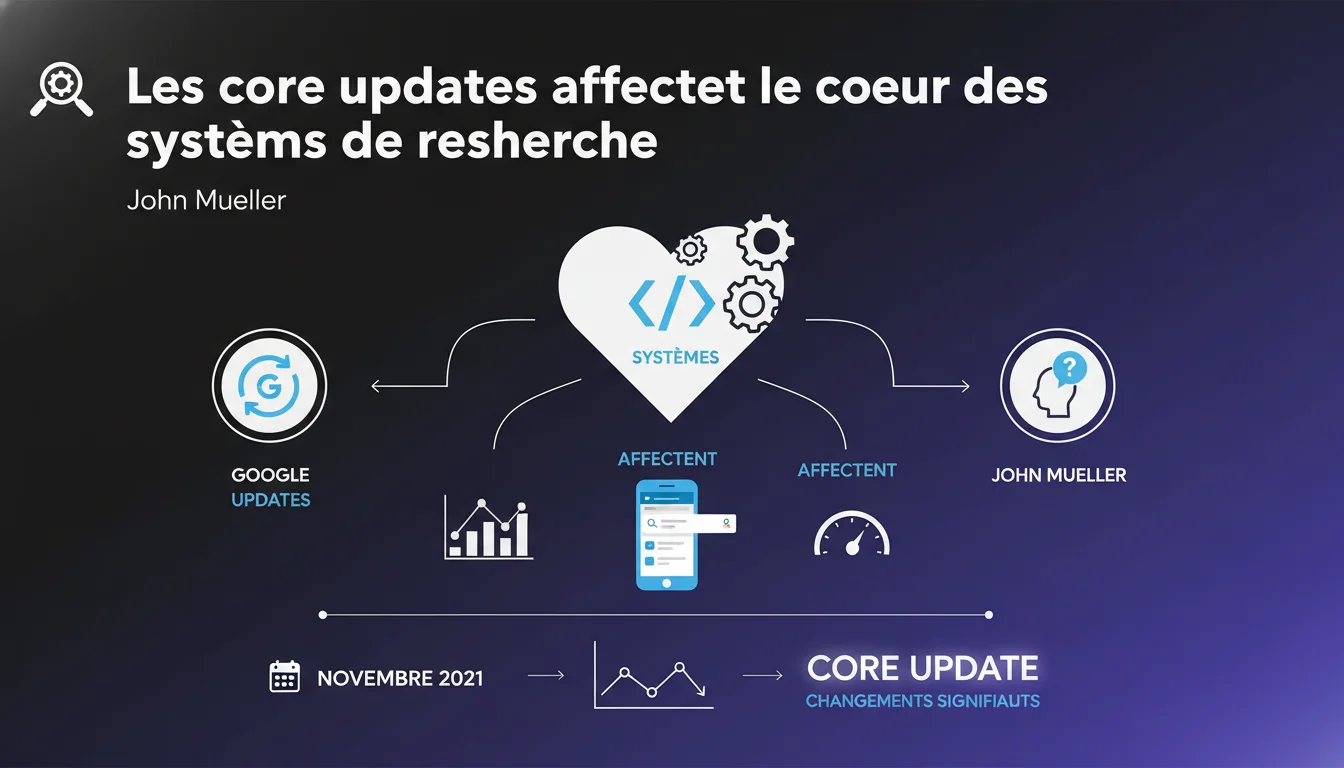
Core updates directly modify Google's central systems, not just secondary parameters. These updates can cause massive fluctuations in SERP and Discover. Unlike targeted adjustments, they reevaluate the quality and relevance of content on a large scale.
What you need to understand
What does it really mean to "affect the heart of systems"?
Google distinguishes its core updates from minor algorithm adjustments. These updates touch the very foundations of page evaluation — how the engine judges quality, relevance, and authority.
Specifically, a core update does not target an isolated criterion. It recalibrates the entire scoring system. A site can lose 40% of traffic without making any changes — simply because the criteria of what constitutes a "good result" have evolved.
How does this differ from other updates?
Targeted updates (historically Penguin, Panda) penalized specific practices: link spam, duplicate content. Core updates are more diffuse. They reevaluate overall hierarchy without necessarily penalizing anything specific.
The result: it’s impossible to point to a "correctable error." Recovery after a core update often requires a deep qualitative overhaul, not a quick technical fix.
Why specifically mention Discover?
Discover operates on quality and engagement signals similar to those of traditional SERPs. A core update that recalibrates these signals also affects recommended content in Discover.
For sites reliant on Discover traffic (news, lifestyle, tech), a core update can cut off traffic overnight. The rules of what "deserves" to be recommended change, often without detailed explanation.
- Core updates modify fundamental criteria of quality and relevance
- They cause massive fluctuations without necessarily a targeted penalty
- Discover is also impacted as it relies on similar quality signals
- Impossible to correct a precise "error" — you need to improve overall quality
- Traffic variations can reach 30-50% without any changes to the site
SEO Expert opinion
Is this statement consistent with real-world observations?
Yes and no. Core updates indeed cause dramatic changes. We regularly see sites lose or gain 40-60% organic traffic in a matter of days. That’s factual.
The problem: saying they "affect the heart of the systems" remains extraordinarily vague. Google never specifies which components of the "heart" are modified. E-E-A-T signals? Fresh content weight? Domain authority? [To be verified] — we are navigating in the dark.
Post-update analyses often reveal patterns: YMYL sites are scrutinized more, thin content is devalued, high authority sites are favored. But Google officially confirms nothing. We are left with correlations, not proven causalities.
What nuances should be added to this claim?
Not all sites are affected equally. YMYL niches (health, finance) typically experience stronger shocks. E-commerce sites may see their categories shifted without apparent logic.
Another point: timing. A core update often rolls out over 1-2 weeks for full deployment. Fluctuations can therefore be gradual, not instantaneous. And some sites may partially recover in the weeks following — a sign that Google is continuously adjusting after the initial rollout.
In what cases does this logic not apply?
If your site experiences a drop outside of core update periods, it’s probably not related to the "heart of systems." Instead, look for a technical issue (indexing, crawling, Core Web Vitals), a manual penalty, or a competitor boosting their authority.
Similarly, ultra-niche sites with little competition sometimes see no impact. Core updates primarily target competitive queries where Google must cut through dozens of similar results.
Practical impact and recommendations
What should you do concretely after a core update?
First, don’t panic. Wait 2-3 weeks to see if fluctuations stabilize. Google continues to adjust post-rollout, and some variations correct themselves.
Next, segment your analysis. Identify which page categories lost traffic: blog posts? Product listings? Category pages? Patterns often reveal what Google has devalued (thin content, lack of authority, poor user experience).
Avoid blind corrections. Adding 500 words to every article or stuffing keywords won't help. Focus on real qualitative improvement: demonstrated expertise, cited sources, updating outdated data.
Which signals should be prioritized to recover traffic?
Sites that recover after a core update have generally strengthened their E-E-A-T. This includes detailed author bios, mentions of authoritative sources, and transparency about who is behind the content.
On the technical side: check that your Core Web Vitals are in the green. Google has confirmed that user experience is part of overall quality signals. A slow site with poor CLS will be disadvantaged, even if the content is good.
Another underestimated lever: internal linking. Important pages should receive links from related content. Google evaluates the site's structure to understand what you consider a priority.
How can you anticipate future core updates?
It’s impossible to predict precisely. However, you can reduce your vulnerability. Regularly audit your content: remove or improve low-value pages, update outdated data, consolidate articles that cannibalize the same keywords.
Diversity your traffic sources. A site relying 80% on SEO is at the mercy of a core update. Email, social networks, partnerships — anything that reduces reliance on Google limits potential damage.
- Wait 2-3 weeks after the rollout to assess the real impact
- Segment your analysis by page type (blog, products, categories)
- Strengthen E-E-A-T signals: identified authors, cited sources, visible expertise
- Check that Core Web Vitals are optimal (LCP, CLS, INP)
- Enhance internal linking to strategic pages
- Audit and prune low-value content
- Update outdated data and enrich high-performing content
- Diversify acquisition channels to reduce reliance on SEO
❓ Frequently Asked Questions
Une core update peut-elle pénaliser un site qui n'a rien changé ?
Combien de temps faut-il pour récupérer après une core update ?
Les core updates affectent-elles toutes les langues et tous les pays ?
Faut-il attendre la prochaine core update pour récupérer ?
Peut-on prévoir les critères modifiés par une core update ?
🎥 From the same video 7
Other SEO insights extracted from this same Google Search Central video · published on 23/12/2021
🎥 Watch the full video on YouTube →
💬 Comments (0)
Be the first to comment.