
Official statement
Other statements from this video 7 ▾
- □ Does Google’s core updates really impact the foundational algorithm?
- □ Is it true that Google really prioritizes high-quality product reviews?
- □ Should you really react quickly after a Google algorithm update?
- □ Should you maintain a static copy of your site during temporary downtime?
- □ Should you really worry if your homepage lacks an H1?
- □ Why is Google refusing to set a final date for mobile-first indexing?
- □ Should you panic when Google Search Console reports redirect errors?
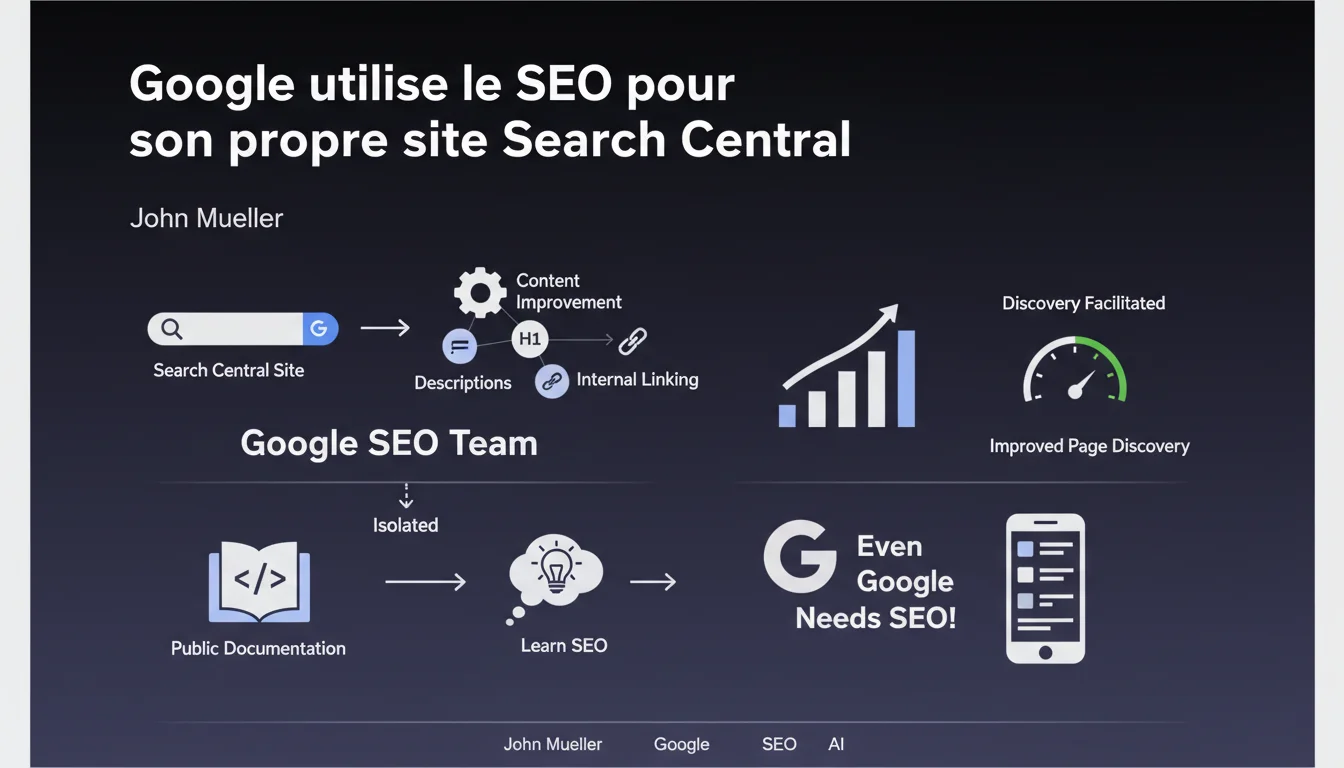
Google's SEO team optimizes Search Central (titles, internal linking, content) solely using public documentation — the same resources available to practitioners. This team operates completely independently from the research teams, confirming that even the engine's publisher must follow the same SEO rules as everyone else.
What you need to understand
What does this statement reveal about the separation of teams at Google?
The central takeaway: The Search Central SEO team has no privileged access to the inner workings of the algorithm. They optimize the site using the same public resources as any practitioner — Search Console, official documentation, general recommendations. This isolation is not anecdotal. It shows that Google applies the same internal separation it imposes on its own products to avoid any conflict of interest. The team that writes the guidelines does not receive algorithmic favoritism. Search Central accumulates thousands of pages of technical documentation. Without a coherent internal linking structure, optimized titles, or relevant descriptions, even Google Search struggles to surface the right content at the right time. The classic problem: quality content that remains invisible due to a lack of clear architecture. Google's teams face the same constraints as any business website — organizational silos, increasing page volumes, navigation that deteriorates over time. It's hard to deny the symbolic aspect. By publicly admitting that it optimizes its own site, Google sends a message: SEO remains essential, even when controlling the engine. But beyond the storytelling, the statement reflects an operational reality. Google’s product teams do not necessarily master the subtleties of organic SEO — just like the technical teams in most businesses.Why would Google need SEO on such a strategic site?
Is this approach a communications operation?
SEO Expert opinion
Does this statement match on-the-ground observations?
Yes, and it's consistent with what has been observed for years: No Google site benefits from visible favoritism in the SERPs. Search Central, Android Developers, Chrome DevTools — all these official domains have to compete to rank, just like any other site. The most telling indicator? Google’s documentation pages sometimes appear behind third-party sites (Stack Overflow, specialized forums) for certain technical queries. If an internal algorithm favored Google properties, this phenomenon wouldn’t occur. That’s where it gets interesting. If Google’s SEO team relies solely on public documentation, it means two things: either this documentation is complete enough to optimize a complex site, or the internal SEO team faces the same gaps as we do. Let's be honest — we know that some areas remain unclear in the official guidelines. The exact operation of EAT, the weighting of ranking signals, the quality thresholds: [To be verified] that these elements are perfectly documented. The internal SEO team probably navigates with the same uncertainties as external practitioners. Saying that Google does SEO on Search Central is one thing. Claiming that this approach proves the universal effectiveness of the official recommendations is another. The fundamental difference: Search Central does not suffer from algorithmic penalties. No risk of massive deindexing, no sudden drops in a Core Update, no manual spam actions. The internal SEO team optimizes in a protected environment — which is not the case for 99% of sites.What does this isolation say about the reliability of public recommendations?
What limitations should we place on this statement?
Practical impact and recommendations
Should you follow exactly the same practices as Google's SEO team?
The priorities mentioned — content, titles, descriptions, internal linking — remain fundamentals. However, mechanically applying this list without context would be a mistake.
On a 50,000-page e-commerce site, internal linking plays differently than on a documentation site. On a news site, titles optimized for CTR may sometimes take precedence over semantic accuracy. Contextualizing the recommendations is more important than just copying and pasting. Start by auditing areas where discoverability is a problem. Orphan pages, poorly linked sections, critical content buried five clicks from the homepage — exactly the issues Google addresses on Search Central. Then review the elements that directly impact the SERPs: overly generic titles, missing or duplicated meta descriptions, inconsistent Hn hierarchy. These projects don’t require a colossal budget, just diligence. Set up segmented tracking in Search Console. Isolate the optimized URLs, compare their progress over 3-6 months. If impressions increase but clicks do not, the issue likely lies with the titles or descriptions. And here’s where it gets tricky: orchestrating these projects on a medium or large site requires solid technical expertise, appropriate tools, and most importantly, time. Many businesses underestimate the complexity of internal linking or the overhaul of metadata at scale. Partnering with a specialized SEO agency can accelerate these optimizations while avoiding costly mistakes — traffic regressions, keyword cannibalization, over-optimization. An external perspective often identifies invisible levers internally.What should you prioritize checking on your own site?
How can you ensure that these optimizations yield results?
❓ Frequently Asked Questions
L'équipe SEO de Google a-t-elle accès à des informations privilégiées sur l'algorithme ?
Quels sont les chantiers SEO prioritaires de Google sur Search Central ?
Cette déclaration prouve-t-elle que les recommandations officielles de Google fonctionnent vraiment ?
Pourquoi un site comme Search Central aurait-il besoin de SEO ?
Faut-il reproduire exactement les mêmes pratiques SEO que Google sur son propre site ?
🎥 From the same video 7
Other SEO insights extracted from this same Google Search Central video · published on 23/12/2021
🎥 Watch the full video on YouTube →
💬 Comments (0)
Be the first to comment.