
Official statement
Other statements from this video 4 ▾
- □ What technical problems are really dragging down e-commerce sites in Google search results?
- □ Does Google really offer free tools to help e-commerce businesses identify their SEO problems?
- □ Why does Google refuse to provide platform-specific SEO recommendations for e-commerce solutions?
- □ Is Google finally showing you which technical SEO fixes will actually move the needle for your e-commerce site?
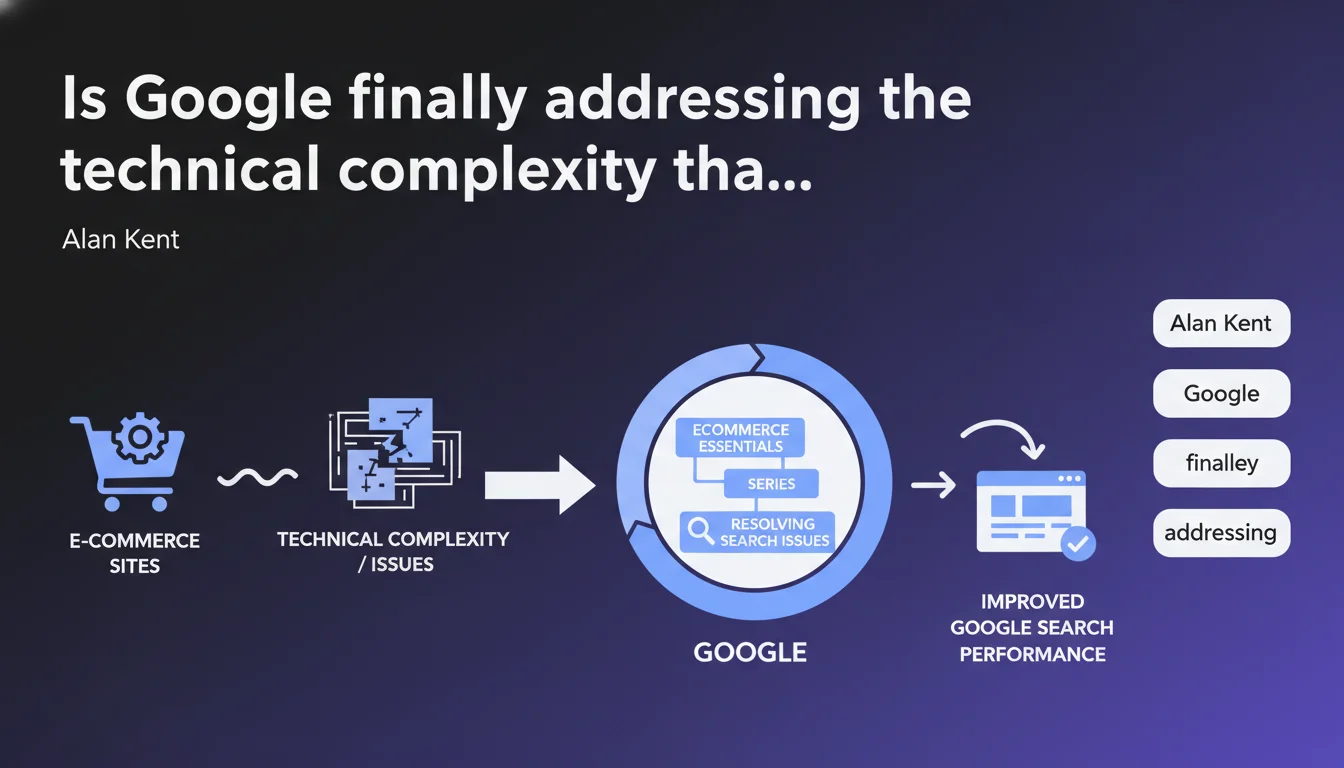
Google is rolling out 'Ecommerce Essentials', a content series targeting recurring problems that online stores face in search results. The initiative aims to clarify friction points specific to e-commerce — product indexation, duplicate content, faceted navigation. A clear signal that Google acknowledges the technical complexity of this sector.
What you need to understand
What exactly is this 'Ecommerce Essentials' series?
Google Search Central is launching a dedicated format for e-commerce sites, led by Alan Kent. The stated goal: address specific challenges that online stores face in organic search results.
Unlike the usual generalist guidance, this series targets concrete problems: managing product variants, optimizing navigation filters, structuring rich data, handling user-generated content. Google is implicitly acknowledging that e-commerce comes with technical constraints that regular websites don't face.
Why is Google targeting e-commerce specifically right now?
Online stores account for a massive share of commercial search queries — and generate considerable advertising revenue through Shopping. Google therefore has a direct stake in ensuring these sites are well-indexed and performing well.
Let's be honest: many e-commerce sites are SEO disasters. Chaotic pagination, duplicate content between variants, filtered pages crawled infinitely, empty product sheets. This series is both a helping hand and a reality check.
What common problems is this initiative targeting?
Google hasn't yet detailed the full program, but we can anticipate the classic issues poisoning e-commerce:
- Wasted crawl budget on filtered URLs with no added value
- Duplicate content between color, size, or packaging variants
- Product structured data poorly implemented or inconsistent
- Faceted navigation generating thousands of indexable URLs
- Customer reviews and UGC unexploited or poorly marked up
- Mobile performance degraded by heavy product sliders
SEO Expert opinion
Does this series really change anything for practitioners?
Honestly, it depends. If Google just recycles the same generic advice on canonicals and noindex, the initiative will fall flat. E-commerce SEOs already know these basics — the problem is that e-commerce tools themselves make implementation difficult.
Shopify, WooCommerce, PrestaShop, Magento: they all impose structural constraints that complicate optimization. A useful series should address these real technical limitations, not just repeat that you need to avoid duplicate content. [To verify] whether Google will go into this level of granularity.
Will Google finally clarify how to handle product variants?
This is THE question every e-commerce SEO asks. Should you create one URL per color? Group under one canonical URL? Use JavaScript selectors without changing the URL? Official recommendations have been vague for years.
If this series delivers clear answers — with concrete examples from real sites — then yes, it will have value. But if we stay in "it depends on context" territory, we'll have gained nothing.
Should we expect algorithmic changes after this series launches?
Possibly. Google doesn't launch this kind of initiative out of philanthropy. If the Search Central team invests in targeted educational content, it's often a prelude to stricter criteria or a specific update.
Practical impact and recommendations
What should you do immediately to anticipate this series?
Even without knowing the exact content, you can start with a technical audit focused on e-commerce pain points. Check your crawl management, canonicals, and Product structured data.
List the gray areas on your site — those technical decisions made two years ago that nobody really remembers. When Google publishes its recommendations, you'll know exactly where you're vulnerable.
What mistakes should you absolutely avoid before the series launches?
Don't rush to change elements that are working. If your variants are indexed and performing, now isn't the time to canonicalize everything on principle. Wait to see what Google actually recommends.
Also avoid mass-blocking entire sections via robots.txt "just in case". Crawl budget is a real problem, but over-blocking is just as bad — especially if you have strategic categories driving traffic.
How do you prepare your site for Google's future recommendations?
- Audit your indexed URLs via Search Console — identify suspicious patterns (filters, sessions, tracking)
- Verify consistency of your Product structured data (price, availability, reviews) with the Rich Results Test
- Analyze your crawl budget: which pages does Googlebot visit most? Are they strategic?
- Test your canonicals on product variants — are they correctly applied and respected?
- Document your current technical choices so you can adjust quickly if needed
- Monitor the publication of series episodes and cross-reference with your own field observations
❓ Frequently Asked Questions
Cette série remplace-t-elle les guidelines générales de Google ?
Faut-il tout revoir sur mon site avant la fin de la série ?
Les plateformes comme Shopify ou WooCommerce sont-elles compatibles avec ces futures recommandations ?
Google va-t-il pénaliser les sites qui ne suivent pas ces recommandations ?
Cette série concerne-t-elle uniquement les gros sites e-commerce ?
🎥 From the same video 4
Other SEO insights extracted from this same Google Search Central video · published on 13/04/2022
🎥 Watch the full video on YouTube →
💬 Comments (0)
Be the first to comment.