
Official statement
Other statements from this video 7 ▾
- □ Pourquoi Google a-t-il besoin d'une équipe SEO dédiée pour son propre site ?
- □ Pourquoi les core updates de Google touchent-elles au cœur même de l'algorithme ?
- □ Comment Google départage-t-il vraiment les avis produits de qualité ?
- □ Faut-il maintenir une copie statique de votre site lors d'une mise hors ligne temporaire ?
- □ Faut-il vraiment s'inquiéter si votre page d'accueil n'a pas de H1 ?
- □ Pourquoi Google refuse-t-il de fixer une date finale pour l'indexation mobile-first ?
- □ Faut-il paniquer quand Google Search Console signale des erreurs de redirection ?
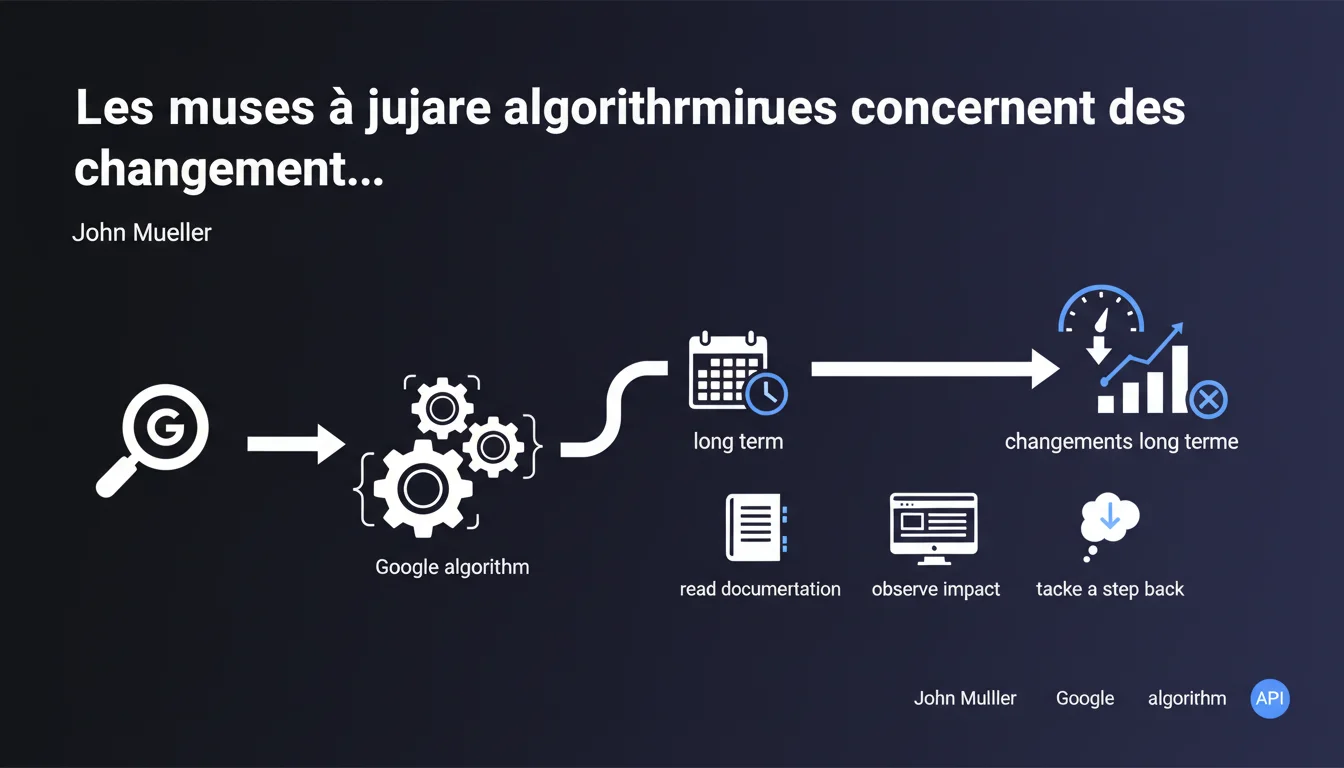
Google's algorithm updates aim at long-term structural changes, not superficial adjustments. Rushing to make quick modifications is counterproductive—it's better to observe the real impact over several weeks before intervening. Official documentation should always be your first reflex.
What you need to understand
Why does Google emphasize long-term considerations?
Algorithm updates do not target one-off tactical optimizations, but rather deep signals of quality and relevance. Google aims to adjust the way its engine evaluates the value of content over time.
A site that loses traffic after an update typically does not need a quick fix. It needs a strategic overhaul of its value proposition, perceived expertise, or content structure.
What does this approach really change?
Unlike past SEO practices where each update triggered a wave of micro-adjustments (keyword density, meta tags, internal links), Google now asks you to take a step back. Observe trends for a minimum of 4 to 6 weeks.
Quick adjustments may distort analysis. If you modify 20 pages the day after an update, it’s impossible to know whether recovery is due to your changes or a natural stabilization of the algorithm.
What pitfalls should you avoid?
The first reflex after a drop in traffic is often panic. Massively rewriting content, deleting pages, or changing the architecture—these actions can worsen the situation if not based on factual analysis.
- Observe without making changes for at least 2 to 3 weeks after the official announcement of an update.
- Consult Google's documentation (Search Central, quality guidelines) before any intervention.
- Measure real impact with segmented data (by page type, query, intention) rather than global trends.
- Avoid simultaneous massive changes that make causal attribution impossible.
- Prioritize structural adjustments (expertise, depth, originality) over superficial technical optimizations.
SEO Expert opinion
Is this statement consistent with observed practices in the field?
Yes and no. In the case of major Core Updates, field observation confirms that sites that rebound rarely do so through quick adjustments. They restructure their editorial approach, strengthen E-E-A-T, and deepen content—efforts that take months.
On the other hand, some targeted updates (Spam Updates, Product Reviews) sometimes show quick recoveries after fixing specific issues. The nuance that Mueller does not detail: it all depends on the type of update. [To be verified] based on the exact nature of the affected algorithm.
What nuances should be added to this recommendation?
"Taking a step back" does not mean "doing nothing." If a Spam update affects your site because you have automatically generated content or massive toxic links, waiting 6 weeks is suicidal.
The real message: distinguish urgent corrections (guideline violations, manual penalties) from strategic optimizations that require analysis and time. Google does not say "never intervene quickly"; it says, "don’t panic with random changes."
In what cases does this rule not apply?
Several clear exceptions:
Manual penalties require immediate corrective action and a reconsideration request. Critical technical issues (blocked indexing, massive server errors, brutal cannibalization after migration) must be corrected without delay.
Updates related to Spam or Security have binary criteria: either you comply or you don’t. In these cases, quick correction is not only possible but recommended. Mueller primarily talks about Core Updates and adjustments to general relevance.
Practical impact and recommendations
What should you do immediately after an update?
First step: identify the type of update. Core Update, Spam, Product Reviews, Helpful Content? Each has its own evaluation criteria. Google Search Status Dashboard and official announcements on X (formerly Twitter) are your primary sources.
Next, segment the analysis. Which categories of pages have dropped? Which queries have lost positions? Informational pages, transactional ones, or both? A global drop and a targeted drop do not call for the same response.
During this observation phase, do not alter existing content unless there’s an obvious bug. Document hypotheses, prepare a data-based action plan—but do not deploy anything until you have a clear view of the impact’s scope and stability.
What mistakes should you absolutely avoid?
Massive content rewriting "to make it new" is the classic error. Google doesn’t need you to rephrase 200 articles—it wants to know if your content provides unique and verifiable value.
Another trap is copying what rising competitors are doing. Their gains may come from signals you don’t see (fresh backlinks, UX signals, thematic authority built over months). Imitating their page structure won't replicate their results.
- Do not massively alter content within 14 days of a confirmed update.
- Analyze data by segment (page type, search intent, level of competition) rather than globally.
- Consult Google's official documentation related to the announced update.
- Avoid "quick fixes" (over-optimizing tags, keyword stuffing, massive redirections) without factual diagnosis.
- Prepare a detailed action plan with testable hypotheses before any deployment.
- If possible, measure the impact of each modification in isolation (A/B tests, progressive deployment).
How to build a resilient strategy in the face of updates?
Rather than reacting to algorithms, anticipate their criteria. Core Updates consistently value demonstrable expertise, originality of angles, depth of treatment. A site that continually builds these foundations experiences less volatility.
Enhance E-E-A-T signals: identified authors with verifiable biographies, cited sources, regular updates to sensitive content (health, finance, legal). These criteria are non-negotiable on YMYL topics.
Algorithm updates reward foundational strategies, not cosmetic adjustments. Observing, analyzing, and then intervening in a targeted manner is more effective than reflexive reactions. Google's documentation remains your compass—and if the guidelines remain vague, always prefer real user experience over assumptions about the algorithm.
These diagnostics and strategic overhauls require sharp expertise and a long-term vision that is hard to build internally without dedicated resources. For complex projects or heavily impacted sites, the support of a specialized SEO agency can accelerate the identification of structural levers and avoid costly mistakes in time and traffic.
❓ Frequently Asked Questions
Combien de temps attendre avant de modifier son site après une mise à jour algorithmique ?
Les petits ajustements techniques peuvent-ils aider à récupérer du trafic perdu ?
Comment savoir si mon site est impacté par une mise à jour spécifique ?
Faut-il supprimer du contenu après une baisse de trafic ?
Les mises à jour peuvent-elles être partiellement annulées par Google ?
🎥 From the same video 7
Other SEO insights extracted from this same Google Search Central video · published on 23/12/2021
🎥 Watch the full video on YouTube →
💬 Comments (0)
Be the first to comment.