
Official statement
Other statements from this video 4 ▾
- □ Les nouveaux TLD (.space, .tech, .xyz) pèsent-ils vraiment le même poids SEO qu'un .com ?
- □ Faut-il choisir www ou non-www pour optimiser son référencement naturel ?
- □ Un ccTLD peut-il vraiment servir de domaine global sans pénaliser le SEO international ?
- □ Les ccTLD empêchent-ils vraiment le géociblage multi-pays ?
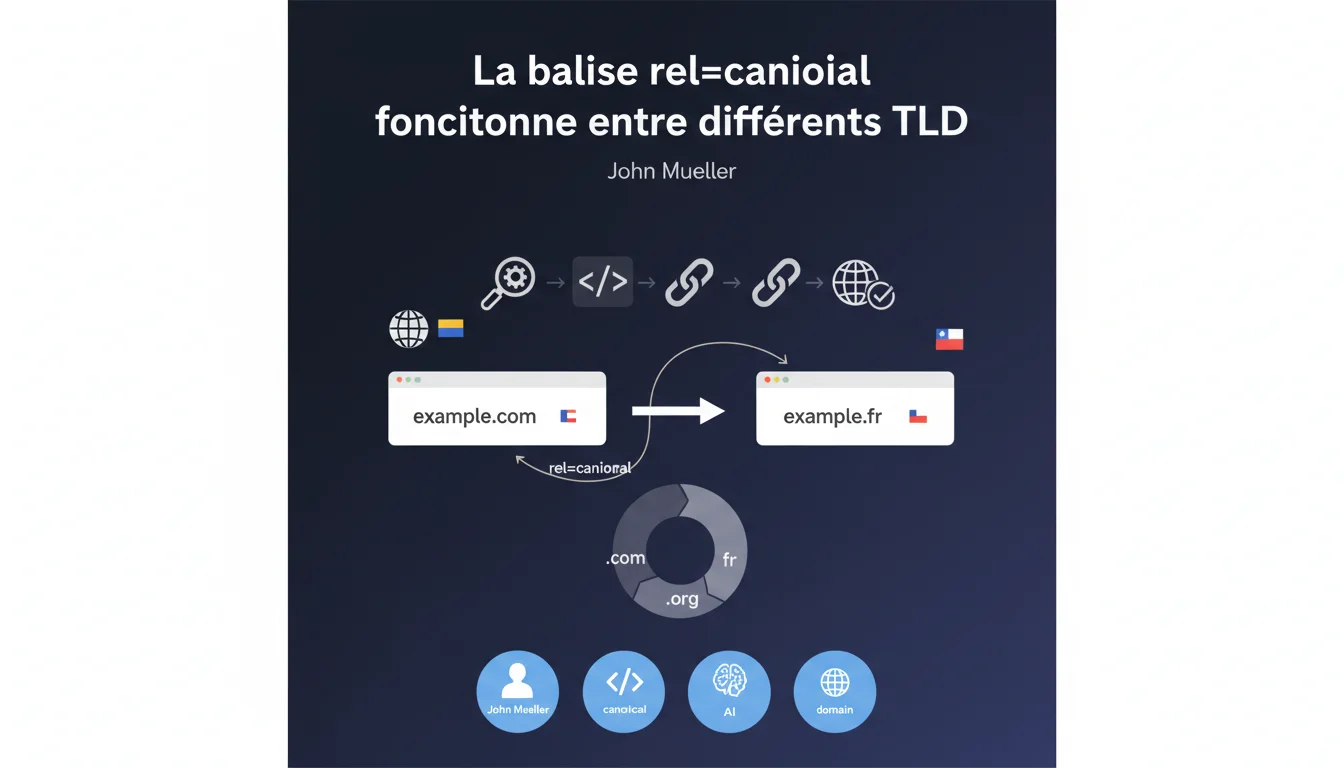
Google confirms that the rel=canonical tag works across different top-level domains, including between distinct country-code TLDs. This flexibility allows for cross-domain canonicalization without any technical restrictions related to the TLD. An official signal that clarifies a widely used practice that is sometimes misunderstood.
What you need to understand
What does this statement really change in practice? <\/h3>
John Mueller clarifies a persistent ambiguity: the canonical tag is not limited to a single domain.<\/strong> You can point from a .fr to a .com, from a .co.uk to a .de, and so on.<\/p> This official confirmation validates a common practice in managing international sites or duplication between distinct domains. Many SEOs were still hesitant to use it cross-domain for fear of an ignored or misinterpreted signal.<\/p> Use cases are numerous: consolidation of syndicated content,<\/strong> managing language versions across different ccTLDs, gradual migration between domains, or dealing with scraping with republishing agreement.<\/p> Google treats this tag as a strong signal of preference,<\/strong> but not as an absolute directive. Other factors (hreflang, geographical signals, domain history) can modulate the final canonicalization decision.<\/p> No technical restrictions related to the TLD itself. Whether you are on .com, .org, .fr, .co.uk, or .xyz, the mechanism remains the same. The tag is read and taken into account in the algorithm for selecting the canonical URL.<\/p> However, be careful: the tag must be consistent and bidirectional<\/strong> if you manage multiple international versions. An inconsistency (A points to B, B points to C) creates noise in the signals and weakens the trust placed in your implementation.<\/p>In what contexts does this rule apply? <\/h3>
Are there any restrictions to be aware of? <\/h3>
SEO Expert opinion
Does this statement really resolve field ambiguities? <\/h3>
Yes and no. Google confirms the technical principle, which is helpful. But the real complexity is not there — it lies in situations where canonical and hreflang coexist.<\/strong><\/p> On multilingual sites with distinct ccTLDs, conflicts between signals are frequently observed: hreflang indicates a linguistic equivalence relationship, while canonical suggests a unique preference. Google then has to make a decision, and the result is not always as expected.<\/p> Mueller does not specify the relative strength of this cross-domain signal<\/strong> compared to other factors. In practice, it is observed that Google assigns more weight to an intra-domain canonical than to a cross-domain canonical.<\/p> Why? Because a cross-domain canonical can obscure manipulation attempts (content farms, disguised PBNs). Google likely applies an additional trust filter<\/strong> in these cases. [To be verified]<\/strong>: no official data on this weighting factor.<\/p> In cases of wild syndication<\/strong> or uncontrolled scraping. If 50 sites replicate your content and point to you via canonical, Google won't necessarily honor all these signals — especially if the source domains are of low quality.<\/p> Another observed limit: processing delays.<\/strong> A cross-domain canonical often takes longer to be validated than an intra-domain canonical, probably because Google needs to check the consistency of signals over several spaced crawls.<\/p>The unspoken limits of this confirmation <\/h3>
Where does this rule actually fail? <\/h3>
Practical impact and recommendations
What should you practically do on your site? <\/h3>
If you manage multiple ccTLDs with identical or very similar content, clearly define your canonicalization strategy.<\/strong> Either you choose hreflang alone (equivalent versions) or consolidate via canonical (a preferred version).<\/p> Do not mix the two approaches without prior reflection. A .fr pointing canonical to a .com while declaring a reciprocal hreflang relationship sends contradictory signals.<\/p> Do not set up a cross-domain canonical without checking editorial consistency.<\/strong> Google may ignore it if the content diverges too much or if the target domain lacks authority on the subject.<\/p> Avoid loops: A → B → C → A. Or overly long chains: A → B → C → D. Google follows this up to a point, then gives up. Always aim for a direct relationship<\/strong> between the duplicated page and the final canonical page.<\/p> Crawl your site and your satellite domains by extracting all canonical tags. Identify inconsistencies, loops, orphan canonicals (pointing to 404s or redirects).<\/p> Use Search Console to check which URL Google has actually selected as canonical. If it differs from your declaration, look for contradictory signals<\/strong>: redirects, conflicting hreflangs, inconsistent XML sitemap.<\/p>What mistakes should you absolutely avoid? <\/h3>
How to audit the current implementation? <\/h3>
❓ Frequently Asked Questions
Un canonical cross-domain est-il aussi efficace qu'un canonical intra-domaine ?
Peut-on combiner canonical et hreflang sur des ccTLD différents ?
Combien de temps faut-il pour que Google prenne en compte un canonical cross-domain ?
Que se passe-t-il si Google ignore mon canonical cross-domain ?
Faut-il utiliser canonical ou 301 pour migrer entre domaines ?
🎥 From the same video 4
Other SEO insights extracted from this same Google Search Central video · published on 05/01/2022
🎥 Watch the full video on YouTube →Related statements
Get real-time analysis of the latest Google SEO declarations
Be the first to know every time a new official Google statement drops — with full expert analysis.
💬 Comments (0)
Be the first to comment.