
Official statement
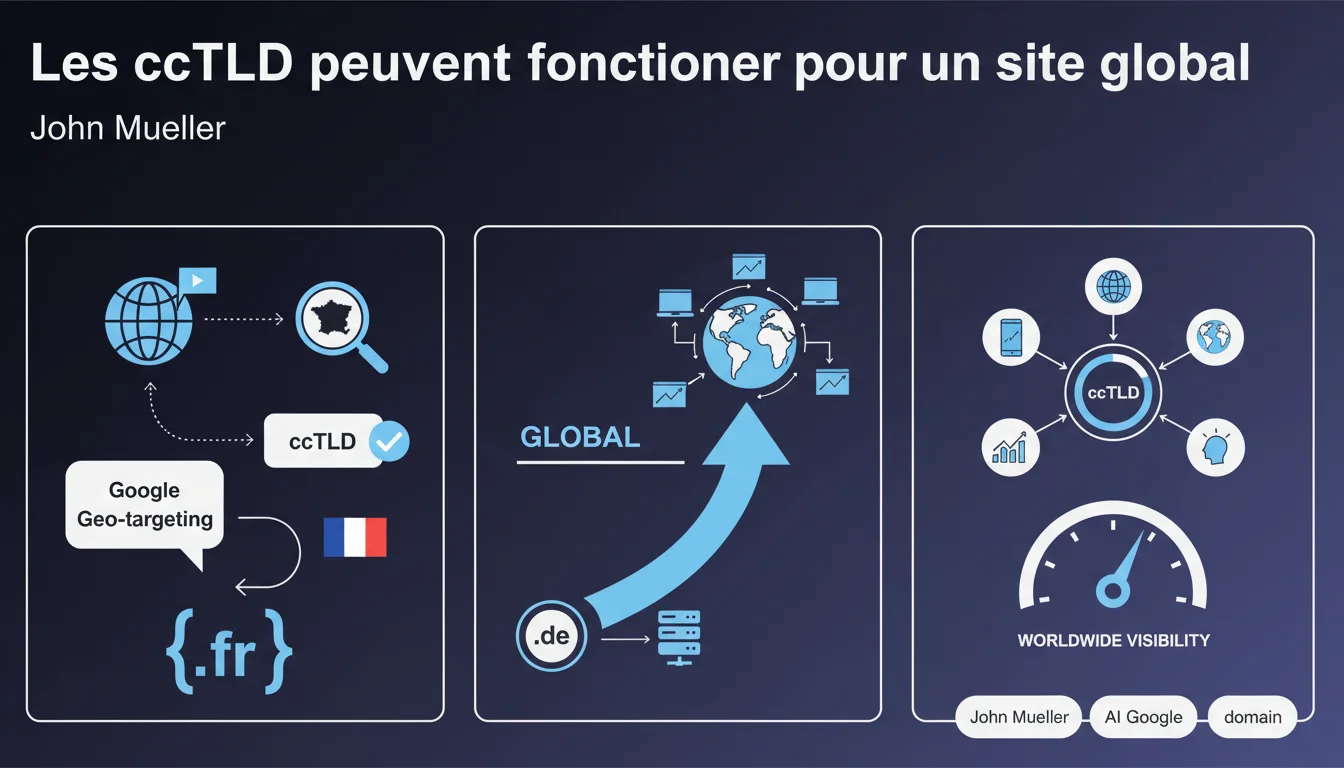
Google confirms that a ccTLD (country code Top-Level Domain) can function for a global website, even though it facilitates geotargeting to a specific country. International visibility remains possible, but there are nuances to understand to avoid pitfalls.
What you need to understand
What is a ccTLD and How Does Google Interpret It?
A ccTLD (country code Top-Level Domain) is a domain extension associated with a country: .fr for France, .de for Germany, .uk for the United Kingdom. Google uses this information as a geotargeting signal to determine in which country to prioritize displaying a site in search results. What does this mean in practice? If you use a .fr, Google assumes by default that your content primarily targets a French audience. This signal is not absolute — other factors come into play — but it does weigh in the balance. This statement addresses a recurring concern: the fear of becoming geo-locked by choosing a ccTLD. Mueller confirms that Google does not prevent a .fr or .de site from ranking in other markets, even if the initial geographical signal directs towards one country. Other signals — content language, international backlinks, hreflang, geographical targeting in Search Console — can counterbalance this initial bias. But beware: "can work" does not mean "works as well as a gTLD." A ccTLD can be justified if your primary market is a specific country, but you also want to reach other areas. For example: a French company exporting to Europe that wants to maintain its local credibility while being visible elsewhere. In this case, the ccTLD reinforces your local presence while allowing for gradual expansion. But if your markets are evenly distributed geographically from the start, a gTLD (.com, .net) or a multi-domain structure makes more sense.Why Does Mueller Emphasize That Global Visibility is Still Possible?
What Are the Use Cases Where a ccTLD Makes Sense for a Global Site?
SEO Expert opinion
Is This Statement Consistent with What We Observe on the Ground?
Yes and no. Google is truthful: a ccTLD can rank internationally. But in practice, it's often more complicated. Sites with .fr or .de generally struggle to impose themselves on competitive queries outside their country, unless with substantial SEO efforts. Why? Because Google prioritizes consistent signals. A .fr with French content, .fr backlinks, hosted in France, will naturally be favored in France. Reversing this perception to rank in the US or the UK requires overcompensating with other signals — and this doesn’t always work. Mueller remains vague on a key point: how much does a ccTLD penalize international visibility compared to a gTLD? He states it “still allows for global visibility,” but he provides no quantification. [To be verified]: there is no official data to measure this delta. Another gray area: the impact varies by country. A .co.uk may rank more easily in the US than a .fr, simply because linguistic proximity and search behaviors are different. Google treats certain ccTLDs (like .co or .io) almost like gTLDs, which further complicates the picture. If your international markets represent a significant portion of your revenue from the launch, starting with a ccTLD is a mistake. You will have to battle for every position outside your primary country, whereas a .com would have given you a neutral base. Worse yet: certain ccTLDs are poorly perceived by users outside the country. A .fr in Germany may arouse suspicion, reduce CTR, and thus indirectly harm SEO. Google doesn’t block anything, but user signals will do the job in its place.What Nuances Are Missing from This Statement?
In What Cases is This Strategy Risky?
Practical impact and recommendations
What Should You Do if You Already Have a ccTLD and Aim for International Expansion?
First step: correctly configure hreflang to indicate to Google the language and geographical versions of your content. Without this, Google will continue to prioritize the ccTLD market. Next, in Search Console, set a clear geographical targeting if you are targeting multiple countries with the same domain. Develop an international backlink strategy. If all your links come from .fr sites, Google will strengthen the French signal. Obtain links from your target countries to level the playing field. Finally, tailor the language and on-page signals (currencies, local references) for each market. Don’t let Google guess. If you have a .fr with English content targeting the US, without hreflang or Search Console targeting, you’re shooting yourself in the foot. Google will assume it's poorly translated French content. Also, avoid diluting your efforts. A ccTLD aiming at 10 different countries without dedicated resources is a recipe for failure everywhere. Focus on 2-3 strategic markets and optimize for them before expanding.What Mistakes Should You Absolutely Avoid?
❓ Frequently Asked Questions
Un ccTLD empêche-t-il vraiment de ranker à l'international ?
Est-ce que Google traite tous les ccTLD de la même manière ?
Faut-il migrer d'un ccTLD vers un gTLD si on vise plusieurs pays ?
Le hreflang suffit-il à compenser un ccTLD pour l'international ?
Peut-on utiliser un ccTLD pour plusieurs langues ?
🎥 From the same video 4
Other SEO insights extracted from this same Google Search Central video · published on 05/01/2022
🎥 Watch the full video on YouTube →
💬 Comments (0)
Be the first to comment.