
Official statement
Other statements from this video 4 ▾
- □ Les nouveaux TLD (.space, .tech, .xyz) pèsent-ils vraiment le même poids SEO qu'un .com ?
- □ Faut-il choisir www ou non-www pour optimiser son référencement naturel ?
- □ Peut-on utiliser rel=canonical entre différents noms de domaine ?
- □ Un ccTLD peut-il vraiment servir de domaine global sans pénaliser le SEO international ?
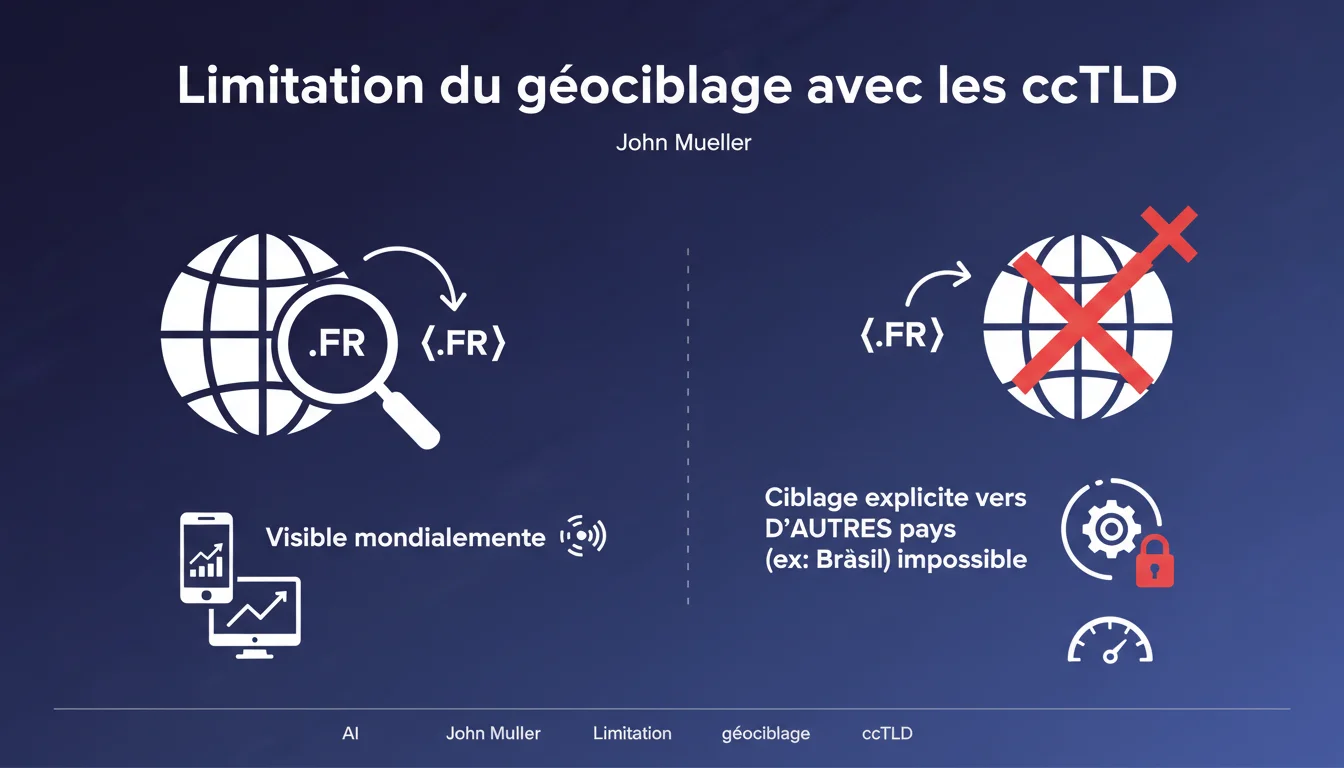
A country code top-level domain (ccTLD) such as .fr or .de prevents you from explicitly targeting other countries via the Search Console. You remain globally visible in SERPs, but Google won’t allow you to indicate a geographic preference different from that of the ccTLD. This is a structural constraint, not a bug.
What you need to understand
John Mueller here reminds us of a technical limitation of ccTLDs (country-code Top-Level Domains) often underestimated. A .fr site is automatically associated with France in Google's systems — it is impossible to declare another target country via Search Console.<\/p>
Specifically? If you deploy a .fr site to sell in Brazil, Google will not accept that setting. You will appear in Brazilian results, certainly, but without the geographical boost provided by explicit targeting.<\/p>
What’s the difference with a gTLD?
With a gTLD (.com, .net, .org), you have the international targeting parameter in Search Console. You can indicate “this site targets Brazil” or “this site targets Belgium,” and Google will take that into account in its geographic ranking.<\/p>
A ccTLD, on the other hand, has its own intrinsic geographic signal. Google considers that .fr = France, .de = Germany, etc. This signal overrides any other potential configuration.<\/p>
Does this mean a ccTLD can't rank outside its country?
No. A .fr site can indeed appear in UK, Spanish, or Japanese SERPs. There’s nothing technically preventing it.<\/p>
What’s lacking is the leverage of explicit targeting. You won’t benefit from the additional signal “this site primarily targets the UK,” for example. Thus, you compete without that advantage against a .co.uk or a .com targeted for the UK.<\/p>
Why does Google impose this constraint?
ccTLDs were originally designed to represent specific geographic areas. Google respects this logic: a .fr should serve France, a .ca Canada. Allowing contradictory targeting would create inconsistencies in the indexes.<\/p>
This is a principled stance. In practice, some ccTLDs (like .co or .tv) are diverted from their original use and treated by Google as de facto gTLDs. But the general rule remains: ccTLD = locked targeting.<\/p>
- A ccTLD enforces the associated country — no other geographic targeting is accepted in Search Console.<\/li>
- Global visibility is possible, but without the explicit targeting boost available for gTLDs.<\/li>
- It’s not a bug, it’s by design — Google considers that the ccTLD already carries its geographic signal.<\/li>
- Some ccTLDs escape the rule (e.g., .co, .tv) and are treated as generic gTLDs.<\/li><\/ul>
SEO Expert opinion
Is this constraint really obstructive in practice?
Let’s be honest: for a single-country site, it’s transparent. An e-commerce .fr selling in France has no issues. The problem arises as soon as one wants to internationalize without changing the architecture.<\/p>
Classic example: a French startup launches a .fr, then wants to expand to Germany. They hesitate to create a distinct .de (cost, maintenance, dilution of link equity). The idea of using the existing .fr with subdirectories /de/ or /en/ seems enticing — except they lose the Search Console targeting leverage.<\/p>
The real handicap? Facing a local competitor with a .de or a .com targeted for Germany, the .fr starts with an algorithmic disadvantage. It’s not a dealbreaker, but it’s an additional burden to carry.<\/p>
In what cases is this not so bad?
If your content is intrinsically linked to France (French news, local services, Francophone culture), the .fr remains coherent even for an international audience. The geographic signal enhances your legitimacy.<\/p>
Similarly, if you target a diaspora (Francophones in Canada, Belgium, Switzerland), the .fr can work — as long as your on-page signals (language, currencies, local mentions) compensate for the lack of Search Console targeting.<\/p>
But as soon as you target a non-Francophone market with a .fr, you are swimming upstream. [To be verified]: some SEOs claim that Google weighs the ccTLD less heavily than before, but no public data clearly backs that up.<\/p>
What’s an alternative if one wants to stay on a single domain?
Migrating to a gTLD (.com, .shop, .io) and using subdirectories or subdomains by language/country. This is the standard path for internationalization — and it unlocks Search Console targeting.<\/p>
The downside: technical migration, risk of temporary traffic loss, costs of redirection and updating backlinks. It’s never trivial.<\/p>
Practical impact and recommendations
What should you do if considering international expansion with a ccTLD?
First, assess your actual geographic ambition. If you’re aiming for 2-3 countries outside of the ccTLD country, it’s better to anticipate a multi-domain architecture or migrate to a gTLD now.<\/p>
Next, compensate for the lack of Search Console targeting with robust on-page signals: impeccable hreflang, geolocated mentions, local currencies, servers close to target users. It’s not as powerful as official targeting, but it helps.<\/p>
What mistakes should be absolutely avoided?
Don't assume a ccTLD will “do the job” for international reach without testing. Field feedback shows that friction is real — especially against well-positioned local competitors.<\/p>
Avoid also multiplying ccTLDs without a differentiated content strategy. Three domains (.fr, .de, .es) with hastily translated content are worse than a single well-thought-out .com.<\/p>
And most importantly: don't rely on intuition. Test with real data. Launch a pilot in a secondary market with a ccTLD, measure performance against a targeted gTLD, and adjust.<\/p>
How can I check if my current architecture is optimal?
Audit your positions by country in Search Console. If you find that your .fr performs poorly in Germany despite quality content, the ccTLD may be the cause.<\/p>
Compare your metrics (CTR, impressions, conversions) with those of competitors with a local domain or a targeted gTLD. A persistent gap may justify an architectural revamp.<\/p>
- Map current and future target markets before choosing the extension.<\/li>
- If international = priority, prefer a gTLD (.com, .net) from the start.<\/li>
- Compensate a ccTLD with strong on-page signals: hreflang, geolocation, currencies.<\/li>
- Regularly audit performance by country in Search Console.<\/li>
- Test a pilot before massively deploying a multi-country ccTLD architecture.<\/li>
- Never mix ccTLDs with contradictory targeting (e.g., .fr hosted in Brazil to target Brazil).<\/li><\/ul>The choice of a domain extension is never trivial — it carries a geographic signal that Google respects strictly for ccTLDs. If your international strategy exceeds the boundaries of the ccTLD country, a migration to a gTLD or a multi-domain architecture is essential. These structural choices and their technical implications can quickly become complex to orchestrate alone. Engaging a specialized SEO agency in internationalization helps secure these decisions and avoid costly visibility mistakes.<\/div>
❓ Frequently Asked Questions
Peut-on changer le ciblage géographique d'un ccTLD dans la Search Console ?
Un site en .fr peut-il quand même apparaître dans les résultats brésiliens ?
Tous les ccTLD sont-ils traités de la même manière par Google ?
Si je veux internationaliser mon site .fr, quelle est la meilleure option ?
Le hreflang peut-il compenser l'absence de ciblage Search Console pour un ccTLD ?
🎥 From the same video 4
Other SEO insights extracted from this same Google Search Central video · published on 05/01/2022
🎥 Watch the full video on YouTube →Related statements
Get real-time analysis of the latest Google SEO declarations
Be the first to know every time a new official Google statement drops — with full expert analysis.
💬 Comments (0)
Be the first to comment.